
615 – 693·Feast December 17
St. Begga
Widowed Noblewoman and Foundress of Andenne
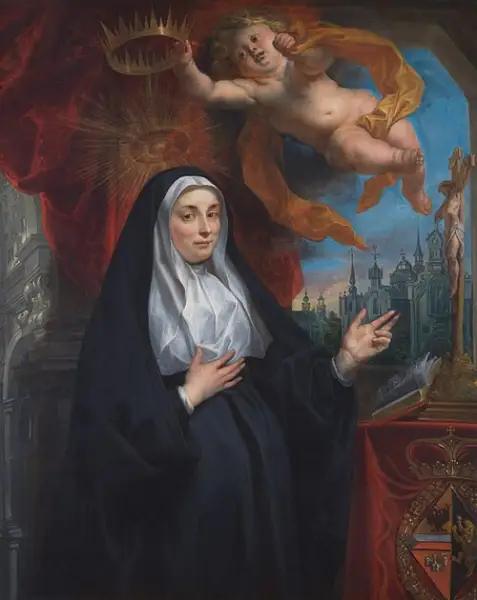
Overview
Begga, also spelled Begue, Beghe, or Begge, was born in 615 into the first family of Austrasian Christianity. Pepin of Landen, who governed Austrasia as mayor of the palace, was her father, and Itta her mother; her younger sister was Saint Gertrude of Nivelles. She married Ansegisel, son of Arnulf, Bishop of Metz, uniting the two great clans from which the Carolingian dynasty would grow, and became the mother of Pepin of Heristal and possibly of Duke Martin. Through Pepin of Heristal she was the grandmother of Charles Martel, who in turn was the grandfather of Charlemagne, so that the blood of a saint runs in the line of the greatest medieval emperors. Ansegisel died violently before 679, cut down in a feud by an enemy named Gundewin. Left a widow, Begga journeyed to Rome; on her homecoming she received the veil, and she raised a group of seven churches at Andenne beside the Meuse — a foundation whose emblem in art is the seven-turreted convent she carries — and governed the community as abbess until her death on 17 December 693, aged about seventy-seven, and was buried in Saint Begga's Collegiate Church in Andenne, where she is commemorated with a feast on 17 December. A later tradition, reflected in an inscription at the beguinage of Lier, hailed her as the foundress of the Beguine movement.
The Complete Life
Daughter of Pepin, Sister of Gertrude
Begga was born in 615 into the household that stood at the summit of Austrasian society and at the heart of its Christianity. Her father, Pepin of Landen, served as mayor of the palace of Austrasia — the effective power behind the Merovingian throne — and her mother, Itta, was herself honored as a saintly woman who would later be associated with the foundation of Nivelles. The family's holiness was not the private affair of one member: Begga's younger sister was Saint Gertrude of Nivelles, whose Catholic Encyclopedia entry preserves the family connection, so that the house of Pepin produced a mother and two daughters revered by the Church. To be a daughter in such a household in the seventh century meant growing up amid the negotiations, wealth, and violence of Frankish power, and also amid its most earnest Christian aspirations. The world of Begga's childhood was the world of the great aristocratic foundations, in which noble families translated their standing into monasteries and their rivalries into piety. She would have known bishops as kin and courtiers, and she learned early that faith and lineage were braided together in Austrasia. Her later life proved how completely she had absorbed both lessons, for she married into sanctity, mothered a dynasty, and ended her days as an abbess. In an age when women of her rank were instruments of alliance, Begga made herself an architect of institutions, and the scale model of a seven-turreted monastery she carries in art announces the founding that became her enduring identity.
§ Life
Marriage, Widowhood, and the Journey to Rome
Begga's marriage carried the hopes of two generations of Frankish Christianity. She wed Ansegisel, the son of Arnulf, Bishop of Metz, joining the family of the mayor of the palace to that of the great bishop-saint of the Austrasian church. The union proved fruitful beyond any private expectation: she was the mother of Pepin of Heristal, and possibly of Duke Martin, and through Pepin of Heristal she became the grandmother of Charles Martel, whose own grandson was Charlemagne. The Carolingian dynasty that would rule and reshape Western Europe descended, in its maternal line, from a woman the Church venerates as a saint. Her married life, however, ended in the manner common to that violent century. Ansegisel met a violent end sometime before 679, struck down through the hatred of Gundewin, and Begga joined the long procession of Frankish noble widows whose freedom followed their loss. What she did with that freedom defined her. She made a pilgrimage to Rome, the journey that so many of her contemporaries undertook as a turning of the whole life toward God, walking from the Meuse country to the tombs of the apostles. Upon her return she took the veil, formally renouncing the status she might have claimed as the matriarch of a ruling house. The pilgrimage, the veil, and the foundation that followed form a single movement of the soul — away from the claims of blood and toward the permanence of prayer — and they mark Begga as one of the many seventh-century women who converted aristocratic widowhood into monastic leadership.
§ Life
Seven Churches at Andenne on the Meuse
The work of Begga's later years was concentrated in a single place: Andenne, on the river Meuse. Having returned from Rome and taken the veil, she had seven churches built there, a foundation that tradition describes as a monastery with seven chapels, and she ruled the community as abbess for the rest of her life. The number seven gave the house its lasting emblem — art gives Begga a miniature seven-turreted convent to carry, an emblem that points straight to the sevenfold church she raised at Andenne. Such a foundation was no modest undertaking. It required land, wealth, patronage, and the authority to organize a religious community, all of which Begga commanded through her own standing and that of her family; in founding Andenne she was doing what noble Frankish women of her rank did at their most ambitious, transforming dynastic resources into an enduring seat of prayer, learning, and hospitality. As abbess she governed this community until her death on 17 December 693, at the age of about seventy-seven or seventy-eight, a long life that had spanned marriage, motherhood, widowhood, pilgrimage, and thirty years and more of monastic rule. She was buried in Saint Begga's Collegiate Church in Andenne, and her tomb anchored the devotion of the town, which grew up around the sevenfold foundation much as the foundation had grown from her faith. Her commemoration on 17 December, the day of her death, has been kept ever since.
§ Life
Grandmother of an Empire and Claimed by the Beguines
Begga's historical legacy runs through two very different channels. The first is dynastic: as the daughter of Pepin of Landen, the wife of Ansegisel, and the mother of Pepin of Heristal, she stands at the fountainhead of the Carolingian line, grandmother to Charles Martel and great-great-grandmother to Charlemagne. The second is religious, and more contested. From the twelfth century there arose in the Low Countries the Beguine movement — communities of lay religious women who lived in simplicity and service without taking permanent vows — and some came to hold that the movement had actually been founded by St Begga, reading her name as the source of theirs. The claim found enduring expression at Lier in Belgium, where the church of the thirteenth-century beguinage keeps a statue of the saint above the words that greet her as its foundress. The attribution flattered the movement with an ancient and aristocratic pedigree, and it honored Begga with a progeny of a spiritual kind to match her carnal one. Scholarship has not endorsed it. Another popular theory holds that the Beguines derived their name from Lambert le Bègue, a priest in whose shelter the Beguines' way of life and service thrived, and students of the movement such as McDonnell, in the classic study of the Beguines and Beghards, have weighed the question carefully. Whatever the etymology, the association reveals what medieval Flanders believed about her: that a woman who had raised seven churches at Andenne was the natural mother for communities of women seeking God without cloister walls.
§ Veneration
Timeline
- 615
Born to Pepin of Landen, the Austrasian mayor of the palace, and his wife Itta.
§ Life
- 679
Ansegisel, her husband, fell victim to a feud, killed by his enemy Gundewin sometime before this year.
§ Life
- 17 Dec 693
Died on 17 December aged 77–78, after years as abbess at Andenne, and was buried in Saint Begga's Collegiate Church there.
§ Life
- 1100
The Beguine movement came to light in the 12th century, later popularly credited to St Begga.
§ Veneration
- 1200
The Lier beguinage was founded; its church later bore a statue of St Begga above the inscription 'St. Begga, our foundress'.
§ Veneration
In Their Own Words
St. Begga, our foundress
The Record
- Major works
- Founded seven churches (a monastery with seven chapels) at Andenne on the Meuse
- Patron of
- Invoked as foundress of the Beguines (by popular tradition)·Patroness of Andenne
- Symbols
- Scale model of a monastery with seven turrets·Habit and veil of a widow-nun·Symbols of Frankish nobility
- Canonization
- Pre-congregation; venerated in the Catholic Church and the Eastern Orthodox Church
Prayer
Bibliography
Show 8 sources
- Phillips, Fr Andrew. 'Latin Saints of the Orthodox Patriarchate of Rome.' orthodoxengland.org.uk.
- Ott, Michael. 'St. Gertrude of Nivelles.' The Catholic Encyclopedia, Vol. 6. New York: Robert Appleton Company, 1909.
- Burns, Paul, ed. Butler's Lives of the Saints, p. 146. Continuum International Publishing Group, 1995.
- Dunbar, Agnes Baillie Cunninghame. A Dictionary of Saintly Women. London, 1904, I, pp. 111–12.
- Ryckel ab Oorbeeck, J. A. Vita S. Beggae Ducissae Brabantiae Andetennensium, Begginarum et Beggardorum fundatricis vetus. Louvain, 1631.
- McDonnell, Ernest W. The Beguines and Beghards, pp. 179, 430–31.
- Attwater, Donald and John, Catherine Rachel. The Penguin Dictionary of Saints, 3rd edition. New York: Penguin Books, 1993.
- Rousseau, Félix. 'Le monastère mérovingien d'Andenne.' À travers l'histoire de Namur, du Namurois et de la Wallonie, pp. 279–313.
Profile text adapted from the Wikipedia article, licensed CC BY-SA 4.0.
Pray with this saint every day
Save St. Begga to your favorites, read the full profile, and get feast-day reminders in the Saints app.
Get the Saints AppFree on the App Store for iPhone and iPad