
7th century (traditional)·Feast November 12
St. Begnet
Virgin Patron of Dalkey in Early Christian Ireland
Overview
Begnet is honoured as the patron saint of Dalkey, the coastal town south of Dublin, where two ruined churches carry her name and a holy well beside the island's martello tower keeps her memory. Calendars in two manuscript breviaries — one connected with Clondalkin, the other with the Dublin parish of St John the Evangelist — enter her as a virgin who did not suffer martyrdom and keep her feast on 12 November, though the Martyrology of Oengus says nothing of her. A genealogical note names her father as Colman, son of Aedh, of Kilbegnet, and storytellers later styled her an Irish princess whose beauty drew many suitors, all of whom she refused for the sake of religion. One legend tells how an angel gave the child a bracelet marked with a cross; fleeing an unwanted marriage she took nothing but that bracelet, was received into the Church by Bishop Aidan in Northumbria, and after years of pirate raids settled in Cumberland, where her bracelet became an object of oath and veneration. Scholars caution that she may be confused with St Bega and other virgins of the Irish calendars, that her name was misread as a form of Benedict, and even that no such person ever existed. Her lifelong chastity was itself counted in early Ireland as a bloodless martyrdom.
The Complete Life
A Saint Known Chiefly by Her Churches
What can be said of Begnet's beginnings rests on a single genealogical note preserved in a local history of the church at Dalkey: her father was Colman, son of Aedh, of the parish called Kilbegnatan, Kilbegnet or Cill Becnait, the 'church of Begnet' in Irish. Around that bare stem later devotion grew a full hagiographical flower. Like so many female saints of the early Irish calendars, she is described as beautiful and much desired, a young woman of such standing that one tradition elevates her to an 'Irish princess', which would have made her a valuable bride in the marriage politics of her day. The one firm note in all this is her refusal: suitor after suitor was turned away so that she might give herself to religion. It is not even certain that she came from Dalkey at all, for the two churches that bear her name there may have been founded by missionaries who brought her cult rather than her person. Her memory survived in the calendars of two manuscript breviaries, one from Clondalkin and one from the parish of St John the Evangelist in Dublin, both held by Trinity College in the nineteenth century; the Martyrology of Oengus omits her entirely. She is entered as a virgin who was not a martyr, with a feast on 12 November. Even her name is unstable — Begneta, Begnete, Begnait, Becnait — and it was long misread as a corruption of Benedict.
§ Life
The Bracelet and the Flight
The legend that keeps Begnet's name alive among the promoters of Dalkey's heritage tells of an angel who visited her in childhood and placed on the child's wrist a bracelet engraved with a cross, the visible sign of a vocation she had not yet chosen for herself. When marriage pressed upon her, she left her father's house taking nothing but that bracelet. In this telling she fled to Northumbria, where Bishop Aidan — the great missionary bishop of Lindisfarne — received her into the Church. Years of raids by pirates followed, we are told, until at last she removed to Cumberland, where she died and where her bracelet became an object of veneration. So great did its repute become that by the twelfth century courts accepted an oath on the bracelet as proof of testimony, and a perjurer so sworn paid with his life. The careful reader is warned, however, that this same story, or a close version of it, is told of St Bega, said to have been Irish, and one source for Bega's legend is a fifteenth-century Book of Hours in the Bodleian Library at Oxford. The bracelet may therefore belong to a shared stock of northern virgin legends rather than to Begnet of Dalkey in particular. Yet even as borrowed legend it reveals what her community believed about her: that she was chosen, that she fled the marriage bed, and that some token of her holiness remained among the faithful after her death.
§ Legend of the bracelet
Chastity as a Bloodless Martyrdom
Modern scholarship has set Begnet's small legend within the wide question of how Christianity encountered the older religions of Ireland. Her narratives and the archaeology of her sites suggest that evangelizing Christianity appropriated rather than extinguished the traditions of ancient Ireland; it is even possible that the legendary Begnet Christianizes the memory of a deity, and that the several similarly named saints of the region reflect cross-identification among local figures. Whatever the historical core, her medieval title 'virgin, not martyr' deserves a closer reading. A seventh-century Irish homily, from the very century in which the earliest sources for these stories were written, distinguishes three martyrdoms: the white, a bloodless separation from all one loves; the blue or green, the mortification of the will through fasting and penitential labour; and the red, torture and death. Theologians such as Basil of Ancyra had argued that such forms lay outside true virtue, but Irish tradition ranked them seriously, adding a Latin triad that demanded self-control in plenty, generosity in poverty and chastity in youth. By these measures Begnet's departure with no possession save the cross-signed bracelet can be read as a white martyrdom, and her refusal of marriage as chastity in youth — a martyrdom not held inferior to one bought with blood. Violent martyrdom, in any case, was rare in Ireland before the Norse raids of the eighth century.
§ Origins and religious influences
Churches, Wells and Doubtful Bones
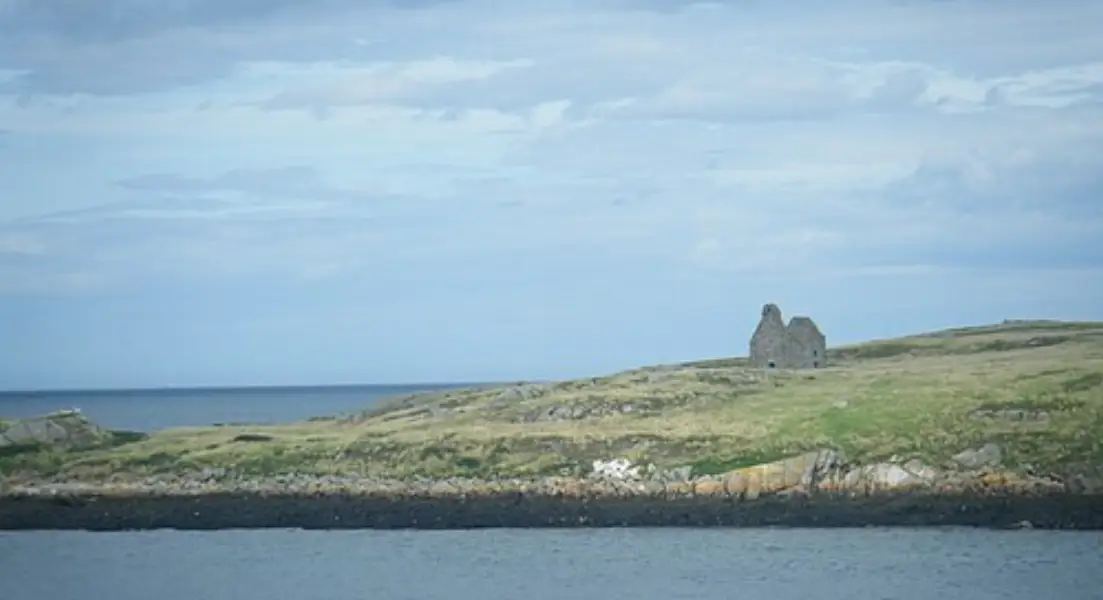
Begnet's afterlife in stone is more substantial than her life in documents. Two ruined churches at Dalkey are named for her, one on Dalkey Island and the other beside a stone townhouse of the 1300s that today houses the Dalkey Castle and Heritage Centre museum, in a quarter whose very name, Kilbegnet, keeps hers; a holy well near the island's martello tower is likewise hers. Pilgrims and antiquaries have long read these sites in layers. Seward's Topographia Hibernica of 1795 found the island rich in herbage and medicinal plants, with the church ruin its only building, and professed to see Druidic remains nearby. A topographical dictionary of 1837 recorded mysterious stone coffins on the island said to contain disarticulated human bones, and nineteenth-century speculation credited these tombs to remote Celtic or Belgic tribes. Scholars now note that in seventh-century Ireland the bodies of saints were sometimes deliberately dismembered and scattered as relics, a dispersal that may explain the spread of similarly named saints — and may echo older Celtic cosmologies of the body. The playwright Hugh Leonard could still write in 1981 that no one in Dalkey bothers to argue about their patron's existence, sex being 'hardly likely to have much relevance' to sainthood. In that amused tolerance lies the saint's real legacy: a community that has kept her churches, her well and her feast for well over a thousand years.
§ Origins and religious influences
Timeline
- 600
Traditional floruit: the calendars place Begnet in the seventh century as a virgin, not a martyr, patron of Dalkey
§ Introduction
- 1120
By the twelfth century legal testimony could be sworn on her bracelet, with death awaiting the perjurer
§ Legend of the bracelet
- 1795
Seward's Topographia Hibernica describes Dalkey Island, its herbs and the church ruin as its only building
§ Origins and religious influences
- 1837
A topographical dictionary notes stone coffins on Dalkey Island reputed to hold disarticulated human remains
§ Origins and religious influences
- 1844
Crosthwaite publishes the Christ Church, Dublin obit book and martyrology, preserving the calendar notices of Begnet
§ Sources
- 1901
Patrick J. O'Reilly studies the sepulchral leacs of Rathdown and the cross-identification of the saint
§ Selected bibliography
- 1902
Joseph P. O'Reilly examines the orientation and fabric of the old churches of Dalkey town and island
§ Selected bibliography
- 1981
Hugh Leonard's Dalkey essay in the New York Times playfully doubts whether Begnet existed at all
§ Introduction
In Their Own Words
Like St. Patrick himself, St. Begnet may never have existed: There is even uncertainty as to whether he or she was male or female.
Continentia in habundantia, largitas in paupertate, castitas in iuventute.
The Record
- Patron of
- Patron saint of Dalkey, Ireland
- Symbols
- Bracelet inscribed with a cross·Healing
- Canonization
- Pre-congregation; recorded in two manuscript breviaries that in the 19th century were held by the Library of Trinity College, Dublin
Prayer
Bibliography
Show 3 sources
- Crosthwaite, John Clarke. The Book of Obits and Martyrology of the Cathedral Church of the Holy Trinity, Commonly Called Christ Church, Dublin. Dublin: Irish Archaeological Society, 1844, pp. lxv–lxvi.
- O'Reilly, Joseph P. "Notes on the Orientation and Certain Architectural Details of the Old Churches of Dalkey Town and Dalkey Island." Proceedings of the Royal Irish Academy 24 (1902–1904), 195–226.
- O'Reilly, Patrick J. "The Christian Sepulchral Leacs and Free-Standing Crosses of the Dublin Half-Barony of Rathdown." Journal of the Royal Society of Antiquaries of Ireland 31 (1901), pp. 134–161, especially p. 158ff.
Profile text adapted from the Wikipedia article, licensed CC BY-SA 4.0.
Pray with this saint every day
Save St. Begnet to your favorites, read the full profile, and get feast-day reminders in the Saints app.
Get the Saints AppFree on the App Store for iPhone and iPad