
4th century·Feast December 10 (Syriac Orthodox); also January 10 (Armenian Apostolic) and December 23 (Coptic Orthodox)
St. Behnam, Sarah, and the Forty Martyrs
Assyrian Royal Martyrs of Mount Alfaf under Shapur II
Overview
Behnam and Sarah are honoured by the churches of Syriac tradition, together with forty companions, as martyrs of the fourth century who died under the Zoroastrian shahanshah Shapur II of Iran. Their story, told in the Persian martyr acts, makes them the children of Sennacherib, king of Nimrud, a vassal of the Persian throne. Separated from his companions on a hunt, Behnam sheltered overnight in a cave, where an angel directed him to Matthew the Hermit, who lived in prayer on Mount Alfaf. The hermit taught him the faith; when the prince demanded proof, Matthew bade him bring his sister, and Sarah was healed of leprosy with water from a spring that sprang up at a blow of the hermit's staff. Behnam, Sarah and forty slaves of the household were baptized. Their father, learning of it, threatened punishment unless they forsook Christ; the group fled toward Mount Alfaf and was cut down by the king's soldiers. A later chapter tells how the king fell into madness, how an angel announced that he would be healed only at the place of his children's death, and how, cured there, he and his wife were baptized by Matthew at Assur. Sennacherib then raised a monastery on the holy mountain — the house known ever since as Mar Mattai.
The Complete Life
Children of the King of Nimrud
The acts introduce Behnam and Sarah as the son and daughter of Sennacherib, king of Nimrud, a ruler who governed under Shapur II, the Zoroastrian shahanshah of Iran in whose long reign the Persian church suffered some of its bitterest persecution. The setting is deliberately ancient: Christian storytellers of the region drew freely on the remembered landscape of Assyria, and the name Sennacherib itself was borrowed from the great Assyrian king of the eighth century before Christ, while Assur, the old imperial capital, appears in the tale as the place of the father's baptism. The Forty Martyrs who complete the company were, in the narrative, slaves of the royal household — a detail that lets the legend honour both high-born and low-born in a single confession. Nothing is recorded of the siblings' upbringing beyond their father's court and its cult of the old gods; their story proper begins only when the hunt goes astray. Historians read the genealogy as hagiographical construction rather than chronicle, a way of rooting a monastery's patrons in a heroic, pre-Islamic past. Yet the fabric of names is itself evidence: it shows how thoroughly the Christianisation of Assyria absorbed the figures and sites of that land's longer history, weaving biblical and imperial memory into a new saints' legend that the churches of Syriac tradition would keep for well over a thousand years.
§ Hagiography
The Angel in the Cave
The turning point of the legend arrives by accident and by angel. Out hunting, Behnam became separated from his companions and was compelled to pass the night in a cave — the desert of northern Mesopotamia is riddled with such shelters, and hermits were their most famous tenants. There a heavenly visitor came to him and told him to seek out Saint Matthew the Hermit, who dwelt in a cave on Mount Alfaf, the ridge that rises above the plain of Nineveh. Behnam sought the anchorite and received from him his first instruction in the Christian faith. The prince, trained no doubt in the evidences of a royal court, asked for proof; the hermit answered with a test of charity rather than of argument: bring your sister, he said, and let her be healed. Behnam returned to the city and reported the dream and the saint to his mother, who consented to let the two go back to the mountain in secret. There Matthew struck the ground with his staff, water gushed from the new spring, and with it Sarah's leprosy was cleansed. The pattern is a familiar one in Syriac hagiography — the noble huntsman, the cave, the angelic message, the healing that confirms preaching — but its details here serve a precise theological point: that the faith came to the house of Nimrud by revelation, and that its first convert was won not by debate but by a cure.
§ Biography
Baptism and Confession
After Sarah's healing the story moves swiftly. Behnam, his sister and the forty slaves of their company were baptized, and the little band returned to the city as Christians. The king soon learned of his children's conversion and threatened punishment unless they abandoned their new faith; the acts present the confrontation in the stark terms of martyr-romance, a father's authority set against a heavenly one. Unmoved, the siblings and their forty companions fled toward Mount Alfaf, to the hermit who had received them; soldiers despatched by Sennacherib overtook them there and put them to the sword. The number of the slain — a royal prince and princess, and forty of the household's slaves — has suggested to some readers an echo of the Forty Martyrs of Sebaste, another company of forty whose memory the eastern churches guard; in the Syriac calendar, indeed, the Forty Martyrs of Bartella, the village beside the saints' monastery, are commemorated on the same day, 10 December, in the Martyrology of Rabban Sliba. The grouping of high and low in a single martyrdom carries its own preaching: in the kingdom of the baptized, prince and slave confess with one voice and die with one stroke. Their relics, the churches hold, remain at the Mar Behnam Monastery in Iraq, with others at the Monastery of Saint Menas in Cairo and, by local claim, in the church of the Forty Martyrs at Mardin in Turkey.
§ Relics
The Father's Madness and Cure
The legend refuses to end at the sword. Grief, in the acts' telling, became madness: Sennacherib was afflicted after the death of the martyrs, and no physician could restore him. Then an angel appeared to Behnam's mother and told her that the king would be healed only if he turned Christian and prayed at the spot where his children had died. Mother and king obeyed the instruction, travelled to the mountain, and there, at the place of blood, Sennacherib's mind was given back to him. The converts were afterwards baptized by Saint Matthew himself at Assur, the ancient capital whose name the hagiographer chose with a memory of empire. In thanksgiving, and at Matthew's request, the king built a monastery on the summit of Mount Alfaf, the house that would become celebrated as the Mar Mattai Monastery, one of the oldest living monasteries of the Christian East; he likewise set up a marker over the ground where they fell, known in Syriac as the gubba, the pit. The narrative arc — persecution, punishment, conversion of the persecutor — follows a logic as old as the Acts of the Apostles, and it served the churches of the region as a standing promise that the blood of martyrs may win even those who shed it. The king who killed the saints becomes, in the end, the founder of their shrine.
§ Biography
Manuscripts, Monasteries and a Living Cult
The martyrs' memory is carried by an unusually wide manuscript tradition: their life survives in at least twenty Syriac manuscripts, the earliest being the History of Mar Behnam and Sarah, which the German historian Gernot Wießner first assigned to Late Antiquity but which later studies have shown to have been written in 1197 by a member of the Syriac Orthodox Church. Details appear in other Syriac manuscripts of the late twelfth and thirteenth centuries, and it has been argued that the hagiography was composed in part to establish a pre-Islamic foundation for the monastery of the saints and so shield it from confiscation by Muslim rulers. A mention by Bar Hebraeus of a church of Saint Behnam at Tripoli in 961 suggests that an oral legend was already in circulation well before the surviving text. Jacob of Serugh, the great Syriac poet-bishop, addressed two homilies to the martyrs under the title On the Martyrdom of Behnam and his Companions, and the fifteenth-century author Ignatius Behnam Hadloyo left two poems on the same subject. The name Sarah itself belongs to the shared stock of Syriac hagiography, the customary name for a male martyr's sister. Their principal shrine, the Mar Behnam Monastery near Mosul, was endowed — so the acts say — by a wealthy pilgrim named Isaac, who came hoping to free his servant from a devil and was told in a dream to build near the tomb.
§ Hagiography
Timeline
- 961
A church of Saint Behnam at Tripoli is mentioned, hinting that an oral version of the legend circulated earlier.
§ Hagiography
- 1197
The History of Mar Behnam and Sarah, the earliest surviving manuscript of their acts, is written by a Syriac Orthodox adherent.
§ Hagiography
- 1450
The fifteenth-century author Ignatius Behnam Hadloyo writes two poems on Behnam, five copies of which survive.
§ Hagiography
The Record
- Patron of
- Venerated at the Mar Behnam Monastery, Iraq
- Symbols
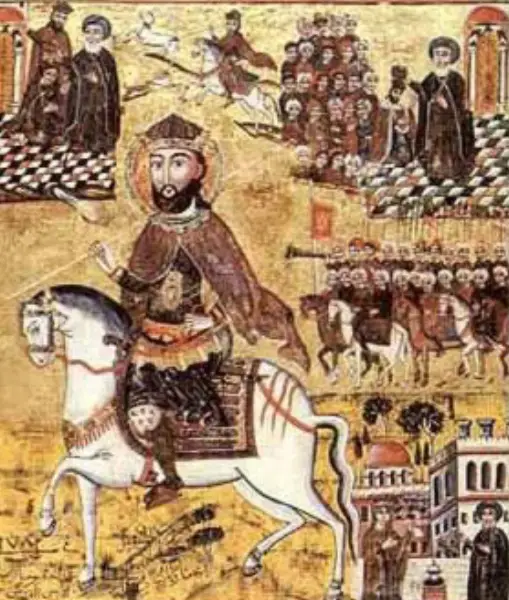
- Depicted together in icons, among them one in the Coptic Museum
- Canonization
- Pre-congregation; venerated as saints in the Oriental Orthodox Churches through the Persian martyr acts
Prayer
Bibliography
Show 6 sources
- Barsoum, Aphrem (2003). The Scattered Pearls: A History of Syriac Literature and Sciences. Translated by Matti Moosa (2nd ed.). Gorgias Press.
- Fiey, Jean Maurice (2004). Saints Syriaques (in French). Lawrence Conrad, ed. The Darwin Press.
- Rassam, Suha (2005). Christianity in Iraq: Its Origins and Development to the Present Day. Gracewing Publishing.
- Saint-Laurent, Jeanne-Nicole Mellon (2019). "Christian Legend in Medieval Iraq: Siblings, Sacrifice, and Sanctity in Behnam and Sarah". In Frank, Holman and Jacobs (eds.). The Garb of Being: Embodiment and the Pursuit of Holiness in Late Ancient Christianity. Fordham University Press, pp. 191–221.
- Smith, Kyle (2016). Constantine and the Captive Christians of Persia: Martyrdom and Religious Identity in Late Antiquity. University of California Press.
- Wolper, Ethel Sara (2014). "Khidr and the Politics of Translation in Mosul: Mar Behnam, St George and Khidr Ilyas". In Sacred Precincts: The Religious Architecture of Non-Muslim Communities Across the Islamic World. Brill, pp. 377–392.
Profile text adapted from the Wikipedia article, licensed CC BY-SA 4.0.
Pray with this saint every day
Save St. Behnam, Sarah, and the Forty Martyrs to your favorites, read the full profile, and get feast-day reminders in the Saints app.
Get the Saints AppFree on the App Store for iPhone and iPad