
died 26 November 1145·Feast November 26
St. Bellinus of Padua
Bishop of Padua, Reformer and Murdered Prelate
Overview
Bellino Bertaldo — in Venetian speech San Bełin de Sasonia — was an Italian prelate of the twelfth century, born into the noble Bertaldi house of Padua, who governed the see of Padua as its bishop from 1128 until his murder in 1145. His ecclesiastical career began in troubled times: he set himself against his own bishop Milone when that prelate adhered to the antipope Clement III, while keeping his loyalty to the legitimate popes, and he gave his support to Bishop Sinibaldo for standing with Pope Paschal II against the same rival. In 1144 he travelled as a pilgrim to Rome, where Pope Celestine II, struck by the man he met, named him to the bishopric of Padua. As bishop he shielded the Church against worldly menaces, stood firm for its rights, led a reform of the diocesan canons, and oversaw the rebuilding of the cathedral after the earthquake of 1117, besides carrying forward the construction of schools. Journeying through a forest near Fratta, in the Polesine towards Rovigo, on his way to Rome, he was stabbed to death by assassins in the pay of the Capodivacca house, for motives the sources do not record. Pope Eugene IV afterwards numbered him among the saints.
The Complete Life
A Noble Paduan in the Age of Antipopes
Bellino Bertaldo was born into the Bertaldi, one of the noble houses of Padua, and spent his early manhood in a church torn by the great quarrel of the investiture era. His own bishop, Milone, had given his adherence to Clement III, the imperial antipope set against Gregory VII's successors, and Bellino set himself against his diocesan on that point while remaining devoted to the legitimate popes throughout Milone's tenure — a position that demanded both courage and tact, since open resistance to one's own bishop was no small matter for a cleric of a noble family. When the see next changed hands he found a leader he could follow: Bishop Sinibaldo had kept his loyalty to Pope Paschal II rather than the antipope, and Bellino gave him steady support. The twelfth century in the Veneto was a web of such loyalties, with noble clans, episcopal factions and the imperial party all pulling at the church's government, and Bellino's record in those years is that of a man whose attachments ran to Rome rather than to local convenience. This steadfastness, rather than any recorded miracle or study, is what the sources remember of him before his elevation, and it was presumably this quality that recommended him when the popes of the day came to know him. His later life as a reforming bishop stands on this early discipline of fidelity.
§ Biography
Reform, Cathedral and Schools
Bellino's government of Padua was that of a reform bishop in the generation after the investiture crisis. He shielded the Church from secular menaces and stood up for ecclesial rights — general phrases that in the Padua of the 1120s and 1130s meant resisting the encroachment of the commune's leading families on church property and jurisdiction. Within his own cathedral he led a reform of the diocesan canons, the body of clergy who served the principal church of the diocese, whose common life and discipline had been a central concern of church reformers since the eleventh century. He also took on the material inheritance of disaster: the earthquake of 1117, one of the most destructive in northern Italy's recorded history, had ruined the cathedral of Padua, and Bellino directed the effort to rebuild it. Alongside church and chapter he attended to education, overseeing the construction of schools — an enterprise that tied the bishop's authority to the growing civic life of the city. Taken together these works sketch a deliberate programme: justice for the church's rights, holiness of life for its clergy, worthy buildings for its worship, and teaching for its young. That a bishop murdered before the age of sixty accomplished all this in under two decades of governance suggests a man of unusual energy, and the grief and anger that followed his death suggest that Padua knew what it had lost.
§ Biography
Assassins in the Forest of Fratta
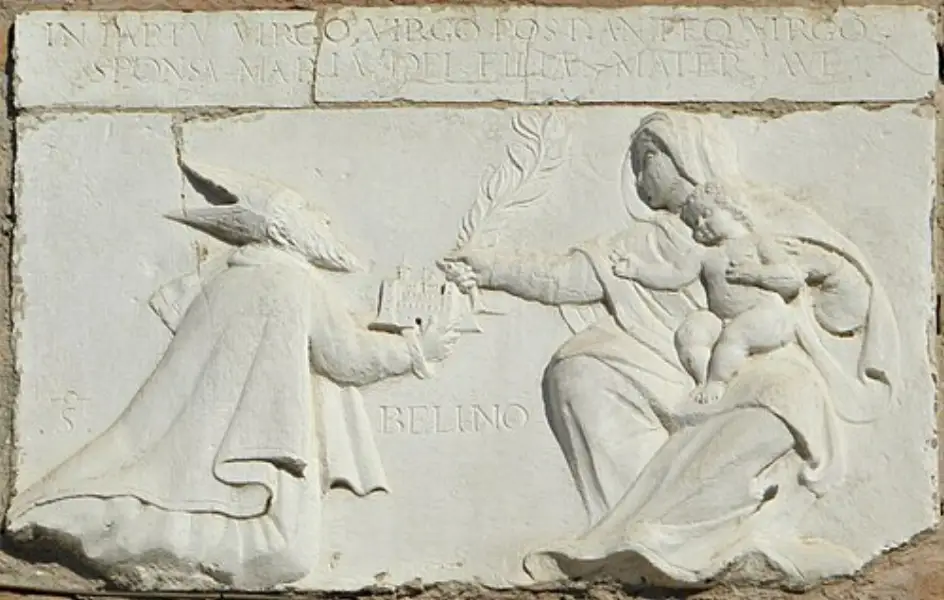
Bellino's death came at the hands of hired killers. He was travelling through a forest at Fratta — a place in the Polesine, near Rovigo in the territory of the Republic of Venice — on the road to Rome when assassins set upon him and stabbed him to death. The plot was afterwards traced to the Capodivacca house, one of the powerful dynasties of the region, which had paid the killers; the reasons for the commission remain unknown to history. The bare fact of a bishop murdered on the road invites several readings — factional hatred within the Paduan nobility, a dispute over lands or rights in the Polesine, or the residue of the conflicts of his reforming governance — but the sources do not allow a choice among them. What is certain is the manner of his end: violence, in a lonely wood, suffered on a journey undertaken for the Church, which counted him among its martyred pastors and fixed his feast on the day of his death, 26 November. The date of his passing, late in 1145, closed an episcopate of some seventeen years. Giovanni Cacio succeeded him in the see of Padua. The Church's memory of Bellino has always joined the reformer to the murdered man: the palm of martyrdom appears among his emblems, alongside the keys of his office and, curiously, a dog at his feet.
§ Biography
Canon, Shrine and Patron against Rabies
Pope Eugene IV, the fifteenth-century pontiff of the Florentine reform, canonized Bellino, giving the murdered bishop the Church's highest honours. His cult has remained strongest in the low country between Padua and the Po: he is the patron of Adria and of its diocese, and is invoked against dog bites and against rabies — a patronage that grows naturally out of rural life in the Polesine, and that explains the dog shown at his feet in his iconography, alongside the keys and palm of a bishop-martyr in episcopal attire. His relics have had a restless history. First housed at Lugarano in the church of San Giacomo, they were forced from that resting place by a flood and translated to the new church of San Bellino at San Martino di Variano, where in 1647 they were solemnly placed in a chapel that still bears his name. The cult thus moved with the waters that govern that country of rivers and lagoons, and each translation enlarged his fame. In the Venetian tongue he is remembered as San Bełin de Sasonia, a name that carries his memory into the everyday speech of the region. Modern students of the saints know him chiefly through the reference works of hagiography, which keep the outline of his career — the fidelity in the time of antipopes, the reform of the canons, the cathedral rebuilt, and the dagger in the forest — and his feast is kept on 26 November.
§ Biography
Timeline
- 1117
An earthquake destroyed Padua's cathedral; as bishop he later championed its rebuilding.
§ Biography
- 1128
Consecrated around this year as Bishop of Padua, succeeding Sinibaldo, an office he held until his murder.
§ Biography
- 1144
Set out on pilgrimage to Rome, where Pope Celestine II, impressed by the meeting, named him to the Padua see.
§ Biography
- 26 Nov 1145
Assassins hired by the Capodivacca house stabbed him to death in a forest at Fratta while he travelled toward Rome.
§ Biography
- 1647
His relics, earlier moved from Lugarano after a flood, were placed in a chapel of the church of San Bellino at San Martino di Variano.
§ Biography
The Record
- Major works
- Rebuilt the cathedral of Padua after the earthquake of 1117·Promoted the construction of schools in the diocese
- Patron of
- Adria·Diocese of Adria·Against dog bites·Against rabies
- Symbols
- Episcopal attire·Dog at his feet·Palm·Keys
- Canonization
- Canonized by Pope Eugene IV
Prayer
Bibliography
Show 2 sources
- "Saint Bellinus of Padua". Saints SQPN. 14 August 2017.
- "Saint Bellino of Padua". Santi e Beati.
Profile text adapted from the Wikipedia article, licensed CC BY-SA 4.0.
Pray with this saint every day
Save St. Bellinus of Padua to your favorites, read the full profile, and get feast-day reminders in the Saints app.
Get the Saints AppFree on the App Store for iPhone and iPad