
died 732·Feast March 11 (September 6 in the Ambrosian Rite)
St. Benedict of Milan
Archbishop of Milan and Defender of Its Metropolitan Rights
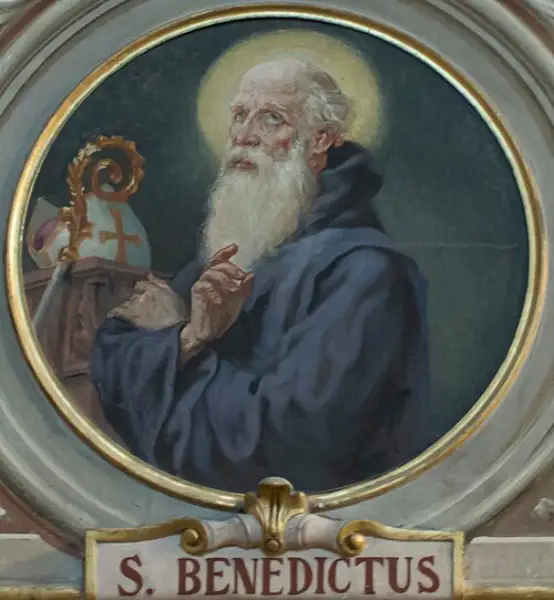
Overview
Benedict — Benedictus in Latin, Benedetto in Italian — was Archbishop of Milan from about 685 until his death in March 732, and is honoured as a saint by Catholics and Orthodox alike. The information that survives about him is sparse but telling. He composed the epitaph of Caedwalla, the West Saxon king who resigned his crown to be baptized in Rome and was buried in St Peter's Basilica — a commission that shows the range of Milanese learning in the late seventh century. In Rome again in the time of Pope Constantine, he resisted the claim of Armentarius, bishop of Pavia, that Pavia stood immediately subject to the apostolic see; Benedict recalled that Pavia had historically belonged to the metropolitan province of Milan, whose archbishop had once consecrated its bishops. The pope, however, judged for Armentarius, perhaps on account of an earlier privilege, or simply because the Lombard kings kept their capital there. In Milan itself Benedict built a church and a monastery, of which no trace now remains, and probably helped to settle the long Schism of the Three Chapters. He died between 9 and 11 March 732 and was buried in the Basilica of Sant'Ambrogio.
The Complete Life
A Long Episcopate in Lombard Italy
Benedict governed the church of Milan for nearly half a century, from about 685 to his death in March 732 — a span covering the reigns of several Lombard kings and the pontificates of a dozen popes. The record of those years is thin, but its entries are of unusual interest. He composed the epitaph of Caedwalla, the young king of Wessex who abdicated in order to receive baptism at Rome and died there almost immediately, in 689, receiving burial in St Peter's Basilica; that a Milanese archbishop should supply the verse for a West Saxon ruler's tomb testifies to the standing of Milanese letters and to the wide web of the early medieval Church. At home he built a church and a monastery in his city, foundations of which archaeology has left no trace but which belong to the general monastic expansion of seventh- and eighth-century northern Italy. He probably also laboured to close the Schism of the Three Chapters, the long quarrel between Rome and the churches of northern Italy over the condemnation of certain writings, which had divided Milan from the apostolic see for generations; his episcopate falls in the generation that finally healed it. Each of these fragments shows the same figure: a bishop building — churches, monasteries, unity, and the Church's memory in stone and verse.
§ Life
Milan and Pavia before the Pope
The one sustained episode preserved from Benedict's career is a jurisdictional battle fought in Rome in the time of Pope Constantine. Armentarius, bishop of Pavia, maintained that his church stood immediately subject to Rome, with no metropolitan between. Benedict travelled to the apostolic see and answered the claim from history: Pavia, he recalled, had belonged of old to the metropolitan province of Milan, and its bishops had been consecrated by the archbishop of Milan. The argument invoked the ancient order of the northern Italian church, in which Milan, the see of Ambrose, held primacy. The pope nonetheless decided in favour of Armentarius — perhaps, as later writers suggest, because of a privilege granted in the time of Bishop Evodius, or perhaps for the hard political reason that Pavia was the capital of the Lombard kingdom and its church too important to leave under a rival's wing. Benedict accepted the ruling without recorded protest, and the question of Milan's metropolitan dignity continued to echo through the Middle Ages. The episode is valuable precisely because it is procedural rather than legendary: it shows a bishop of the eighth century defending his see's rights with historical argument before the universal bishop, in the plain language of canon law rather than of miracle.
§ Life
A Saint Venerated All Over Italy
Benedict died between 9 and 11 March 732, after one of the longest episcopates in the history of the Milanese church, and was buried in the Basilica of Sant'Ambrogio, beside the city's greatest father. His sanctity was recognised quickly and widely. About ten years after his death an anonymous poet, in the verse encomium De laudibus Mediolani ('In Praise of Milan'), praised him among the glories of the city and recorded his resting place. Some fifty years after his death Paul the Deacon, the great Lombard historian, could still speak of him as a saint honoured throughout the whole of Italy — an explicit testimony to a cult already national in extent. His feast is kept on 11 March in the Roman Rite and in the Eastern Orthodox Church, and on 6 September in the Ambrosian Rite, the liturgy proper to his own city. Theodorus II succeeded him in the see. Later ages added little to his story: a tradition associating him with the Milanese Crespi family is dismissed as without historical foundation, and modern reference works — Cazzani's history of the bishops and archbishops of Milan among them — treat him briefly, as one of the shadowed but solid figures of the Ambrosian line. He remains what Paul the Deacon called him: a saint of the whole Italian peninsula, honoured in the calendar of both East and West.
§ Life
Timeline
- 685
Becomes Archbishop of Milan in succession to Mansuetus
§ Life
- 689
Writes the epitaph of Caedwalla, the king of Wessex baptized in Rome and buried in St Peter's Basilica
§ Life
- 710
In Rome under Pope Constantine he contests the bishop of Pavia's claim to be immediately subject to Rome; the pope rules for Pavia
§ Life
- Mar 732
Dies between 9 and 11 March after an episcopate of nearly half a century, and is buried in the Basilica of Sant'Ambrogio
§ Life
- 742
The poem De laudibus Mediolani, written about ten years after his death, praises him and records his burial place
§ Life
- 782
Paul the Deacon, writing some fifty years after his death, recalls him as a saint venerated throughout Italy
§ Life
The Record
- Major works
- Epitaph of King Caedwalla of Wessex·A church and a monastery in Milan (no longer extant)
- Canonization
- Pre-congregation; venerated as a saint in the Catholic and Eastern Orthodox churches
Prayer
Bibliography
Show 6 sources
- Casari, Mario (1987). "Benedetto, santo". Dizionario della Chiesa Ambrosiana (in Italian). Vol. 1. Milano: NED. p. 392. ISBN 88-7023-102-X.
- Cazzani, Eugenio (1996). Vescovi e arcivescovi di Milano (in Italian). Milano: Massimo. pp. 57–58. ISBN 88-7030-891-X.
- The Benedictine Monks of St. Augustine's Abbey, Ramsgate (1921). "Armentarius (St.) Bp." The Book of Saints: A Dictionary of Servants of God Canonised by the Catholic Church. London: A. & C. Black Ltd. p. 31.
- The Benedictine Monks of St. Augustine's Abbey, Ramsgate (1966). "Benedict Crispus of Milan". The Book of Saints: A Dictionary of Servants of God Canonized or Beatified by the Catholic Church (Fifth, revised ed.). New York: Thomas J. Crowell Company. p. 111.
- Magnoli, Claudio, ed. (2010). Celebrazioni dei santi. Messale ambrosiano quotidiano (in Italian). Vol. 4. Milano: Centro Ambrosiano. p. 747. ISBN 978-88-8025-763-9.
- "Latin Saints of the Orthodox Patriarchate of Rome". Orthodox Europe. Retrieved 25 March 2023.
Profile text adapted from the Wikipedia article, licensed CC BY-SA 4.0.
Pray with this saint every day
Save St. Benedict of Milan to your favorites, read the full profile, and get feast-day reminders in the Saints app.
Get the Saints AppFree on the App Store for iPhone and iPad