
1748 – 1783·Feast April 16
St. Benedict Joseph Labre
French Franciscan tertiary and pilgrim beggar
Overview
Benedict Joseph Labre, born on 26 March 1748 at Amettes near Arras in the province of Artois, was the first of the fifteen children of a shopkeeper in comfortable circumstances. Educated for the priesthood by an uncle who was a parish priest, he sought entry to the strictest monastic orders of his day and was refused by them all: the Trappists judged him too young and too frail, the Carthusians and Cistercians found him unsuited to communal life, and a brief stay at the Cistercian Abbey of Sept-Fonts from November 1769 ended when his health collapsed. Convinced that God was calling him to a different path, inspired by Alexius of Rome and Saint Roch, he joined the Third Order of Saint Francis and embraced a life of voluntary poverty as a permanent pilgrim. Walking everywhere, begging his bread, sleeping in the open, he visited nearly all the great shrines of Europe, among them Loreto, Assisi, Naples, Bari, Einsiedeln, Paray-le-Monial, and Santiago de Compostela, often several times over. He spoke rarely, prayed constantly, shared what alms he received, and bore insults silently. In his later years he settled in Rome, living for a time among the ruins of the Colosseum and leaving only for an annual pilgrimage to Loreto; his hours before the Blessed Sacrament earned him the name the saint of the Forty Hours. He collapsed on the steps of Santa Maria ai Monti and died there, starved and spent, on 16 April 1783 in Holy Week at thirty-five years of age.
The Complete Life
A Shopkeeper's Eldest Son in Artois
On 26 March 1748, at Amettes, a village close by Arras, Benedict Joseph Labre was born, in the old province of Artois in northern France. His father, Jean-Baptiste Labre, was a prosperous shopkeeper, and his mother, Anne Grandsire, would bear fifteen children in all, of whom Benedict was the eldest. The family's means were comfortable enough that his future might have been expected to follow the pattern of respectable bourgeois life, but the boy showed other inclinations early. A paternal uncle, a parish priest living at some distance from the family home, received the young Benedict and took charge of his early education, preparing him with an eye toward the priesthood. The bond between uncle and nephew was deep and practical, and it would be tested severely. At sixteen, Benedict approached his uncle with the desire to become a Trappist monk; his parents rebuffed the idea, insisting that he wait until he was older before embracing so hard a life. Two years later, when an epidemic swept the city where the uncle served, the priest devoted himself to the sick while his nephew cared for the town's cattle. The uncle was among the epidemic's last victims, leaving the young man free, and bereft, to pursue the vocation he believed was his.
§ Life
Refused by the Monasteries
After his uncle's death Labre set out for La Trappe Abbey to apply to the Trappist Order, and was refused, the community judging him under age, too delicate in constitution, and without the special recommendations that commended a postulant. He did not abandon the attempt. He turned to the Carthusians and the Cistercians in turn, and each order in its own way concluded that he was unsuited to enclosed communal life; for roughly six weeks he was a postulant with the Carthusians at Neuville, an experience that ended without profession. Admission to the Cistercian Abbey of Sept-Fonts came in November 1769, but after only a short residence his health gave way, and the verdict was that God called him to something else. To a determined soul this string of rejections could have meant one of two things: that there was no vocation at all, or that God was pointing to a form of consecrated life the cloister could not contain. Catholic tradition records that Labre experienced a desire he believed was given him by God, kindled by the example of Alexius of Rome, the ancient pilgrim-beggar, and by the Franciscan tertiary Saint Roch, to leave behind country, parents, and every worldly attraction for a life most painful and most penitential, lived not in wilderness or cloister but amid the world itself, a pilgrim devoutly visiting the renowned places of Christian devotion.
§ Life
Pilgrim to the Shrines of Europe
Labre entered the Third Order of Saint Francis and fixed upon a life of chosen poverty and unending pilgrimage. His first great journey was to Rome, made entirely on foot, and he lived along the way on whatever begging could obtain. From there his pilgrimages radiated across the continent: he journeyed to nearly every great shrine Europe held, returning again and again to the same sanctuaries. Among them were the shrines at Loreto, Assisi, Naples, and Bari in Italy; Einsiedeln in Switzerland; Paray-le-Monial in France; and Santiago de Compostela in Spain, at the very edge of the known pilgrim world. The manner of his travel never varied: always on foot, sleeping in the open air or in a corner of whatever room would hold him, his clothes muddy and ragged. On one journey he lodged at the farmhouse kept by Matthieu and Marie Vianney, the couple who would later become the parents of the Curé d'Ars, an incidental meeting that links two generations of French holiness. He lived on the little that was given him and frequently divided even that with others poorer still. He is reported to have spoken seldom, prayed much, and borne in silence the abuse directed at him, walking the way of the mendicant Fool-for-Christ, a type more at home in the Eastern Orthodox Church.
§ Life
The Saint of the Forty Hours
The centre of Labre's inner life was Eucharistic. Long hours he kept in adoration before the Blessed Sacrament, and in his last years, living in Rome, he became a familiar figure of the city's churches, so devoted to the Forty Hours devotion, the Quarant' Ore, that the Romans called him the saint of the Forty Hours. Contemplation of the crown of thorns would overcome him; accounts of the period say that during these states he would swoon, and it was claimed of him that he levitated or bilocated, and that he cured some of the homeless people he met and even multiplied bread for them, reports that belong to the traditional hagiography surrounding him. What is beyond dispute is the shape of his devotional existence: silence, adoration, and the voluntary acceptance of destitution as a share in Christ's poverty. He embodied the type of the holy fool, the Fool-for-Christ, whose sanctity appears as scandal and whose wisdom appears as folly, a role more often found in the Eastern Church than in the West. His prayer was not confined to church walls; the roads and shrines of Europe were his cloister, and his begging bowl his monastic rule. For a man rejected by the strictest orders as unfit for community, he had found in the streets of Rome and the pilgrim roads a solitary and total observance that no abbot could have imposed.
§ Life
Death in Holy Week
The last years of Labre's life were spent in Rome, where he lived for a time among the ruins of the Colosseum, that ancient arena of martyrdom serving as his shelter. From the city he would depart only once a year, to make his annual pilgrimage on foot to the shrine of Our Lady of Loreto, keeping intact the rhythm of pilgrimage even when he had, in effect, become a resident of Rome. He was known throughout the city, a gaunt, ragged figure recognizable in the streets and constant in the churches. The end came quickly. On the eve of his death he fell on the steps of Santa Maria ai Monti, a short distance from the Colosseum, and protesting all the while he was carried to a house behind the church in the Via dei Serpenti. There, starved and spent, he died on 16 April 1783, thirty-five years old, in the middle of Holy Week, the Church's annual remembrance of the Lord's suffering matching the manner of his own slow self-offering. He was buried in the Church of Santa Maria ai Monti, which remains his major shrine, where his body rests beneath the altar and where the death mask taken after his passing has fixed for posterity the emaciated face of the pilgrim.
§ Life
From Roman Cult to Canonization
Devotion to Labre arose almost immediately after his death. His confessor, Marconi, wrote his biography and set down 136 distinct cures obtained through his intercession in the three months after he died, a remarkable harvest of reported miracles for so short a period. Those miracles played a part in a conversion of wider significance: the Reverend John Thayer, the first American Protestant clergyman to become a Catholic, was living in Rome when Labre died, and the events surrounding the dead beggar were instrumental in bringing him into the Church. A cult grew up around Labre very soon after his death, centred on Santa Maria ai Monti, and the formal process moved, by the standards of the time, steadily. He was declared Blessed by Pope Pius IX in Rome on 20 May 1860, and canonized by Pope Leo XIII in Rome on 8 December 1881, a little over a century after his death in Holy Week. The speed of his rise to formal recognition, for a man who owned nothing and held no office, testifies to the force of his reputation among the poor of Rome and the pilgrims who had met him on the roads of Europe.
§ Veneration
Patron of the Homeless
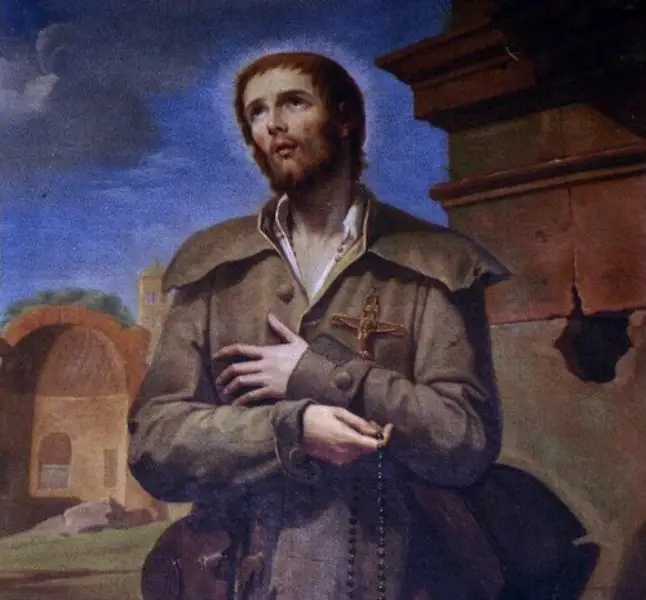
Labre's legacy is carried less by institutions than by his patronage and his image. He is the patron saint of the homeless, the beggar of the eighteenth century now invoked for those who have no place to sleep in the twenty-first, and he is also invoked for those suffering from mental illness, his strange, silent, stumbling pilgrimage read as a sign that holiness can inhabit lives the world regards as broken. His iconographic attributes, the tri-cornered hat of his era and the alms on which he lived, fix him in the costume of the old pilgrim roads. A reliquary bust containing his image stands in the Basilica of Saint-Sernin in Toulouse, and his death mask survives, one of the most affecting relics of any modern saint. Parishes and schools bear his name, including Saint Benedict Joseph Labre Parish in Richmond Hill, New York, and St. Labre Indian Catholic High School, while in Montreal a lay apostolate called the Benedict Labre House continues his care for the destitute. Artists depicted him in his own century, notably Antonio Cavallucci, who painted the pilgrim during Labre's lifetime or within a decade of it. His feast is observed on 16 April, the day he died in Holy Week.
§ Veneration
Timeline
- 26 Mar 1748
Born on 26 March at Amettes in Artois, eldest of fifteen children of Jean-Baptiste Labre and Anne Grandsire.
§ Life
- 1764
Aged sixteen, raises with his uncle his wish to join the Trappists, but his parents defer the idea.
§ Life
- 1766
During an epidemic he tends the city's cattle while his uncle nurses the sick; the uncle dies among the last victims.
§ Life
- 1767
Applied to La Trappe Abbey but is refused as underage, delicate, and lacking recommendations; the Carthusians also reject him.
§ Life
- Nov 1769
After six weeks as a Carthusian postulant at Neuville, he enters the Cistercian Abbey of Sept-Fonts in November, but his health fails.
§ Life
- 1770
Joining the Third Order of Saint Francis, he sets out as a pilgrim to Rome on foot, living by begging.
§ Life
- 16 Apr 1783
Dies of malnutrition and exhaustion on 16 April, during Holy Week, at a house behind Santa Maria ai Monti in Rome.
§ Life
- 20 May 1860
Declared Blessed by Pope Pius IX in Rome on 20 May.
§ Veneration
- 8 Dec 1881
Canonized by Pope Leo XIII in Rome on 8 December.
§ Veneration
The Record
- Major works
- Third Order of Saint Francis (tertiary oblation)·Pilgrimages on foot to the major shrines of Europe, including Loreto, Assisi, Santiago de Compostela, and Einsiedeln
- Patron of
- The homeless·Those suffering from mental illness
- Symbols
- Tri-cornered hat·Alms·Ragged pilgrim's clothing
- Canonization
- Beatified by Pope Pius IX in Rome on 20 May 1860; canonized by Pope Leo XIII in Rome on 8 December 1881.
Prayer
Bibliography
Show 6 sources
- Herbermann, Charles, ed. "St. Benedict Joseph Labre." Catholic Encyclopedia. New York: Robert Appleton Company, 1913.
- Attwater, Donald and Catherine Rachel John. The Penguin Dictionary of Saints. 3rd edition. New York: Penguin Books, 1993. ISBN 0-14-051312-4.
- De la Gorce, Agnes. St Benedict Joseph Labre. London: Sheed & Ward, 1952.
- Foley, Leonard, O.F.M. Saint of the Day, Lives, Lessons, and Feast. Franciscan Media. ISBN 978-0-86716-887-7.
- "Labre Project." John Carroll University.
- Savelli Admin. "Who are the Patron Saints of mental illness?" Savellireligious.com, 3 February 2022.
Profile text adapted from the Wikipedia article, licensed CC BY-SA 4.0.
Pray with this saint every day
Save St. Benedict Joseph Labre to your favorites, read the full profile, and get feast-day reminders in the Saints app.
Get the Saints AppFree on the App Store for iPhone and iPad