
c. 747 – 821·Feast February 12
St. Benedict of Aniane
Benedictine reformer of the Carolingian Empire
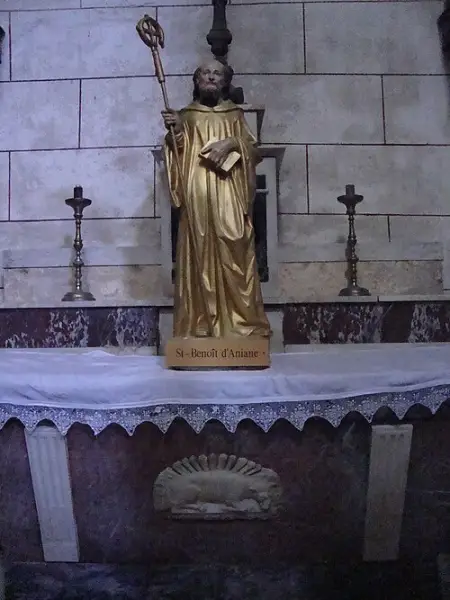
Overview
Benedict of Aniane, born Witiza around 747, was the son of Aigulf, Count of Maguelonne, a Visigoth nobleman. He was schooled at the Frankish court of Pippin the Younger and began royal service as a page; he served Charlemagne and joined the Italian campaign of 773, during which he nearly drowned in the Ticino near Pavia while trying to rescue his brother. The narrow escape crystallised a long-gestating resolve to leave the world, and he was received at the Abbey of Saint-Seine. Made cellarer and then elected abbot there, he saw that the monks would never adopt his severe practices and withdrew to his father's estates in Languedoc to live as a hermit. Around 780 he gathered a community at Aniane modelled on Eastern asceticism, and in 782 founded on the same site a monastery living under the Benedictine Rule. His success gave him wide influence, and he reformed or founded many houses, until he stood as effective abbot over every monastery in Charlemagne's empire. Louis the Pious, after becoming King of Aquitaine in 781, charged him with reforming the monasteries of his territory, and later as emperor entrusted him with coordinating monastic practice across the realms. In 814 Louis had him found a house on the river Inde near Aachen, later Kornelimünster Abbey, and in 817 Benedict presided over the council of abbots at Aachen that produced the binding Codex regularum. He died there on 11 February 821 and was buried the following day.
The Complete Life
A Gothic Nobleman at the Frankish Court
The man who would be called the Second Benedict began life as Witiza, a name his Gothic parents gave him around 747 in the Kingdom of the Franks. According to Ardo, his biographer, his father was Aigulf, Count of Maguelonne, a Visigoth nobleman holding office in the Frankish realm, which placed the boy from birth within the orbit of the Carolingian court. He was educated at the court of Pippin the Younger, the father of Charlemagne, and entered royal service as a page, the customary first step for a son of the high aristocracy toward a career at court. He went on to serve Charlemagne himself, and in 773 he marched with the king's army into Italy, the campaign that broke the Lombard kingdom. It was there, near Pavia, that the incident occurred which tradition marks as the turning point of his life: attempting to save his drowning brother, he himself nearly perished in the Ticino River. The brush with death brought to a head a resolve that had been slowly forming in him, the determination to renounce the world and embrace the monastic life. Soon afterwards he quitted the court and entered Saint Sequanus's monastery, the Abbey of Saint-Seine, exchanging the intimacy of the greatest court in Europe for the obscurity of a Burgundian cloister.
§ Life
From Saint-Seine to the Hermitage of Aniane
Benedict's first years as a monk showed both his capacity and the difficulty of his ideals. At Saint-Seine he was made cellarer, a post of considerable responsibility in the house's economy, and he was afterwards elected abbot, the monks choosing the court-educated nobleman to lead them. Yet he came to realise that the community would never conform to the strict practices he had set his heart on, and rather than preside over a compromise he left, withdrawing to the family estates in Languedoc and raising a hermitage there. There, around 780, he founded a small monastic community modelled on Eastern asceticism, a program of unusual severity drawn from the desert tradition of the Christian East. This first foundation did not develop as he had intended, and in 782 he established a second monastery on the same site at Aniane, this time on the Benedictine Rule. The change proved decisive: the house flourished, and its success gave Benedict considerable influence throughout the region. He used that influence to found and to reform a number of other monasteries, and over the years his authority extended until he stood as effective abbot over every monastery of Charlemagne's empire, a position no title adequately described but which the kings and emperors themselves confirmed in practice.
§ Life
Reforming the Monasteries of an Empire
Benedict's mission was imperial in the literal sense. Louis the Pious, on becoming King of Aquitaine in 781, asked Benedict to reform the houses of his territory, an invitation that joined the reformer's zeal to the crown's authority. When Louis later became Emperor, he placed Benedict over the coordinating of practices and of communication among the monasteries within his domains, effectively making him the overseer of Benedictine life from the Atlantic to the Elbe. Benedict carried into this work a broad command of patristic literature, and churchmen of the first rank, Alcuin among them, sought his counsel, testimony to the reputation his learning and judgment enjoyed in the Carolingian renaissance. In 814, the year Louis acceded as Emperor, he had Benedict raise a new monastery on the Inde beside the court at Aachen, first styled the Redeemer's monastery on the Inde, and afterwards known as Kornelimünster Abbey, and intended as the base for Benedict's supervisory work, placing the reformer within reach of the imperial court. From there he laboured to restore what he understood as the primitive strictness of observance wherever houses had let it slacken or traded it for the easier canonical life, the daily, unglamorous work of visitation, correction, and exhortation across hundreds of houses.
§ Life
Strictness Rooted in the Fathers
The spirituality of Benedict of Aniane was a spirituality of the rule, learned from books and enforced in practice. His reading ranged widely through the patristic literature of East and West, and it convinced him that the Benedictine way, rightly observed, stood in harmony with the whole monastic tradition of the Church. That conviction produced his most personal literary work, the Concordia regularum, in which sections of the Benedictine rule, apart from chapters nine to sixteen, are set out in their order with parallel texts culled from the other rules assembled in the Liber regularum, to demonstrate the agreement of principles among them all and thereby enhance the respect owed to the Benedictine text. He was above all an ecclesiastic, one who put his considerable theological learning zealously at the service of orthodoxy and of the cause of Benedictine monasticism, a scholar whose scholarship existed for the sake of discipline. His ascetic ideal, first attempted in the Eastern-inspired community at Aniane and tempered by the failure of that experiment, found its mature expression not in exotic severity but in the faithful, uniform, exact observance of a rule already ancient, applied without exception to every house under his care.
§ Life
Kornelimünster and the Aachen Legislation
The last phase of Benedict's life was his most public. Installed at the monastery on the Inde, within reach of the court at Aachen, he presided in 817 over a council of abbots assembled at Aachen which created a code of regulations, the Codex regularum, intended to be binding on all their houses. The legislation represented the high-water mark of the Carolingian project to order the religious life of the empire by law: uniform observance, uniform discipline, and a single standard of monastic strictness imposed from the centre. Benedict gave the council its learning and its drive, drawing on the collection of rules and patristic texts he had spent decades assembling. He did not long survive his masterpiece. He died at Kornelimünster Abbey on 11 February 821, in the monastery Louis had built to be the base of his supervisory work, and he was buried the following day, 12 February. That twofold date explains why some calendars list his feast on the eleventh and some on the twelfth of February. The empire he had organised outlived his arrangements only briefly, for the new codes soon lapsed after Benedict and his patron the Emperor Louis the Pious died.
§ Life
Honoured East and West
Benedict of Aniane was canonised in the era before the modern process; no formal canonisation date, place, or pontiff is attached to his name, and his sanctity was acknowledged by the durable consent of the churches. He is titled a Confessor, the traditional designation for a saint who bore witness to Christ neither by martyrdom nor by the episcopate but by the witness of a holy life. He is venerated in the Catholic Church, and the Eastern Orthodox Church likewise honours him, a recognition of his debt to Eastern ascetic sources and of the unity of the monastic tradition before the schism. His feast is kept on 12 February in the Roman tradition, with the alternative date of 11 February, the day of his death, appearing in some calendars, including Orthodox ones; the difference goes back simply to whether the day of death or the day of burial is commemorated. The Proper Masses for the Use of the Benedictine Confederation and the Roman Martyrology both carry his memory, and the bibliography of his cult runs from Ardo's contemporary Life through the Bollandist Acta Sanctorum to the scholarly literature of the nineteenth century, a continuous chain of remembrance reaching from the ninth century to the present.
§ Works
The Second Benedict
Benedict of Aniane is remembered as the Second Benedict, a deliberate echo of the sixth-century patriarch of Western monks, and the title is earned rather than rhetorical. Though the detailed codes of 817 fell into disuse shortly after his death and that of the Emperor Louis the Pious, they nonetheless had lasting effects on Western monasticism: the principle that monastic observance could be legislated, coordinated, and reformed from a centre, and the habit of consulting the whole tradition of rules rather than a single house's custom, both descend from his work. His Codex regularum and Concordia regularum preserved and juxtaposed the monastic legislation of the early centuries in a way that made later reform movements possible, for every subsequent effort, from Cluny to the Cistercians, worked with materials he had gathered and ordered. The Abbey of Aniane gave its name to a reform that spread across the Carolingian world, and Kornelimünster, the house built for him near Aachen, kept his tomb and his memory. His writings survive in the Patrologia Latina and in the modern critical edition of the Concordia regularum published in the Corpus Christianorum, and historians of monasticism continue to treat his career as the hinge between the first Benedictine age and the Carolingian reformation of religious life.
§ Works
Timeline
- 747
Born Witiza, son of the Visigoth Aigulf, Count of Maguelonne, in the Kingdom of the Franks.
§ Life
- 773
Serving in Charlemagne's Italian campaign, he nearly drowns in the Ticino near Pavia saving his brother, deciding him on the monastic life.
§ Life
- 780
After leaving Saint-Seine as abbot-elect, he founds a hermitage community on Eastern ascetic lines at Aniane in Languedoc.
§ Life
- 781
Louis the Pious, become King of Aquitaine, asks Benedict to reform the monasteries of his territory.
§ Life
- 782
Founds a second monastery at Aniane based on the Benedictine Rule, the seed of his reform.
§ Life
- 814
The Emperor Louis makes Benedict establish a new house on the river Inde by Aachen, later known as Kornelimünster Abbey.
§ Life
- 817
Heads a council of abbots at Aachen that issues the Codex regularum binding on all their houses.
§ Life
- 11 Feb 821
Dies at Kornelimünster Abbey, the monastery Louis the Pious had built for him as a base for his supervisory work.
§ Life
- 12 Feb 821
Buried the day after his death, which is why some calendars keep his feast on the 11th and others on the 12th.
§ Life
The Record
- Major works
- Codex regularum (code of monastic regulations, Aachen, 817)·Concordia regularum (the Benedictine rule set against parallel passages of other rules)·Letters (Patrologia Latina 103:703–1380)
- Symbols
- Abbot's staff·Monastic habit
- Canonization
- Pre-congregation; venerated as a Confessor by the Catholic Church and the Eastern Orthodox Church, with his cult dating from soon after his death.
Prayer
Bibliography
Show 7 sources
- Kirsch, Johann Peter. "St. Benedict of Aniane." The Catholic Encyclopedia, Vol. 2. New York: Robert Appleton Company, 1907.
- "Benedict of Aniane." Cistercian Studies, No. 220. Kalamazoo, Michigan: Cistercian Publications, 1979. ISBN 978-0-87907-320-6.
- Attwater, Donald and Catherine Rachel John. The Penguin Dictionary of Saints. 3rd edition. New York: Penguin Books, 1993. ISBN 0-14-051312-4.
- Seebass, Otto. "Benedict of Aniane." The New Schaff-Herzog Encyclopedia of Religious Knowledge, Vol. II, ed. Philip Schaff.
- Ardo Smaragdus. Life of Benedict of Aniane, in Patrologia Latina CIII, 353 sqq.
- Acta Sanctorum, February, II, 606 sqq.
- Concordia regularum, ed. Pierre Bonnerue. Corpus Christianorum Continuatio Mediaevalis, vol. 168/168A. Turnhout: Brepols, 1999.
Profile text adapted from the Wikipedia article, licensed CC BY-SA 4.0.
Pray with this saint every day
Save St. Benedict of Aniane to your favorites, read the full profile, and get feast-day reminders in the Saints app.
Get the Saints AppFree on the App Store for iPhone and iPad