
480-547·Feast July 11
St. Benedict of Nursia
Abbot, Father of Western Monasticism
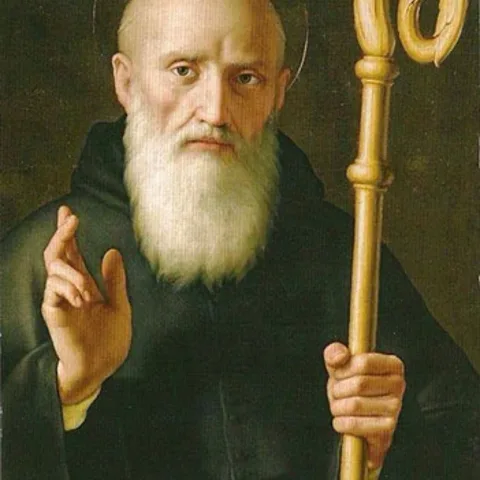
Overview
Benedict, son of a Roman noble of Nursia in Umbria, was born around 480 and sent to Rome for schooling. Disillusioned by what the city's studies offered, he fled its noise, settled briefly at Enfide, and then withdrew to a cave above a lake near Subiaco, where the monk Romanus gave him the habit and he lived as a hermit for about three years. His reputation grew, and when a neighboring community lost its abbot, the monks pressed him to take charge; the experiment failed when they tried to poison his drink, the cup shattering at his blessing, and he returned to his cave. Disciples gathered around him until he had founded twelve small monasteries in the Subiaco valley, until the envy of a local priest, whose poisoned bread a raven carried away, pushed him to leave. Around 530 he established the great abbey of Monte Cassino on its hill between Rome and Naples, and there he wrote the Rule for monks living together under an abbot: seventy-three short chapters joining spiritual counsel to practical governance, marked by moderation. He died of a fever there in 547, shortly after his sister Scholastica, and was buried beside her. His Rule became the founding document of thousands of religious communities and the early Middle Ages are often called the Benedictine centuries.
The Complete Life
Early Life
Benedict was born around 480 at Nursia — modern Norcia in Umbria — the son of a Roman noble, at the moment when Roman Italy was passing under Gothic kings and the institutions of the ancient world were visibly failing. His parents sent him to Rome for the literary education proper to his class, but the city's schools disappointed him; in Gregory the Great's account, Benedict turned from learning he found corrupt to a life deliberately sought in the wilderness. He left with his nurse and settled at Enfide — tradition identifies it with Affile — in the Simbruini hills some forty miles from Rome. Even that was too close to the world for his purpose. Near Subiaco the valley narrows to a gorge beneath a cliff over a lake, and there in a cave, still shown as the Sacro Speco, Benedict began the life of a solitary.
§ Early life
Conversion and Vocation
At Subiaco Benedict met the monk Romanus, who lived in a monastery on the mountain above the cave, discussed with him the purpose that had brought him there, clothed him in the monastic habit, and supported him. For about three years Benedict lived alone in the cave, fed on fixed days by Romanus, maturing — as Gregory frames it — in knowledge of himself and of human nature before he was asked to lead anyone. The hermit's retirement ended the way ascetic retirements often did in the early medieval record: a neighboring community, having lost its abbot, came and begged the holy man to take charge. Benedict knew their way of life differed from his own and predicted disagreement, but consented to their entreaties. The prediction held: the monks tried to poison his drink, and at Benedict's blessing of the cup it shattered. He returned to his cave, advising them to choose an abbot more to their taste.
§ Early life
Mission and Ministry
What followed at Subiaco was not planning but attraction. Disciples gathered to the cave, and Benedict organized them — eventually into twelve small monasteries in the valley, each with its own superior under his direction, among them boys sent by Roman families, the young noblemen Placid and Maurus of the Dialogues. The experiment attracted envy as well: a neighboring priest, Florentius, tried to kill Benedict with a poisoned loaf — carried off, in Gregory's story, by a raven at Benedict's blessing — and then attempted to corrupt his monks. Around 530 Benedict left Subiaco altogether and moved southeast to the hill of Monte Cassino, between Rome and Naples, where he founded the monastery that would become the most famous in Western Christendom, on the site of an ancient sanctuary of Apollo that his biographer says he destroyed.
§ Introduction
Spirituality and Teaching
Benedict's lasting work is the Rule of Saint Benedict: seventy-three short chapters for monks living communally under an abbot. He drew heavily on John Cassian and on the earlier Rule of the Master, but gave the inherited material a distinctive temper — the balance, moderation, and reasonableness he called epieíkeia — that made his version the one monastic code Western Europe could actually live by. The Rule's wisdom is deliberately double: spiritual, teaching a Christ-centered life of obedience and humility, and administrative, specifying how a monastery is governed, how novices are tested, how the kitchen and the infirmary and the cellarer's accounts are run. More than half the chapters treat obedience and humility and what to do when a brother fails at them; about a quarter regulate the opus Dei, the daily round of communal prayer; the rest handle the practical management of the house. Its most quoted command — to prefer nothing to the love of Christ, and to treat every guest, every tool, every sick brother as Christ himself — gave Latin monasticism its ethic of ordinary sanctity.
§ Introduction
Trial and Final Years
Benedict's last years at Monte Cassino were the mature season of the Rule and of the community it governed. Gregory's second book of Dialogues, our only ancient narrative, closes not with illness but with two scenes of farewell: the famous meeting with his sister Scholastica, whose prayer for one more night of conversation Benedict could not refuse, and the standing vision of her soul departing in the form of a dove. Death came to Benedict by fever at Monte Cassino, soon after his sister, traditionally on 21 March 547, and was buried in the same tomb with her — the grave over which the abbey's high altar stands.
§ Introduction
Canonization
Benedict belongs to the pre-congregation era; no process canonized him because none was needed — his cult was the settled memory of Latin monasticism long before any formal procedure existed. The liturgical honor paid him is unusually wide: the Catholic Church, the Eastern Orthodox, the Anglican Communion, the Lutheran churches, and the Old Catholics all keep his feast, on 11 July in the current Roman calendar (moved from 21 March, always impeded by Lent) and on other dates in the eastern rites. In 1964 Pope Paul VI named him patron protector of Europe, and in 1980 Pope John Paul II added Cyril and Methodius as co-patrons.
§ Veneration
Legacy
Monte Cassino became the motherhouse of a movement rather than an order in the modern sense — today a confederation of autonomous congregations. In the centuries after Benedict's death his Rule, adopted by Charlemagne's reformers as the standard for Frankish monasticism, became the organizing document of Western monastic life, and through the monasteries — their schools, their scriptoria, their farms, their hospitals — of early medieval civilization itself; the centuries between Benedict and Cluny are often simply called the Benedictine centuries. He is honored also as a protector against poison and as patron of speleologists, of Europe, and — from the Tenerife romería that bears his name — of fields and farmers.
§ Introduction
Timeline
- 2 Mar 480
Born at Nursia in Umbria, son of a Roman noble.
§ Introduction
- 500
Abandons his studies in Rome a few years before 500 and settles at Enfide, then as a hermit in a cave at Subiaco for three years.
§ Early life
- 530
Has founded twelve communities for monks in the vicinity of Subiaco before leaving the district.
§ Later life
- 530
Founds the great Benedictine monastery of Monte Cassino on a hilltop between Rome and Naples.
§ Later life
- 21 Mar 547
Dies of a fever at Monte Cassino, tradition says on 21 March, not long after his sister Scholastica, and is buried in the same tomb.
§ Veneration
- 593
Pope Gregory I's Dialogues, whose second volume is the only ancient account of Benedict, are thought to have been written this year.
§ Hagiography
- 1220
Canonized in Rome by Pope Honorius III.
§ Introduction
- 1880
The Jubilee Saint Benedict Medal is first struck to mark the fourteenth centenary of his birth.
§ Saint Benedict Medal
- 1964
Pope Paul VI names him patron protector of Europe.
§ Veneration
- 1969
Revision of the General Roman Calendar moves his memorial from 21 March to 11 July.
§ Veneration
- 1980
Pope John Paul II proclaims him co-patron of Europe alongside the saints Cyril and Methodius.
§ Veneration
In Their Own Words
Listen carefully, my child, to your master's precepts, and incline the ear of your heart.
Your way of acting should be different from the world's way; the love of Christ must come before all else.
There are times when good words are to be left unsaid out of esteem for silence.
The Record
- Major works
- The Rule of Saint Benedict
- Patron of
- Europe·Speleologists (cave explorers)·Farmers and fields (Tenerife)
- Symbols
- Broken poisoned cup·Raven carrying away poisoned bread·The Rule and a crosier·Benedictine medal (cross, raven, cup)
- Canonization
- Pre-congregation (ancient cult); named patron protector of Europe by Pope Paul VI in 1964 and co-patron of Europe by Pope John Paul II in 1980
Prayer
Bibliography
Show 1 sources
- ↑ For the various literary accounts, see Anonymous Monk of Whitby, The Earliest Life of Gregory the Great , tr. B. Colgrave (Cambridge: Cambridge University Press, 1985), p. 157, n. 110.
Profile text adapted from the Wikipedia article, licensed CC BY-SA 4.0.
Pray with this saint every day
Save St. Benedict of Nursia to your favorites, read the full profile, and get feast-day reminders in the Saints app.
Get the Saints AppFree on the App Store for iPhone and iPad