
10th century – 1012·Feast May 1
St. Benedict of Skalka
Hungarian hermit monk of Mount Zobor
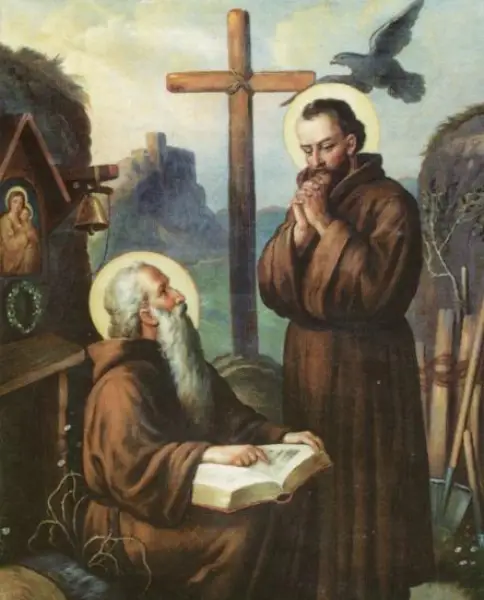
Overview
Benedict of Skalka, also spelled Szkalka, known in Hungarian as Zoborhegyi Szent Benedek and in Slovak as Svätý Benedikt pustovník, was born in Nitra in the tenth century, then part of the Kingdom of Hungary. He became a Benedictine monk at the St. Hippolytus Monastery on Mount Zobor near Nyitra in the late tenth or early eleventh century. During the reign of King Saint Stephen of Hungary he left the monastery to live as a hermit alongside his fellow saint and spiritual teacher, Andrew Zorard. The two settled in a cave by the Váh River near Trencsén, the modern Skalka nad Váhom in Slovakia, leading a life of severe austerity. Andrew died in 1009, and Benedict remained alone in the cave for a further three years. In 1012 a gang of robbers, believing treasure was hidden there, strangled him to death and threw his body into the Váh. A year later the body was recovered from the river, perfectly preserved. In 1083 his relics were translated to St. Emmeram's Cathedral in Nitra, where they still rest, and he was canonized in 1083 or 1085 by Pope Gregory VII. Maurus, Bishop of Pécs, wrote a biography of Benedict and Andrew, and Benedict is honoured for his piety and strict asceticism in Hungary, Poland, Slovakia, and among American emigrant communities.
The Complete Life
A Monk of Mount Zobor
Benedict of Skalka was born in Nitra, in the tenth century, when the town stood in the Kingdom of Hungary; today it lies within Slovakia. His birthplace set him at one of the meeting points of the new Christian order that was spreading through the Danubian basin in his lifetime, for the Benedictine order had reached the region as part of the evangelisation of the Hungarians, and the monastic life it offered gave shape to Benedict's earliest recorded choices. He became a monk at the St. Hippolytus Monastery on Mount Zobor near Nyitra, entering that house in the late tenth or early eleventh century, within a generation of the conversion of the Magyar people. The monastery on Zobor was thus a young foundation in a young church, and Benedict belonged to its first florescence. His years there formed him in the rule and in the liturgy, but they did not hold him to the end. The reign of King Saint Stephen of Hungary, the first Christian king of the Hungarians and the great patron of the Church in that realm, coincided with Benedict's maturity, and under that devout sovereign he made the decision that would define his memory: to leave even the monastic community and go into the wilderness as a hermit.
§ Life
Hermit beside the Váh
The vocation of Benedict of Skalka was the eremitical life, undertaken not alone but under a teacher. He became a hermit with Andrew Zorard, his fellow saint and spiritual master, and the pair made their home in a cave beside the Váh River close to Trencsén, the modern town of Skalka nad Váhom in Slovakia. The site gave the saint the name by which he is best known, Benedict of Skalka or Szkalka, while his Hungarian title, Zoborhegyi Szent Benedek, and the Slovak Svätý Benedikt pustovník, meaning Benedict the hermit, each recall a different aspect of his story. The life the two hermits led there was austere by any measure: a cave for a cell, the river valley for a cloister, and whatever the rough country yielded for sustenance. This form of discipleship, an older monk guiding a younger in the practice of solitude and penance, reproduces the pattern of the desert fathers of the East within the landscape of the Váh valley. Their example belonged to the first age of Hungarian Christianity, when the ideals of the anchoritic tradition, carried by the Benedictines into the new kingdom, were lived out on cliffs above a Slovak river under the protection of a saintly king.
§ Life
Piety and Strict Asceticism
What chiefly survives of Benedict is the character of his holiness: his name became a byword for piety and strict asceticism. The two words summarise a life whose outer history is almost entirely hidden. His asceticism was the discipline of the cave at Skalka, the deliberate embrace of hardship in a cell cut into the rock above the Váh, in imitation of the desert tradition and under the direction of Andrew Zorard. His piety was the inner substance of the same life, the prayer and penitence that filled the hours not spent in the minimal labour of keeping a hermit alive. The tradition of the region attached itself to this combination and kept it alive: the image that preserves him shows him together with St. Andrew Zorard, the master and the disciple united in the memory of the Church, and Maurus, Bishop of Pécs, judged the two lives worth recording in a written biography in the generation after them. That a bishop of Pécs should write the Life of a cave hermit killed by robbers is itself testimony to the impression Benedict's holiness made: the world of courts and cathedrals recognised in the ascetic of the Váh a quality it could not produce and wished to remember.
§ Life
Murder and the Miraculous River
The last chapter of Benedict's life opened with bereavement. Andrew Zorard, his teacher and companion in the hermitage, died in 1009, and Benedict stayed on alone in the cave by the Váh, keeping his solitude for three years more without the human support that had sustained it at the beginning. The end, when it came in 1012, was violent: a gang of robbers, believing that treasure was hidden in the hermit's cave, strangled Benedict to death when he could not, or would not, produce it. The men then dumped his body in the Váh River, disposing of the one witness to their crime. The river, however, refused to keep him. A year later, the body was found perfectly preserved, a finding the piety of the age received as a sign of the holiness of the dead man and as the beginning of his public veneration. The recovered body made possible the cult that followed: a martyr's death by violence, a burial in water, and a recovery that read as divine vindication, the familiar grammar in which the Church has recognised its saints from the earliest centuries. His feast is kept on 1 May.
§ Life
Canonized under Gregory VII
Benedict's formal recognition came within the great wave of Hungarian canonisations of the eleventh century. He was canonized in 1083, or possibly 1085, and the pope who confirmed the canonization was Gregory VII, the great reforming pontiff whose name is attached to the Gregorian reform of the Church. The year 1083 is also the year of the translation of his relics to St. Emmeram's Cathedral in Nitra, where they remain to this day, the cathedral serving as his major shrine and the resting place that has kept his memory anchored to the city of his birth. The pairing of translation and canonization in the same year is characteristic of the medieval process: the raising of a saint's body to a place of honour and the formal entry of the saint into the Church's calendars commonly formed a single act of recognition. His cult in the centuries after has been kept by both the Catholic Church and the Eastern Orthodox Church, which venerates him among the Latin saints of the patriarchate of Rome, an unusual double recognition that reflects the place of medieval Hungary between the Latin and Byzantine worlds.
§ Life
Venerated from the Váh to America
Benedict of Skalka is venerated across a wide arc of Europe and beyond. He is honoured especially in Hungary, Poland, and Slovakia, the three nations that lay claim to the heritage of the medieval Hungarian kingdom in which he lived, and also among the emigrant diasporas in the United States, whose churches carried his name across the Atlantic. His patronage reflects that spread: he is the patron of the sailors of the Váh River, the water that received his body; of the Diocese of Nitra, his home see; of the Diocese of Tarnów in Poland; of St. Andrew Abbey in Cleveland, the Benedictine house named for his master; and of the parish of Ss. Andrew & Benedict in Detroit, where master and disciple stand together in the dedication as they do in the old image of the two hermits. His feast day is 1 May, though some calendars join him to Andrew Zorard on 13 June or 17 July, the commemorations of the two saints intertwined from the beginning. Maurus, Bishop of Pécs, wrote the joint biography that is the root of all later knowledge of him, and his relics at St. Emmeram's in Nitra remain the centre of his cult.
§ Feast Day and Veneration
Timeline
- 1000
Becomes a monk at the St. Hippolytus Monastery on Mount Zobor near Nyitra, around the turn of the tenth and eleventh centuries.
§ Life
- 1009
Andrew Zorard, his spiritual teacher and fellow hermit, dies at the cave by the Váh.
§ Life
- 1012
Is strangled to death by robbers searching for treasure; they dump his body in the Váh River.
§ Life
- 1013
His body is found in the river a year later, perfectly preserved.
§ Life
- 1083
He is canonized by Pope Gregory VII; some sources give 1085 instead.
§ Introduction
- 1083
His relics are translated to St. Emmeram's Cathedral in Nitra, where they remain to this day.
§ Life
The Record
- Patron of
- Sailors of the Váh River·Diocese of Nitra·Diocese of Tarnów·St. Andrew Abbey in Cleveland·Ss. Andrew & Benedict in Detroit
- Symbols
- Hermit's cave·Benedictine habit
- Canonization
- Canonized in 1083 (or 1085) by Pope Gregory VII.
Prayer
Bibliography
Show 3 sources
- Phillips, Fr Andrew. "Latin Saints of the Orthodox Patriarchate of Rome." www.orthodoxengland.org.uk, accessed 30 December 2017.
- Mackenzie, Georgina Muir and Irby, Adelina Paulina. Across the Carpathians. Macmillan, 1862, p. 54.
- "Saint Benedict of Szkalka." Patron Saints Index.
Profile text adapted from the Wikipedia article, licensed CC BY-SA 4.0.
Pray with this saint every day
Save St. Benedict of Skalka to your favorites, read the full profile, and get feast-day reminders in the Saints app.
Get the Saints AppFree on the App Store for iPhone and iPad