
1526 – 1589·Feast April 4
St. Benedict the Moor
Afro-Sicilian Franciscan lay brother and cook
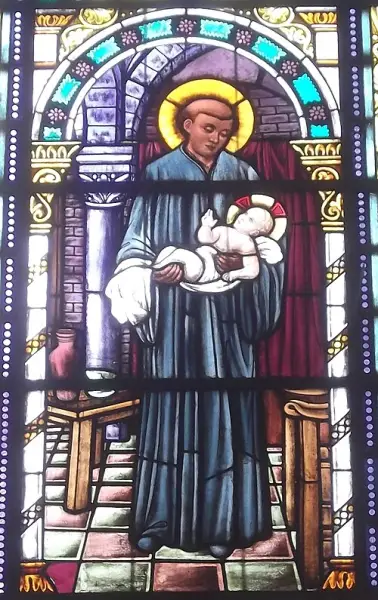
Overview
Benedict the Moor, in Italian Benedetto il Moro, also called Benedict of Palermo, Benedict the Black, or Benedict the African, was an Afro-Sicilian Franciscan friar born in 1526 at San Fratello near Messina in Sicily. His parents, Cristoforo and Diana Manasseri, were Africans taken as slaves to San Fratello in the early sixteenth century; they received Italian names, converted to Christianity, and earned, by loyal service, the freedom of their son before he was born. Illiterate like most peasants of his condition, Benedict worked as a shepherd in youth and gave away his earnings to the poor. At twenty-one he was publicly insulted for his colour, and his forbearance under the abuse drew the notice of the leader of an independent community of hermits on Monte Pellegrino who lived by the rule Francis of Assisi wrote for hermits. Benedict joined them, served as their cook, and at twenty-eight succeeded Jerome Lanze as leader. In 1564 Pope Pius IV disbanded the independent hermit groups, and Benedict became a lay brother of the Order of Friars Minor at the Friary of St. Mary of Jesus in Palermo. There he rose from cook to master of novices and finally Guardian of the community, an extraordinary elevation for an unlettered lay brother, and he guided the order to a stricter observance of the Franciscan Rule. Famous for an intuitive grasp of theology and scripture, sought as a counsellor, and reputed a healer, he returned voluntarily to kitchen duty in later years. He died on 4 April 1589, reportedly at the hour he had himself foretold.
The Complete Life
Son of Slaves in San Fratello
Benedict was born in 1526 at San Fratello, a small town near Messina in Sicily, then under the Crown of Aragon; the place was also known as San Fradello or San Philadelphio, the last of these names surviving in Benedict's Latin designation as a saint of San Philadelphio. His parents, Cristoforo and Diana Manasseri, were Africans carried into slavery in the early sixteenth century and brought to this Sicilian town, where they were given Italian names and later became Christians. Their son's freedom was secured before he was born: his parents were granted freedom for the child because of their loyal service, so that Benedict entered the world free though his parents had not. The Italian epithet il Moro, the dark-skinned one, has been read as pointing to Moorish heritage, and Benedict was additionally called Æthiops or Niger in his lifetime, both terms describing his black skin rather than any modern nationality. Like most peasants of his place and time he never attended school and remained illiterate all his life. As a boy and young man he worked as a shepherd on the hills around San Fratello, and already then showed the bent of his character: he was quick to hand over what he earned to anyone poorer than himself, a habit of almsgiving that never left him.
§ Life
From Insult to the Hermits of Monte Pellegrino
The turning point of Benedict's early manhood came through an act of contempt endured. At the age of twenty-one he was publicly insulted on account of his colour, an experience that in Sicily in the 1540s carried the weight of the whole slave society around him. What witnesses remembered was not the insult but the response: his patience under it caught the attention of the leader of an unaffiliated group of hermits dwelling on nearby Monte Pellegrino, a body that kept the rule Francis of Assisi wrote for hermits. Benedict was soon invited to join, and not long after he renounced every earthly possession and entered the community. His place in it was first the humblest: he served as the cook for the hermits, feeding the men whose prayers structured the community's day. But his gifts could not be confined to the kitchen. At the age of twenty-eight he succeeded Jerome Lanze as leader of the group, governing an eremitical community before he had turned thirty, a former shepherd directing the religious life of men who had chosen the wilderness under the Franciscan rule for hermits. The pattern of his life was already set: humility and authority held together, each proving the other.
§ Life
Lay Brother, Master of Novices, Guardian
In 1564 Pope Pius IV suppressed the independent communities of hermits, directing that they attach themselves to an established religious order, and in Benedict's case the order was the Order of Friars Minor. Thus, in his late thirties, the hermit leader became a Franciscan lay brother, and he was assigned to Palermo, to the Franciscan Friary of St. Mary of Jesus. He began there as he had begun on Monte Pellegrino, in the kitchen as cook. Promotion followed with startling speed for a man who was neither priest nor reader: he was soon appointed master of novices, charged with forming the young men entering the order, and afterwards Guardian, the superior of the whole community. The paradox is a striking one: he discharged these offices though a lay brother and no priest, and though he never learned to read. Benedict accepted the charge and used it, successfully guiding the order into a stricter observance of the Franciscan Rule, so that his guardianship left the community more observant than he found it. His wide respect rested on more than office: he was sought out for counseling by many, and his reputation as a healer of the sick drew still more, so that visitors came continually to the friary to see the black lay brother whom everyone in Palermo seemed to know.
§ Life
Unlettered Wisdom in the Kitchen
The spirituality of Benedict the Moor is a study in the reversal of expectations. A man who could not read was widely respected for a deep, intuitive understanding of theology and scripture, the learning of the schools replaced in him by something the community recognised as gift rather than deficit. People came to him for counsel, bringing the weight of their lives to a cook, and left satisfied; the sick were brought to him because he was reputed a healer; and these characteristics combined to keep a stream of visitors at his door through his years at Palermo. Underneath the fame lay the plain substance of his vocation: charity, the first of his traits, visible from his shepherd days when he gave his wages to the poor. And at the summit of his career came the most telling gesture of all. Having risen from cook to master of novices to Guardian, he chose in his later years to return to kitchen duty, because he enjoyed cooking. The highest office in the friary was laid down for the pot and the fire, and the man who had governed the community ended his days feeding it, a living parable of the last being first and the greatest being the servant of all.
§ Life
A Foretold Death in Palermo
Benedict's final years were spent back at the stove of the Friary of St. Mary of Jesus, the office he had begun in and returned to by choice. He died in 1589 at the age of about sixty-three, and the tradition attached to his death is precise: it is claimed that he died on the very day and at the very hour he had himself predicted, the unlettered cook proving, at the last, a prophet of his own passage. His cell in the friary is still marked: at its entrance stands a plaque bearing the inscription 'This is the cell where Saint Benedict lived', together with the dates of his birth and death given there as 1524 and 1589, though other sources, and the weight of the evidence, place his birth in 1526. His body was laid in the friary church, and his death drew honour from the highest level of the Sicilian crown: King Philip III of Spain commanded a magnificent tomb to hold his remains in the friary church. The claim of incorruption belongs to the years after: his body was said to have been found incorrupt when exhumed a few years after his burial, one of the traditional signs by which the Church has read the holiness of its dead.
§ Life
Beatified and Canonized
Benedict's progress to formal sainthood unfolded across the eighteenth century and the first years of the nineteenth. He was beatified by Pope Benedict XIV, with the year given as 1734 or 1743 in different accounts. The canonization followed in 1807, when Pope Pius VII, in the difficult years of his pontificate, inscribed Benedict among the saints on 24 May. The interval between beatification and canonization, more than sixty years, suggests how gradually his cause advanced, and its completion under Pius VII gave the Church one of its earliest formally canonised saints of African descent. His major shrine was located at the Convent of Santa Maria di Gesù al Capo in Palermo, the city where he had cooked and governed and died. In a sad modern postscript, the church, together with his relics, was largely lost to the Italian wildfires of 2023, so that the material centre of his cult has been lost within living memory, even as his place in the calendar remains. His titles in the Church's records are Religious and Confessor, the latter marking a holiness attested by life rather than by martyrdom.
§ Veneration
Patron of African Americans and the Black Atlantic
Benedict the Moor is remembered first for his patience and understanding in the face of racial prejudice and taunts, the quality that shaped his whole public identity. The Church named him a patron saint of African Americans, together with the Dominican lay brother Martin de Porres, and his patronage extends to African missions, black missions, black people generally, and the Sicilian places of his life: Palermo, San Fratello, Acquedolci, and Sicily as a whole. In the United States at least seven historically Black Catholic parishes bear or bore his name, from the Archdiocese of Washington, where a parish was canonically established in 1946, to churches in New York, Brooklyn, Pittsburgh, Chicago as St. Benedict the African, Dayton, Baton Rouge, San Francisco, and Shreveport. The Savannah parish, established in 1874, is the oldest Catholic church for African Americans in Georgia and among the oldest in the Southeastern United States, and churches bearing his patronage also arose in Columbus, Georgia, and in St. Augustine, Florida. Across Latin America his veneration runs from Mexico to Argentina; in Venezuela his devotion spreads through the states on many local dates; and in Brazil he is cherished in Brazil as a Black saint, born of enslaved Africans, standing for faith, resistance, and dignity among Afro-descendants, and his feast is kept there on 5 October. His principal feast is 4 April, and 3 April in the Franciscan Order.
§ Veneration
Timeline
- 1526
Born at San Fratello near Messina to Cristoforo and Diana Manasseri, enslaved Africans whose loyal service won the unborn boy his freedom.
§ Life
- 1547
After being publicly insulted for his colour at twenty-one, joins the independent hermit community on nearby Monte Pellegrino.
§ Life
- 1554
Succeeds Jerome Lanze as leader of the Monte Pellegrino hermits at age twenty-eight, after serving as their cook.
§ Life
- 1564
Sent to the Franciscan Friary of St. Mary of Jesus in Palermo after Pope Pius IV ordered independent hermit groups to join established orders.
§ Life
- 4 Apr 1589
Dies at the Palermo friary on the day and hour he had predicted; King Philip III of Spain later orders a magnificent tomb for him.
§ Life
- 1743
Beatified by Pope Benedict XIV.
§ Veneration
- 24 May 1807
Canonized by Pope Pius VII.
§ Veneration
The Record
- Major works
- Master of novices and Guardian of the Friary of St. Mary of Jesus, Palermo·Leadership in adopting a stricter observance of the Franciscan Rule
- Patron of
- African missions·African Americans·Black missions·Black people·Palermo·San Fratello·Acquedolci·Sicily
- Symbols
- Cook's pot or kitchen implements·Franciscan lay brother's habit
- Canonization
- Beatified by Pope Benedict XIV in 1734 (the Veneration section gives 1743); canonized by Pope Pius VII on 24 May 1807.
Prayer
Bibliography
Show 7 sources
- Venable, Cecelia Guiterrez. "St. Benedict the Moor (1526-1589)." BlackPast.org.
- "Black Saints: Benedict the Moor." National Catholic Reporter, November 18, 2013.
- Cotter, Holland. "A Spectrum from Slaves to Saints." The New York Times, 9 November 2012, pp. C21 and C28.
- Foley, Leonard, O.F.M. "St. Benedict the African." Saint of the Day, revised by Pat McCloskey, O.F.M. Franciscan Media.
- "St. Benedict the African." AmericanCatholic.org.
- Attwater, Donald and Catherine Rachel John. The Penguin Dictionary of Saints. 3rd edition. New York: Penguin Books, 1993. ISBN 0-14-051312-4.
- "São Benedito: um dos santos mais amados pelos brasileiros." Vatican News, 5 October 2021.
Profile text adapted from the Wikipedia article, licensed CC BY-SA 4.0.
Pray with this saint every day
Save St. Benedict the Moor to your favorites, read the full profile, and get feast-day reminders in the Saints app.
Get the Saints AppFree on the App Store for iPhone and iPad