
c. 1163 – 1184·Feast April 14
St. Bénézet
Shepherd Boy Who Bridged the Rhône at Avignon
Overview
Bénézet, whose name is a Provençal form of Benedict and who also appears in records as Benedict, Benezet, Benet and Benoît, was born around 1163 at Hermillon in Savoy and died in 1184. Christian tradition remembers him as a shepherd boy who, during an eclipse in 1177, received a vision that sent him to Avignon to build a bridge over the Rhône. Assured that the angels themselves would mind his flocks while he was gone, he set about the work alone, for neither the ecclesiastical nor the civil authorities would help him. He heaved a huge stone into position and proclaimed it the foundation's first course, and the shouts of the crowd, crying miracle, greeted the laying of that first stone. Eighteen miracles were counted on that occasion: the blind saw, the deaf heard, cripples walked and hunchbacks stood straight. The spectacle won him wealthy sponsors, who organised themselves as the Bridge-Building Brotherhood to fund the work that became the Pont Saint-Bénézet. He died at about twenty-one and was buried on the bridge itself, in a chapel dedicated to Saint Nicholas, the patron of mariners, raised on one of its piers. When the flood of 1669 swept off part of the bridge, his coffin was rescued and opened, and his body was found incorrupt; the relics were then translated to Avignon Cathedral and afterwards to the Celestine church of Saint Didier. What is left of the bridge still draws pilgrims.
The Complete Life
A Shepherd of Savoy
Bénézet was born around the year 1163 at Hermillon, a village in the Alpine county of Savoy, far upstream from the great river with which his name would be joined. The records give his name in several forms, Benedict, Benezet, Benet and Benoît among them, for Bénézet is simply the Provençal way of saying Benedict, the name of the great monastic father. He was a shepherd boy, and it is as a boy that tradition has always pictured him: young, poor, unknown, keeping flocks in the mountains, with no trade, no learning and no standing that would commend him to the authorities of a great city. Nothing further is recorded of his family or upbringing, and the silence is itself telling. The hagiography of the Middle Ages delighted in precisely this kind of figure, the child or the labourer called by God to a task that kings and bishops declined, and in Bénézet the type found one of its most beloved instances. What the tradition does fix with unusual precision is the hour of his calling: it came during an eclipse, in the year 1177, when the darkening of the sun stamped itself on the memory of all who saw it. For a shepherd watching the light fail over the Alps, the vision that came in that darkness carried a command that would demand everything he had.
§ Biography
The First Stone
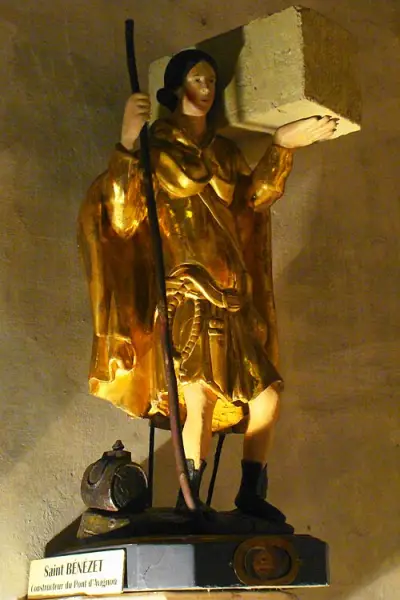
The vision of 1177 sent Bénézet from the pastures of Savoy to Avignon, where the Rhône ran broad and dangerous between the city and the country beyond. He understood himself to be charged with building a bridge across that river, a work that dwarfed the resources of any shepherd, and he was given a promise to carry with him: angels would watch over his flocks during his absence. Neither churchman nor magistrate would lend the project a hand, and so, the tradition states, he built it single-handedly. The moment that turned the tide is preserved with vivid economy. Bénézet heaved an immense stone into position and proclaimed this the seed of the foundation. The crowd answered with shouts of miracle, and the legend counts eighteen wonders on that one occasion: the blind received their sight, the deaf heard again, cripples walked, and hunchbacks found their backs made straight. Whatever history may make of the tally, the consequence is not in doubt. Wealthy sponsors came forward, and they organised themselves into a brotherhood to fund the continuing construction, the Bridge-Building Brotherhood, an association that carried the work forward long after the founder's death. The structure that rose over the Rhône took his name and keeps it still: the Pont Saint-Bénézet.
§ Biography
The Bridge that Remains
Bénézet did not live to see old age; he died in 1184, barely twenty-one years old, having set in motion a work that would outlast him by centuries. His body was laid to rest upon the bridge, within a little chapel of Saint Nicholas, the mariners' patron, raised on one of its piers toward the Avignon side. There his relics rested and were honoured until 1669, when a great flood carried away part of the bridge. The chapel survived on its pier, but the coffin was recovered from the wreckage, and when it was opened the body of the saint was found to be incorrupt, a discovery that confirmed the devotion of the city. The relics were translated first to Avignon Cathedral and afterwards to the Celestine church of Saint Didier, where the cult found a new centre. The bridge itself, repeatedly damaged by the river, survives only in part, yet those remaining arches reaching from the Avignon bank into midstream are among the best-known stones of France, sung in the nursery rhyme that has carried the name of the dance upon the bridge to every land. The ruin remains a pilgrimage site, and the saint who began it as a boy with a stone on his shoulder is honoured as the patron of Avignon, of bachelors, and of all who build bridges, on April 14.
§ Veneration
Timeline
- 1163
Born at Hermillon in Savoy around this time.
§ Introduction
- 1177
As a shepherd boy he saw a vision during an eclipse that summoned him to build a bridge over the Rhône at Avignon; he laid the founding stone amid reported miracles.
§ Biography
- 1184
Died; his remains were laid in a chapel dedicated to Saint Nicholas standing upon the bridge.
§ Veneration
- 1669
A flood swept away part of the bridge; his recovered coffin revealed an incorrupt body, and the relics were translated to Avignon Cathedral and then Saint Didier.
§ Veneration
The Record
- Major works
- Pont Saint-Bénézet (the Bridge of Avignon)
- Patron of
- Avignon·Bachelors·Bridge-builders
- Symbols
- Portrayed as a boy carrying a large stone on his shoulder
- Canonization
- Pre-congregation; venerated in the Catholic Church as patron of Avignon
Prayer
Bibliography
Show 3 sources
- Gross, Ernie. This Day in Religion. New York: Neil-Schuman Publishers, 1990. ISBN 1-55570-045-4.
- "Saints of April 14: Bénézet". External link recorded in the article.
- "L'histoire du Pont St Bénezet" (in French). Archived 2013-05-17 at the Wayback Machine.
Profile text adapted from the Wikipedia article, licensed CC BY-SA 4.0.
Pray with this saint every day
Save St. Bénézet to your favorites, read the full profile, and get feast-day reminders in the Saints app.
Get the Saints AppFree on the App Store for iPhone and iPad