
died 467·Feast November 9
St. Benignus of Armagh
Patrick's Psalm-Singer and Coadjutor Bishop of Armagh
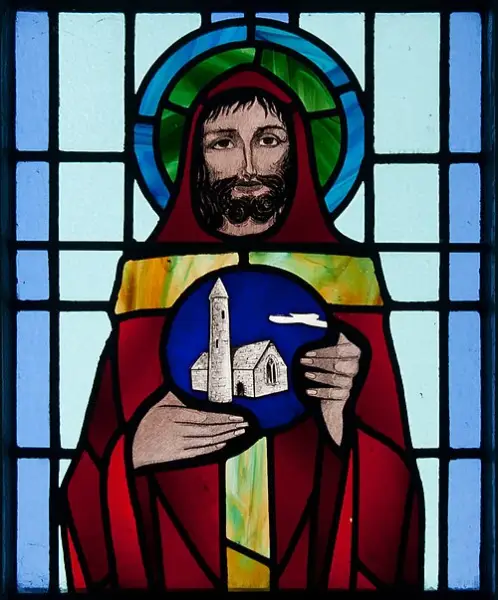
Overview
Benén, a name the Latin writers gave as Benignus, owed his birth to Sesenen, a chieftain whose country lay in what is now County Meath. According to the Tripartite Life, he was a boy of seven when Saint Patrick lodged with his family around 433; the child laid flowers on the sleeping missionary and, in Patrick's prophetic reading of the sign, was claimed as his disciple and eventual heir. Baptised by Patrick himself, he travelled thereafter at the apostle's side, helping to shape the choral worship of the young Irish Church and earning the enduring nickname of Patrick's psalm-singer. Trained from youth in sacred learning and fluent in the native language and scholarship, he served as secretary to the Commission of Nine that compiled the Brehon Laws, and is credited with supplying material for the Psalter of Cashel and the Book of Rights. Around 450 he became Patrick's coadjutor in the Diocese of Armagh, succeeding Sechnall and serving as first rector of the Cathedral School of Armagh. He witnessed the synod whose canon recognised the See of Peter as the final court of appeal, a text preserved in the Book of Armagh. He laid down his office and died in 467; the Church keeps his memory on 9 November each year. His foundation of Kilbennan near Tuam made him patron of Connacht, though medieval collectors such as Tirechán distinguished him from another Benignus of Kilbannon.
The Complete Life
Early Life
Benignus was born Benén, the son of Sesenen, a chieftain who ruled in the district of Ireland now reckoned as County Meath. The most vivid picture of his childhood survives in the twelfth-century traditions and in the Tripartite Life of Saint Patrick. Around 433, so the account runs, Patrick came preaching into the country around Bray or onto the island that bears his name and resolved to keep the coming Easter with one of the local households. He stayed under the roof of Sesenen, whose family accepted baptism on the spot. In that house was a little son of seven years. While the saint slept, the boy laid flowers upon him and was scolded for the liberty; Patrick, however, read in the gesture a sign of coming holiness, and prophesied that the child would one day succeed him as a great bishop. From that hour the boy clave to the missionary, and when the time came to depart he begged to go along. Patrick took him, gave him the Latin name Benignus on account of his mild and winning disposition, and proclaimed him his heir. Whatever legendary colouring the story carries, it preserves the plain fact that Benignus belonged to the first generation of Irish children raised inside the new faith, taken from a pagan noble house and given wholly to the Church while still young.
§ Benén and Patrick
Vocation
The vocation of Benignus was inseparable from the person of Patrick. Baptised by the apostle and attached to him from childhood, he followed his master through all his journeys and shared the burdens of the missionary work. His people, perhaps, were of the bardic order, Ireland's hereditary race of learned men, which would explain both the boy's readiness at language and his later fame in the Church's song. His gentle character, noted by his earliest biographers, suggested the name Benen, which Latin writers rendered as Benignus, the kindly one. Out of his musical gifts grew the title by which he was longest remembered, Patrick's psalm-singer: he assisted in forming the choral services of the infant Irish Church, setting the psalms at the centre of its daily prayer. Because Patrick had trained him from youth in sacred learning, and because he commanded both the tongue and the scholarship of his own people, he was appointed secretary to the Commission of Nine, the body directed a few years earlier to compile the native Brehon Laws. Around the year 450 his long apprenticeship bore its full fruit when he was made coadjutor in the Diocese of Armagh, succeeding Sechnall, Patrick's own nephew, and taking charge as first rector of the Cathedral School of Armagh.
§ Life
Mission
The mission of Benignus was carried forward on three fronts: teaching, lawgiving and foundation. As first rector of the Cathedral School of Armagh he stood at the head of the church's learning in Ireland, and the tradition credits him with contributing materials to two of the most treasured compilations of medieval Ireland, the Psalter of Cashel and the Book of Rights. His work as secretary to the Commission of Nine placed a Christian scholar at the heart of the codification of the Brehon Laws, wedding the native jurisprudence to the new faith. He likewise witnessed the synod that passed the canon naming Peter's apostolic See the ultimate tribunal for difficult causes, a decision recorded in the Book of Armagh and one of the earliest Irish testimonies to Roman primacy. Beyond Armagh he planted monasteries: most sources name him as founder of Kilbennan in East Galway close to Tuam, the foundation that made him patron of Connacht, though Tirechán's collections in the Book of Armagh give Kilbannon instead to a Benignus son of Lugni of Connaught. In Cavan he established a house on Drom Benen, the hill of Benan, today's Drumbannon, and further churches at Kilbonane in West Cork keep his name.
§ Life
Spirituality
The legends that gathered around Benignus all turn upon the same spiritual centre: purity given to God and protected by God. In the Deer's Cry episode of 433, Patrick clashed with King Laoghaire at Tara after lighting the Paschal fire on the hill of Slane in defiance of the injunction against fires for the Feast of Tara. Warned by his druids that the fire would burn forever unless quenched before midnight, Laoghaire sought Patrick's death and later laid an ambush. Patrick blessed his company with the Lorica now called Saint Patrick's Breastplate, and under cover of darkness they passed to Tara; the ambushers made out only eight deer and one fawn carrying a bundle upon its back, the fawn being Benignus carrying Patrick's Epistolary. In the trial by fire that followed the conflict, a pagan druid and the young Benignus were shut into a timber building, one side stacked with dry wood and the other green, each wearing the other's garments. Benignus was chosen, the story explains, because his recent baptism had cleansed him from sin. The druid's side burned to ash while the boy came out untouched, and at that turning point Christian teaching was established in the land. The Tripartite Life and the Martyrology of Donegal add the tale of Earcnat, daughter of Dáire, who desired him and died; sprinkled with holy water brought from Patrick, she returned to life, loved him spiritually and vowed chastity.
§ The Deer's Cry
Final Years
The closing chapter of Benignus's life is briefly told but full of significance for the Irish Church. After serving as coadjutor at Armagh and presiding over its cathedral school, he laid down his office in 467 and died within the same year, the first peaceful succession of the new hierarchy in Ireland. His death closed a career that had begun as a child's offering of flowers and ended with the ordered transmission of Patrick's authority. Later generations, unwilling to let so beloved a figure remain a name in a list, drew his story into the wider heroic age of Irish Christianity; and the compilers of the twelfth century in particular retold the legends of his youth with fresh detail. A shadow of doubt hangs over some of the attributions: most authorities have equated Patrick's singer of psalms with the Kilbannon founder near Tuam, whereas Tirechán's collections in the Book of Armagh make that Benignus the son of Lugni of Connaught, a man whose famous monastery educated Jarlath and who presided over Drumlease, with a sister Mathona serving as abbess of Tawney in Tirerrill. The medieval habit of merging worthy names is familiar, and it takes nothing from the substance of his sanctity.
§ Life
Legacy
Benignus left his mark upon Ireland in names still on the map and in the devotional memory of Connacht. Kilbennan in East Galway, close to Tuam, remembers his foundation, and through it he became patron of the whole province. In Cavan the hill of Drom Benen, today's Drumbannon, preserves his memory, and the church of Kilbonane in West Cork carries his name into the far south, though the latter tradition awaits fuller documentation. The Book of Armagh, which records the synod canon he witnessed, stands among the greatest manuscripts of the Irish Church, and his association with the Psalter of Cashel and the Book of Rights ties him to the scholarly machinery of early Christian Ireland. The archiepiscopal succession of Armagh lists him as Benén mac Sescnén, fourth in the line from Patrick, and his feast is kept on 9 November in both the Roman Catholic and the Eastern Orthodox calendars. Modern scholars continue to weigh the old question of his identity with the founder of Kilbannon, a reminder that the sources for fifth-century Ireland are thin and treasured at once. What endures beyond the scholarly quarrels is the picture of the boy who chose the wandering apostle over his father's house and sang the psalms into the heart of a nation.
§ Life
Timeline
- 426
Born to the chieftain Sesenen in what is now County Meath — the tradition makes him about seven years old in 433.
§ Benén and Patrick
- 433
Baptized along with his whole household when Patrick celebrated Easter among them; the boy attached himself to the saint, who named him Benignus and declared him his heir.
§ Benén and Patrick
- 433
In the Deer's Cry legend he walks unseen through Laoghaire's ambush at Tara, figured as the fawn bearing Patrick's Epistolary.
§ The Deer's Cry
- 433
Legend recounts that he stood unharmed in a trial by fire against a pagan druid after the conflict with King Laoghaire.
§ Trial by Fire
- 450
Around this year he became Patrick's coadjutor in the Diocese of Armagh and first rector of its Cathedral School.
§ Life
- 467
Laid down the coadjutorship of Armagh and died before the year was out.
§ Life
In Their Own Words
Patrick's psalm-singer
The Record
- Major works
- Contributed materials for the Psalter of Cashel·Contributed materials for the Book of Rights·Served as secretary to the Commission of Nine compiling the Brehon Laws·Helped in the formation of choral services in the early Irish Church
- Patron of
- Patron of Connacht, through his foundation of Kilbennan near Tuam
- Symbols
- A fawn bearing a bundle, from the Deer's Cry legend·Surviving chasuble from the trial by fire
- Canonization
- Pre-congregation; venerated from antiquity in the Irish Church
Prayer
Bibliography
Show 7 sources
- Farmer, David (2004). Oxford Dictionary of Saints. Oxford University Press. p. 53. ISBN 978-0-19-860949-0.
- Grattan-Flood, William. "St. Benignus." The Catholic Encyclopedia. Vol. 2. New York: Robert Appleton Company, 1907.
- Healy, John. "The School of Armagh." The Catholic Encyclopedia. Vol. 1. New York: Robert Appleton Company, 1907.
- Wilhelm; Winterbottom, Michael; Thomson, Rodney M. (2007). Saints' lives: lives of SS. Wulfstan, Dunstan, Patrick, Benignus and Indract. Oxford medieval texts (Reprinted ed.). Oxford: Clarendon Press. ISBN 978-0-19-820709-2.
- Webb, Alfred (1878). A compendium of Irish biography: comprising sketches of distinguished Irishmen, and of eminent persons connected with Ireland by office or by their writings. Dublin: M.H. Gill & son.
- "THE TRIPARTITE LIFE OF PATRICK". The Tripartite Life of Patrick. Cambridge University Press. 15 November 2012. p. v-viii. doi: 10.1017/cbo9781139382878.002. ISBN 978-1-108-05322-8.
- O'Clery, Michael; O'Donovan, John; Reeves, William; Todd, James Henthorn (1864). The martyrology of Donegal: a calendar of the saints of Ireland. Dublin: Printed for the Irish Archaeological and Celtic Society by A. Thom.
Profile text adapted from the Wikipedia article, licensed CC BY-SA 4.0.
Pray with this saint every day
Save St. Benignus of Armagh to your favorites, read the full profile, and get feast-day reminders in the Saints app.
Get the Saints AppFree on the App Store for iPhone and iPad