
trad. died c. 270–275·Feast November 1
St. Benignus of Dijon
Martyr and First Herald of Christianity at Dijon
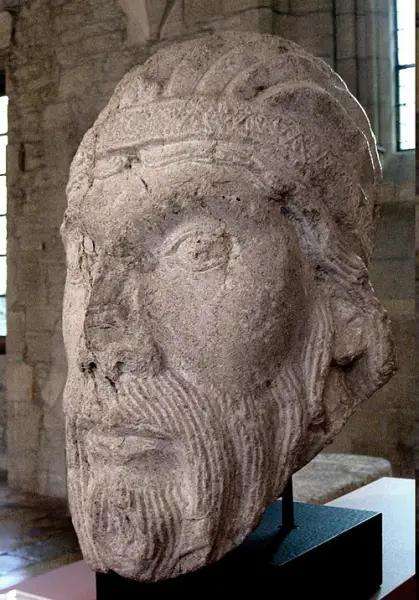
Overview
Benignus of Dijon, the French Saint Bénigne, is honoured as the patron saint and the first preacher of the Gospel at Dijon in Burgundy, the Roman Divio. Nothing certain about the man himself was known at Dijon even in the Middle Ages; he may have been a priest missionary out of Lyon, martyred at Épagny near the city. The sixth-century Passio Sancti Benigni gives the fuller legend: a native of Smyrna, sent westward by Polycarp after a vision of the dead Irenaeus, shipwrecked off Corsica, landed at Marseille, and travel-stained up the Rhône and Saône to Autun, where he won over Symphorianus, the son of the noble Faustus. Preaching alone through Gaul and working miracles under persecution, he was denounced to the Emperor Aurelian, arrested at Épagny, and refused to sacrifice to the pagan gods or to Caesar; after savage torture he was clubbed to death with an iron bar and his heart pierced. His tomb, disguised as a pagan monument, was overlooked until a night vision revealed it to Saint Gregory, bishop of Langres, who restored the sarcophagus and raised a basilica over it. Saint Benignus' Abbey grew on the site, joined the Cluniac order, and was rebuilt by William of Volpiano; the present Dijon cathedral, dedicated to Benignus, still shows his purported sarcophagus in the crypt. Modern critics, led by Louis Duchesne, judge the acta historically worthless, but the cult endures, with his feast kept on November 1.
The Complete Life
Early Life
The historical Benignus is almost wholly hidden from us. The oldest local tradition at Dijon knew nothing definite about his person or career; Butler's later editors record only that his nationality is doubtful, that little seems to have been known of him locally, and that he was traditionally held to have carried the Gospel through Burgundy. One plausible guess makes him a missionary priest from Lyon who was put to death at Épagny near Dijon. Everything else comes from the sixth-century Passio Sancti Benigni, which supplies a birthplace and a calling. In that account Benignus was born at Smyrna in Asia Minor and stood within the circle of Polycarp, the aged bishop of that city. Polycarp one night received a vision of Saint Irenaeus, already dead, and took the apparition for a command to send preachers to Gaul. He therefore despatched Benignus together with two priests and a deacon to carry the Gospel westward. It is a genealogy designed to attach a Gallic martyr to the apostolic age through the great chain of Smyrna, Polycarp and Irenaeus; as Butler observes, the historical Irenaeus of Lyon outlived Polycarp by some fifty years, which makes the vision chronologically impossible. Yet the story fixed itself, and it gave Dijon an apostle of venerable pedigree.
§ The Passio of Saint Benignus
Vocation
The mission to Gaul, as the Passio tells it, began in shipwreck. The little company from Smyrna was wrecked on Corsica yet contrived to reach Marseille, and from there worked their way inland along the Rhône and then the Saône. Reaching Autun, they preached with such effect that they converted Symphorianus, the son of the noble Faustus; the young man was afterwards martyred for his faith and is honoured as Saint Symphorian. At this point the companions fall out of the narrative and Benignus goes on alone, an itinerant priest carrying the faith through the towns and countryside of Gaul. The vocation the legend assigns him is that of the solitary missionary: no See, no community named after him in his lifetime, only open proclamation of Christ in a land still largely pagan, attended by numerous miracles even while the persecution of Christians raged. Whatever the historical kernel, the picture answers to what is known of second- and third-century evangelisation in the Rhône valley, which spread from Lyon outward through the river towns. A preacher from the churches of Asia or of Lyon, working the road between Autun and Divio, is exactly the sort of man whose grave a later generation would discover beneath its own feet.
§ The Passio of Saint Benignus
Final Years
The end of Benignus, in the Passio, is a courtroom and an execution. Denounced to the Emperor Aurelian, he was arrested at Épagny and brought to trial. The charge was the usual one and the demand the usual one: sacrifice to the pagan deities and to Caesar, and deny Christ. Benignus would do neither. The authorities answered with savage torture, to which, the account says, he responded with fresh miracles, and his resolve never wavered. His death at last was dealt with a bar of iron, his heart run through, and he was buried in a tomb deliberately made to look like a pagan monument so as to deceive the persecutors. The stratagem succeeded only too well: the grave lay forgotten for centuries among the tombs of the great cemetery outside the Roman town. Kirsch notes that for some unknown reason the death is assigned to the persecution under Aurelian, in the years 270 to 275, though Butler observes that Aurelian's own coming to Gaul fell roughly a century after Polycarp died, and Polycarp was supposed to have sent Benignus on his mission. The date, like the pedigree, is a sixth-century construction; the martyrdom itself, stripped of its impossible frame, remains the city's oldest Christian memory.
§ The Passio of Saint Benignus
Spirituality
The spiritual heart of the Benignus legend lies not in the martyr's own words, of which none are recorded, but in the history of his grave. Gregory of Tours relates that the common people reverenced the tomb, while his great-grandfather Saint Gregory, bishop of Langres from 507 until 539 or 540, at first wished to suppress the veneration, believing the burial to be a heathen's. In a night vision the bishop learned instead that the spot, in the great necropolis outside the Roman city, was the overlooked grave of Benignus. He thereupon had the tomb with its sarcophagus restored and raised a basilica over it. The story is a small parable of popular devotion outpacing official caution, and of discernment: a bishop willing to be corrected by a dream, and a cult received once the claim was tested. Benignus's own spiritual character, as the Passio draws it, is simply constancy under suffering, the refusal to trade incense for safety; and the abiding attraction of the shrine, which drew pilgrims before any clergy blessed it, is offered as the proof of the man. In Dijon the saint is invoked as the city's patron, his intercession sought at the cathedral that carries his name, and his emblem of the dog speaking fidelity, and the key speaking the unlocking of heaven's gate.
§ Life
Legacy
The legacy of Benignus is written in stone at Dijon. Saint Benignus' Abbey grew up around Gregory's basilica and entered the Cluniac obedience; its early eleventh-century abbot William of Volpiano, who died in 1031, raised a yet larger church. A Romanesque basilica then displaced Gregory's own building; when it fell in 1272 the cathedral that stands today, dedicated to the saint, took its place. The shrine rode out both the earthquake of 1280 and the Revolution, and pilgrims to the crypt may still look upon the sarcophagus claimed as his. The scholarly legacy is more sobering. In the time of Gregory of Tours there was a sudden appearance of acta narrating the martyrdom, said to have reached Dijon from Italy in a pilgrim's baggage, though seemingly given final shape in the city during the sixth century. Louis Duchesne demonstrated that these acta head a whole family of legends, born in the first years of the sixth century to advertise the antiquity of Christianity in the cities of the region, among them Besançon, Autun, Langres and Valence; the tales lack historical worth, and whether some of the martyrs linked to these cities ever lived is itself uncertain. The cult nonetheless stands, and with it the feast of November 1, shared with All Saints.
§ Life
Timeline
- 275
Martyred in the persecution under Aurelian: seized at Épagny, tried, tortured, then clubbed to death with an iron bar
§ Life
- 500
Acta and the Passio Sancti Benigni legend-cycle take shape at Dijon in the early sixth century
§ Critique
- 507
Bishop Gregory of Langres, whose episcopate began in 507, identifies the forgotten grave through a night vision, restores the sarcophagus, and raises a basilica
§ Life
- 1031
William of Volpiano, the abbey's early eleventh-century abbot who died in 1031, has built a larger church on the site
§ Life
- 1272
The Romanesque basilica collapses; the present Dijon cathedral, dedicated to Benignus, rises in its place
§ Life
- 1280
The shrine in the new cathedral comes through an earthquake, and later survives the French Revolution
§ Life
In Their Own Words
They are all falsifications by the same hand and possess no historical value.
The Record
- Patron of
- Dijon, Burgundy·First herald of Christianity at Dijon
- Symbols
- Dog at his side·Key in hand
- Canonization
- Pre-congregation; ancient cult at Dijon, his name entered under November 1 in the Martyrology of St. Jerome
Prayer
Bibliography
Show 6 sources
- Ed. Rossi-Duchesne; cf. Acta Sanctorum, November, I, 138.
- Sarah Fawcett Thomas, David Hugh Farmer, Paul Burns, eds. Butler's Lives of the Saints, First Full Edition: November, (1997) s.v. "1: St. Benignus of Dijon, Martyr (?Third Century)", p 2f.
- Kirsch, Johann Peter. "St. Benignus of Dijon." The Catholic Encyclopedia Vol. 2. New York: Robert Appleton Company, 1907.
- Gregory of Tours, De gloriâ martyrum, I, li.
- Duchesne, Fastes épiscopaux de l'ancienne Gaule, I, pp 51–62, noted in Butler 1997.
- Drake, Maurice and Drake, Wilfred. Saints and their Emblems, page 18.
Profile text adapted from the Wikipedia article, licensed CC BY-SA 4.0.
Pray with this saint every day
Save St. Benignus of Dijon to your favorites, read the full profile, and get feast-day reminders in the Saints app.
Get the Saints AppFree on the App Store for iPhone and iPad