
1873 – 1922·Feast July 31
St. Benjamin of Petrograd
Hieromartyr and Metropolitan of Petrograd under Soviet Persecution
Overview
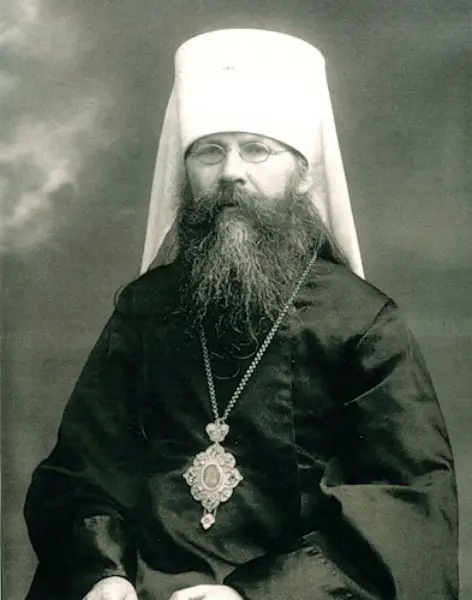
Benjamin of Petrograd, born Vasily Pavlovich Kazansky on 29 April 1873 in a priestly family of the Olonets Governorate in the far northwest of the Russian Empire, became a hieromartyr of the Russian Orthodox Church under Soviet anti-religious persecution. Tonsured a monk in 1895 and ordained priest the following year, he taught and administered in theological schools for two decades, rising to rector of the St. Petersburg Spiritual Academy in 1905 and to the episcopate as vicar Bishop of Gdov in 1910, where he served the poorest suburbs of the capital and was called the indefatigable bishop. In 1917 he became the first bishop in the Russian Church to be popularly elected by clergy and people, rising to Metropolitan of Petrograd and Gdov. Through the revolution and civil war he kept an apolitical stance, leading nonviolent resistance to the confiscation of church valuables during the famine of 1921 while offering voluntary donations for the starving. When the state-backed Renovationist Living Church moved to seize his see in May 1922, he anathematized its clergy as schismatics and was arrested, tried before a drumhead revolutionary tribunal from 10 June to 5 July, and, after a speech forgiving his judges, was shot in the night of 12 to 13 August 1922 near the Porokhov Station outside Petrograd, together with Archimandrite Sergius (Shein), Professor Yury Novitsky and the lawyer John Kovsharov. He was canonized in 1992 and is venerated throughout Eastern Orthodoxy.
The Complete Life
Early Life
Vasily Pavlovich Kazansky was born on 29 April 1873, old style 17 April, into a priestly household in the village-pogost of Nimenskii, Andreevskii volost, Kargopolsky Uyezd, not far from Arkhangelsk, in the Olonets Governorate of the Empire's far northwest. The son and grandson of parish priests, he followed the well-worn road of the clerical estate through its schools to its seminaries. He completed the course at the Olonets Theological Seminary in 1893 and proceeded to the St. Petersburg Spiritual Academy, from which he graduated in 1897 with the degree of candidate of theology, defending a thesis on the anti-heretical labours of Archbishop Arcadius of Olonets. Two years before graduating, in 1895, he received the monastic tonsure and with it the name Benjamin, diaconal ordination following within the year and the priesthood, as hieromonk, the year after. The pattern of the man was set early: scholarship placed at the service of the Church, the cross taken on voluntarily, and the north country, poor and devout, never far from his sympathies. His formation belonged to the last generation of the old Russian ecclesiastical world, the world that the revolution would sweep away in his middle age.
§ Early life
Vocation
The vocation of Benjamin was first that of a teacher in the Church's schools. After graduating in 1897 he taught sacred scripture at the Riga Theological Seminary for a year, then served as inspector of the Kholm Theological Seminary from 1898 to 1899 and of the St. Petersburg Spiritual Academy from 1899 to 1902. In 1902 he was appointed rector of the Samara Theological Seminary and bestowed with the rank of archimandrite, and in 1905 he returned to the capital as rector of the St. Petersburg Spiritual Academy itself. The episcopate came on 6 February 1910, old style 24 January, with his consecration as Bishop of Gdov, auxiliary to the St. Petersburg diocese, Metropolitan Antonii (Vadkovskii) of St. Petersburg and Ladoga performing the rite in the Alexander Nevsky Lavra. As vicar he made the office his own by going where the dignity of the rank was least seen: his services were most often in the city's poorest and remotest outskirts, and at the Putilovsky and Obukhovsky works he himself officiated at the great Easter and Christmas liturgies each year, besides founding the Mother of God charity that cared for abandoned women. People came to call him, simply, the indefatigable bishop.
§ Vicar Bishop
Mission
The mission of Benjamin as metropolitan began in the upheavals of 1917. When Metropolitan Pitirim (Onkova) was arrested and deposed on 15 March, the diocese passed into his hands as vicar; on 6 June the clergy and laity chose him by vote for the see of Petrograd and Ladoga, the first popular election of a bishop in the Russian Church; a Synod decree of 30 June restyled him Archbishop of Petrograd and Gdov, and on 26 August he was raised to the metropolitan dignity. Amid persecution he led a religious revival: Exarch Leonid Feodorov wrote to Pope Pius XI that Orthodox priests who had once seemed struck dumb were preaching well, that women's study circles carried instruction in the Bible, church history, the fathers, doctrine and morals, apologetics and the liturgy, and that the flame of fervour was spreading fast. Unlike many bishops who backed the Whites, Benjamin kept a purely apolitical stance, even offering to suspend any priest of his diocese who aided the White Movement if the Soviet state refrained from desecrating the relics of St Alexander Nevsky. During the famine of 1921 he was willing to donate church valuables voluntarily, met a famine-relief commission on 6 March, and on 5 March 1922 signed an agreement to surrender even Eucharistic chalices, provided the Church could deconsecrate and melt them down itself before witnesses, with parishioners allowed to substitute their own valuables. When the state reneged and raids provoked stone-throwing protests, he demanded proof that other revenues were exhausted and Patriarch Tikhon's signed consent before further confiscations.
§ Metropolitan of Petrograd
Spirituality
The spiritual character of Metropolitan Benjamin can be read in the reaction of the city to his ministry and in his own words from prison. Witnesses of the Petrograd of those years describe churches swollen with people: Dmitri Likhachev, then a devout young layman, recalled that persecution of the Church began almost with the October seizure of power and was so intolerable to any Russian that many unbelievers began attending, and that services in the remaining churches were conducted with especial devoutness, the choirs swollen by singers from the Mariinsky opera. An old woman at the Kazan Cathedral told the writer Isaak Babel that the Metropolitan himself had conducted the services and that the workers came too, finding in the church quiet and singing. Benjamin's own spirituality was one of surrender to the divine will. Suffering, he wrote, is hard, yet God's consolation flows in measured to what a man endures; the one who gives himself wholly to God's will scarcely feels the greatest sufferings, but filled with inner peace draws others to imitate him. At the trial he answered with a single act of thanksgiving, blessing God for all things, whatever the verdict, life or death. The words were remembered because they were kept.
§ Quotes
Final Years
The last months of Benjamin's life were a sequence of confrontation, arrest and judicial murder. In May 1922 Alexander Vvedensky and Vladimir Krasnitsky of the state-controlled Living Church came to Petrograd to win the see for the Renovationists. Benjamin, confident of his flock, proposed an open meeting at the Alexander Nevsky Lavra at which both sides would speak and the people would vote. On Sunday 28 May 1922 Vvedensky denied the divinity of Christ and the virginity of Mary before the assembled clergy and laity, and Krasnitsky praised the Living Church's rejection of infant baptism, of the veneration of saints and relics, and its permission of married bishops and remarried priests. After quieting the outraged crowd, Benjamin accused the Living Church of reviving the fourth-century heresy of Arianism and anathematized its clergy and laity as schismatics and heretics; Vvedensky slipped out to GPU agents waiting outside, who burst in and arrested the metropolitan despite the audience's efforts to shield him. Instead of yielding, Benjamin issued a pastoral letter on 29 May forbidding Vvedensky and all Living Church priests from administering the sacraments in the diocese until they repented before Patriarch Tikhon. Tried with ten others from 10 June to 5 July before a drumhead revolutionary tribunal on charges of anti-Soviet agitation, he blessed the crowds who stood for him, and defence witnesses were arrested as they came forward. Found guilty as dangerous foes of the Republic, six sentences were commuted by the Politburo, but not his. In the night of 12 to 13 August 1922, shaved and dressed in rags so the firing squad would not know they were shooting clergy, he and Archimandrite Sergius (Shein), Professor Yury Novitsky and the lawyer John Kovsharov were shot near the Porokhov Station of the Irinovskaya railroad east of Petrograd.
§ Martyrdom
Canonization
The glorification of Benjamin came at the end of the Soviet era and in part because of it. The hierarchy of the Russian Orthodox Church Outside Russia, formed among the anti-communist emigration, had already declared saints the Orthodox victims of the Red Terror long before the Soviet collapse, while the Moscow Patriarchate, whose leadership passed in 1926 to the former Renovationist and police informant Metropolitan Sergei (Stragorodsky), had embraced a policy, condemned by other jurisdictions as the heresy of Sergianism, of declaring the Soviet state just in all its actions. Covert veneration of Benjamin and the other new martyrs nonetheless continued within the Moscow Patriarchate through the decades of silence. The political thaw made official recognition possible: on 1 October 1990 the USSR's Supreme Soviet formally abandoned the Marxist-Leninist war on religion of the preceding seventy years and granted freedom of worship and equality before the law to all denominations. In April 1992 the Council of Bishops of the Russian Orthodox Church, meeting at the Danilov Monastery in Moscow, formally canonized Metropolitan Benjamin as a saint and hieromartyr, together with Archimandrite Sergius (Shein), Professor Yury Novitsky and John Kovsharov, who had been executed with him. The canonization decree ordered that, if their precious remains were ever recovered, they were to be honoured as holy relics.
§ Legacy
Legacy
The legacy of Benjamin of Petrograd is bound up with the memory of the whole body of the new Russian martyrs. News of his execution devastated even those separated from him by confession and by quarrel: the news shattered Exarch Leonid Feodorov and his superiors at the Vatican alike, despite the theological differences and the recent collapse of their friendship, and Captain Francis McCullagh, the Irish Catholic correspondent of the New York Herald, tried repeatedly to make the world aware of the trial and execution, finding every dispatch suppressed by the censor, and insisted that Benjamin had suffered martyrdom no less truly than Budkiewicz. His cenotaph stands in the Nikolskoe Cemetery of the Alexander Nevsky Lavra, where he had been consecrated and where he had faced down the Renovationists, and pilgrims venerate there the metropolitan whom his own generation called indefatigable. His feast is kept on 31 July, the day of his death by the old calendar, and again on the Sunday on or following 25 January with the Synaxis of the New Russian Martyrs and Confessors. For the Russian Church he stands as the emblem of the bishop who would not surrender his see to the state, who forgave his judges from the dock, and whose thanksgiving in the face of death, glory to God for everything, became the watchword of a church that outlived its persecutors.
§ Legacy
Timeline
- 29 Apr 1873
Born Vasily Pavlovich Kazansky (29 April N.S., 17 April O.S.) to a priestly family in the Olonets Governorate
§ Introduction
- 1893
Graduates from the Olonets Theological Seminary
§ Early life
- 1895
Tonsured a monk with the name Benjamin and ordained hierodeacon the same year
§ Early life
- 1896
Ordained hieromonk (priest-monk)
§ Early life
- 1897
Takes his theology candidate's degree at the St. Petersburg Spiritual Academy, defending a thesis on the anti-heretical work of Archbishop Arcadius of Olonets
§ Early life
- 1902
Becomes rector of the Samara Theological Seminary and is raised to archimandrite
§ Early life
- 1905
Becomes rector of the St. Petersburg Spiritual Academy
§ Early life
- 6 Feb 1910
Consecrated Bishop of Gdov, a vicar of the St. Petersburg diocese, at the Alexander Nevsky Lavra
§ Vicar Bishop
- 15 Mar 1917
After Metropolitan Pitirim's arrest and deposition, he administers the Petrograd diocese as vicarial Bishop of Gdov
§ Metropolitan of Petrograd
- 6 Jun 1917
Chosen by clergy and laity as Archbishop of Petrograd and Ladoga, the Russian church's first bishop selected by popular vote
§ Metropolitan of Petrograd
- 30 Jun 1917
His title is changed by decree of the Holy Synod to Archbishop of Petrograd and Gdov
§ Metropolitan of Petrograd
- 26 Aug 1917
Elevated to Metropolitan of Petrograd and Gdov
§ Metropolitan of Petrograd
- 5 Mar 1922
Signs an agreement with Petrograd party officials on handing over church valuables, on condition the Church may deconsecrate the vessels itself
§ Metropolitan of Petrograd
- 28 May 1922
At the Alexander Nevsky Lavra he anathematizes the Living Church clergy as schismatics and heretics, and is arrested by GPU agents
§ Arrest
- 29 May 1922
Issues a pastoral letter forbidding Vvedensky or any Living Church priest to administer the sacraments in his diocese
§ Arrest
- 10 Jun 1922
His drumhead trial before a revolutionary tribunal, with ten co-defendants, opens; it runs to 5 July and ends in a death sentence
§ Show trial
- 13 Aug 1922
Executed by firing squad in the night of 12-13 August at Porokhov Station, with Sergius, Novitsky and Kovsharov
§ Martyrdom
- Apr 1992
Glorified (canonized) by the Russian Orthodox Church together with the companions executed alongside him
§ Introduction
In Their Own Words
Regardless of what my sentence will be, no matter what you decide, life or death, I will lift up my eyes reverently to God, Cross myself and affirm, 'Glory to Thee my Lord; glory to Thee for everything!'
It is difficult, hard to suffer, but according to the measure of my sufferings, consolation abounds from God...
The Record
- Major works
- Thesis on Archbishop Arcadius of Olonets' anti-heretical activities (1897)·The charitable foundation of the Mother of God for the Care of Abandoned Women·Pastoral letter of 29 May 1922 forbidding Renovationist clergy the sacraments
- Patron of
- Venerated among the New Martyrs and Confessors of Russia
- Symbols
- Metropolitan's white klobuk and panagia·Blessing the crowd from the dock of the 1922 tribunal
- Canonization
- Glorified as a hieromartyr by the Russian Orthodox Church on 4 April 1992 at the Danilov Monastery, Moscow
Prayer
Bibliography
Show 12 sources
- "Proclamation of the Holy Council of Bishops of the Russian Orthodox Church of Canonization". Retrieved 2012-10-25.
- "Lives of the Saints — July 31 — Hieromartyr Benjamin the Metropolitan of Petrograd and Gdovsk". Retrieved 2012-10-25.
- Paul Gabel (2005), And God Created Lenin: Marxism vs. Religion in Russia, 1917-1929, Prometheus Books.
- Roslof, Edward E. (2002). Red Priests: Renovationism, Russian Orthodoxy, & Revolution, 1905–1946. Bloomington: Indiana University Press.
- Dmitri S. Likhachev (2000), Reflections on the Russian Soul: A Memoir, CEU Press.
- Fr. Paul Mailleux, S.J. (2017), Blessed Leonid Feodorov: First Exarch of the Russian Catholic Church; Bridgebuilder between Rome and Moscow, Loreto Publications.
- Edited by Nathalie Babel, The Complete Works of Isaac Babel, W.W. Norton and Company.
- Francis McCullagh (1924), The Bolshevik Persecution of Christianity, London.
- Walter Kolarz (1966), Religion in the Soviet Union, St Martin's Press.
- Christopher Andrew and Vasili Mitrokhin (1999), The Sword and the Shield: The Mitrokhin Archive and the Secret History of the KGB, Basic Books.
- "Дело" митрополита Вениамина (Петроград, 1922 г.). М., 1991.
- Manuil (Lemeševskij). "Die russischen orthodoxen Bischöfe von 1893 bis 1965": Bio-Bibliogr. Erlangen, 1981. T. 2. S. 142–145.
Profile text adapted from the Wikipedia article, licensed CC BY-SA 4.0.
Pray with this saint every day
Save St. Benjamin of Petrograd to your favorites, read the full profile, and get feast-day reminders in the Saints app.
Get the Saints AppFree on the App Store for iPhone and iPad