
c. 329 – c. 424·Feast March 31 (October 13 in the Byzantine Rite)
St. Benjamin the Deacon
Persian Deacon and Martyr who Refused Silence
Overview
Benjamin was a deacon of the church in Persia, born around 329 and put to death around 424 during one of the longest persecutions Christians of that country endured. The persecution lasted some forty years and spanned two royal reigns, that of Isdegerd I, dead in 421, and that of his son and heir Varanes V, under whom the fury against Christians so increased that they were subjected to the most cruel tortures. Benjamin was imprisoned for a year on account of his faith and was released only on condition that he abandon preaching and say nothing more of his religion, his freedom obtained through an ambassador of the Eastern Roman Emperor Theodosius II. He would not accept the bargain: he declared that preaching Christ was his duty and that he could not be silent. Rearrested on the king's orders, he was tortured to death in 424, the accounts describing sharpened reeds driven beneath the nails of his fingers and toes, reeds run between nail and flesh and torn out again, and at the last a knotty stake thrust into his body, in which torment he died. He is honoured as a martyr by the Catholic, Eastern Orthodox and Oriental Orthodox churches, his feast kept on 31 March in the West and with Abdas of Susa, and on 13 October in the Byzantine Rite.
The Complete Life
Early Life
Benjamin was born in Persia around the year 329, into a Christian community that lived always on the margins of the Sasanian order. Nothing is recorded of his family, his city or the circumstances of his conversion, if convert he was, for the church of his birth may have reached him through the Syriac-speaking communities that stretched across Mesopotamia and western Iran. The one office the tradition preserves is that of deacon: he belonged to the diaconate, the order given to service of the altar and of the poor, and in the Persian church the deacon was also the preacher and catechist of the congregation. His life therefore fell in the century in which Persian Christianity grew large even as it stood under suspicion, caught between a Zoroastrian state and a Roman rival whose emperors had lately become Christian. The persecutions of that age came in waves, ordered by kings who saw in the church a colony of the enemy within. Benjamin's own generation endured the harshest of them, the forty years of repression that ran through the reigns of Isdegerd I, who died in 421, and of his son and successor Varanes V, under whom the rage of the persecution was such that Christians were delivered to the most cruel tortures the age could devise.
§ Introduction
Vocation
The vocation of Benjamin was the diaconate, and it was precisely that office that carried him to his death. As a deacon of the Persian church he was charged with the ministry of the word, and the tradition remembers him above all as a preacher. This was no safe trade in the Persia of the early fifth century. The church there had already given a long roll of martyrs to the reigns of Isdegerd I and Varanes V, among them bishops, priests and laypeople swept up in the suspicion that Christians of the empire were agents of Rome. It was for his Christian faith that Benjamin was first imprisoned, and the state kept him in prison for a year. His release, when it came, was a diplomatic rather than a judicial event: the Eastern Roman Emperor Theodosius II intervened on his behalf through an ambassador, and the Persian authorities granted the deacon his freedom. But the freedom was conditional, and the condition struck at the heart of his office. He was to abandon preaching and to speak no more of his religion, in effect to accept a gag as the price of his life. The bargain assumed that a man values his safety above his calling. Against Benjamin the assumption failed, for he answered that preaching Christ was his duty and that he could not hold his peace, and he kept preaching in defiance of the ban, choosing the whole of his vocation over a mutilated life.
§ Martyrdom
Spirituality
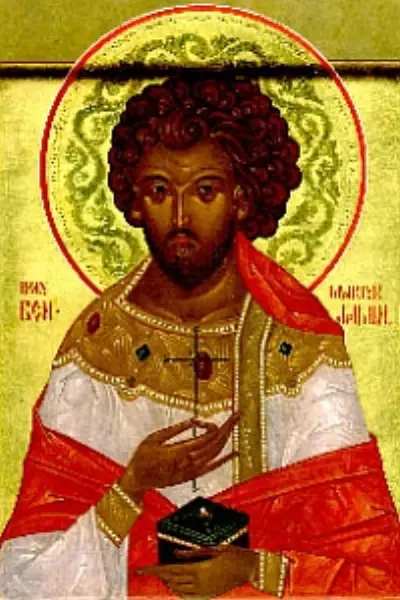
The spiritual figure of Benjamin is drawn almost entirely in a single stroke: the refusal to be silent about Christ. Every other consideration, life itself included, was weighed against the duty of the word and found lighter. The hagiography places his stand in the plainest terms, reporting that he answered that to preach Christ was a duty laid upon him and that silence was not in his power. That sentence is the whole of his theology and the whole of his spirituality, a theology of obedience before eloquence, of office accepted with its risks. The church that read his acts understood the point precisely: a deacon who would not speak was no deacon at all, and a faith that could be quarantined into private opinion had already surrendered. In the iconography of the East, Benjamin stands in the robes of a deacon, the crossed stoles marking the order whose ministry he fulfilled to death. The instruments of his passion, the sharpened reeds, have become part of his memory, a grim sign that the word of God in his mouth was judged dangerous enough to be answered with torture. His witness belongs with that whole company of Persian confessors whose names fill the martyrologies of the Syriac churches, men and women for whom the liturgy of the church was worth the fury of a king.
§ Martyrdom
Final Years
The end of Benjamin came in the year 424, in the reign of Varanes V. When the king was informed that the deacon had not stopped preaching, the machinery of the persecution was turned on him in full. The accounts of his passion are unsparing. Pointed reeds were driven beneath the nails of hands and feet alike; the older passion narrative tells of reeds forced between nail and living flesh, pushed into the body's most tender parts and torn out again, the torture repeated again and again with violence; and at the last a knotty stake was driven into his entrails to rend them, and under it he died. He had already endured a year in prison for the faith and had tasted freedom on terms he could not keep, and when the choice returned in its final form he made it again. His death belongs to the second and fiercer phase of the persecution, the years after 421 in which Varanes pressed the war on the church beyond anything his father had done. The tortures enumerated in the acts were designed to break the body's endurance, and the memory of the church kept them, not from relish of cruelty, but because the flesh of the deacon held out while his confession did not change. He died as he had lived, a man under orders to speak.
§ Martyrdom
Legacy
The cult of Benjamin the Deacon spans the whole family of eastern and western churches. His feast is celebrated on 31 March by the Catholic Church and the Eastern Orthodox, together with Abdas of Susa, the bishop whose burning of a Zoroastrian temple had helped ignite the persecution; the Byzantine Rite keeps him again on 13 October, a date shared by the Eastern Orthodox and the Byzantine Catholic churches, and the Syriac churches honour him among their own Persian martyrs. He is mentioned in the Roman Martyrology, the universal calendar of the Latin Church's saints, though he has never been included in the General Roman Calendar, which reserves the days of the year to a selection of the Church's principal memorials. His acts belong to the broader literature of the Persian martyr acts, a body of Syriac and Greek narratives that preserved the memory of the Sasanian persecutions for the whole Church. An Eastern Orthodox icon of Saint Benjamin survives as his standing image, the deacon in his vestments holding the cross of his confession. For the Christians of Iran, heirs of the church in which he served, his name keeps the memory of a very old fidelity, and for deacons everywhere he remains the type of the minister of the word who would not trade it away.
§ Veneration
Timeline
- 329
Born in Persia around this year
§ Introduction
- 421
King Isdegerd I, whose forty-year persecution of Christians had raged, dies; his son Varanes V continues it with great fury
§ Introduction
- 424
Tortured to death for preaching again: sharpened reeds driven under his nails, and at last a knotty stake
§ Martyrdom
In Their Own Words
sharpened reeds [were] stuck under the nails of his fingers and toes
The Record
- Symbols
- Deacon's stoles, crossed on the breast·Sharpened reeds, instrument of his martyrdom
- Canonization
- Pre-congregation; named in the Roman Martyrology, though never added to the General Roman Calendar
Prayer
Bibliography
Show 5 sources
- Shea, John Dawson Gilmary. "Saint Benjamin, Deacon, Martyr". In: Pictorial Lives of the Saints, 1889. CatholicSaints.Info. 6 February 2014.
- Collin, Johann E. (1738). Der Kampff und Sieg der ersten Blut-Zeugen Jesu Christi: durch Glauben und Gedult, nach alphabetischer Ordnung entworffen, und in Kupffern vorgestellet. Frankfurt and Leipzig.
- "Martyr Benjamin the Deacon of Persia". Orthodox Church in America.
- Martyrologium Romanum. Libreria Editrice Vaticana 2001. ISBN 88-209-7210-7.
- Delaney, John P. (1980). Dictionary of Saints (Second ed.). Garden City, NY: Doubleday. ISBN 0-385-13594-7.
Profile text adapted from the Wikipedia article, licensed CC BY-SA 4.0.
Pray with this saint every day
Save St. Benjamin the Deacon to your favorites, read the full profile, and get feast-day reminders in the Saints app.
Get the Saints AppFree on the App Store for iPhone and iPad