
c. 1010 – 1106·Feast June 16
St. Benno of Meissen
Saxon Bishop of Meissen and Apostle of the Wends
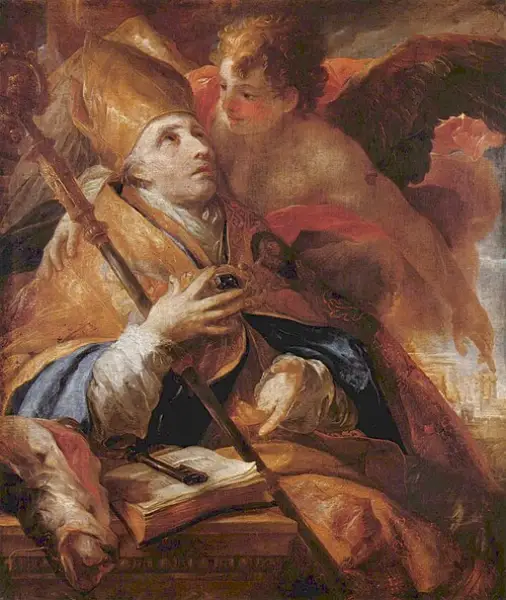
Overview
Benno, born around 1010 at Hildesheim into a Saxon noble line, entered church life as a canon of the Goslar chapter and was raised by King Henry IV to the bishopric of Meissen in 1066. His long episcopate unfolded against the storms of the Investiture Controversy. He leaned toward the Saxon uprising of 1073, endured a year of exile at the king's hands in 1075, and afterwards sided with Pope Gregory VII, taking part in the election of the rival monarch Rudolf of Rheinfelden in 1077. A synod held at Mainz in 1085 excommunicated him and stripped him of his see; reconciliation came through Archbishop Guibert of Ravenna, the antipope Clement III, after Benno acknowledged his offences with penitence. He switched allegiance back to the papal side in 1097, accepting Urban II as lawful pope, and then passes out of secure historical record. He governed his diocese with reforms on the Hildebrandine pattern as well as practical building works, and died a natural death on 16 June 1106. Venerated in Saxony throughout the later Middle Ages, he was declared a saint in 1523, and Protestant desecration of his Meissen tomb in 1539 only strengthened Catholic devotion to him, the Wittelsbachs adopting him as patron of Munich and Old Bavaria.
The Complete Life
A Noble Son of Hildesheim
Benno's beginnings are sparsely documented. What can be affirmed is that he was a native of Hildesheim, a great Saxon episcopal city, and that tradition counts him among the scion of a noble house, with the Woldenburgs named as one candidate for his kin. His likely place of schooling was the Benedictine monastery of St. Michael at Hildesheim, one of the most venerable houses of northern Germany, whose cloister trained generations of Saxon churchmen. Certain knowledge begins with his membership in the chapter of canons at Goslar, an imperial seat whose collegiate clergy stood close to the Ottonian and Salian courts. It was from this formation, noble blood, monastic discipline, and chapter service, that Benno passed to the highest orders. In 1066 King Henry IV presented him to the episcopal see of Meissen, a frontier diocese on the Elbe that bordered the lands of the Wends. The appointment placed a Saxon churchman of royal nomination over a see that would soon become a battleground between empire and papacy. Nothing in his early years forecast the turbulence ahead: a canon of Goslar, educated perhaps at St. Michael's, advanced in middle life to a border bishopric in the year that followed the death of the Empress Agnes's regency. That modest beginning is the whole of what authentic history can report before the storms of the Investiture Controversy claimed him, and later legends of his youth deserve the caution that scholars have long urged.
§ Life
Bishop on the Elbe Frontier
Benno's consecration as Bishop of Meissen in 1066 committed him to a diocese serving both Saxon Christians and the neighboring Wends, among whom his later title of apostle rests on traditions that documented history cannot verify. As bishop he set about the twin work of reform and construction. Ecclesiastical renewal on the Hildebrandine model, the program associated with Pope Gregory VII that sought to free the Church from lay domination and clerical corruption, marked his governance; alongside it stood material development of his diocese, the practical building and endowing that a frontier see required. His vocation, however, was tested almost at once by the struggle between Henry IV and the papacy. In 1073 he appears among the backers of the Saxon rising against the king, though the chronicler Lambert of Hersfeld and other contemporary writers assign his share in it little weight. Exile followed in 1075, with permission to return the next year. When the Investiture Controversy sharpened, Benno supported Pope Gregory and is said to have joined in choosing Rudolf of Rheinfelden as antiking in 1077; after Rudolf's death he transferred his backing to Hermann of Salm. The Synod of Mainz in 1085 answered with excommunication and deprivation of his see. Benno then went to Archbishop Guibert of Ravenna, the imperial antipope Clement III, and by penitent acknowledgment of his faults obtained absolution and a commendation to Henry that restored him to Meissen.
§ Life
Reform and Reconciliation in a Divided Church
The substance of Benno's mission lay in holding a diocese together while Christendom itself split over the question of who grants the Church its shepherds. His reforms followed the Hildebrandine pattern: obedience to canon law, the dignity of the episcopal office, and resistance to treating bishoprics as instruments of royal policy. His material care for Meissen, the churches built and maintained, the liturgical life ordered and sustained, gave those ideals a visible body. Yet his political path was winding. Having pledged, it seems, to work for peace between the crown and the Saxons, he failed to keep that word, and in 1097 he moved back to the papal party, acknowledging Urban II as the rightful successor of Peter. With that act he disappears from authentic history; the attractive later stories of missionary labors among the Wends, of zeal in church-building, and of devotion to ecclesiastical music belong to legend rather than to history. His real mission was less romantic and more demanding: to govern faithfully when every allegiance was contested, to accept correction when his own conduct required it, as his penitence before Guibert showed, and to leave a diocese stronger in both discipline and fabric than he found it. That record, reform on the Roman model joined to practical development, is what his own age remembered and what the soberest modern authorities, Kirsch and the New Schaff-Herzog encyclopedia, preserve.
§ Veneration
The Fish with the Keys
Benno's spiritual legacy is inseparable from the emblem that made him instantly recognizable: a fish holding keys between its gills. The legend behind it belongs to the contest with Henry IV. When the king lay under excommunication, so the story runs, Benno instructed his canons to fling the cathedral keys into the Elbe, so that the church could not be used while the interdict stood. Some time later a fisherman drew from the river a fish that had swallowed the keys, and returned them to the bishop, a sign read as heaven's ratification of the Church's stand. Whether history or devotion, the image fixed itself in glass, paint, and carving, and the stained glass of St. Benno's church in Munich still shows the bishop with fish and keys in hand. Beside the fish he carries a book, the symbol of a teaching bishop. This iconography encodes a spirituality of obedience held at cost: keys surrendered rather than misused, authority exercised only under the gospel, and a willingness to lose the instrument of power rather than wield it unjustly. His patronage of fishermen and weavers, trades of river and loom, grew naturally from the legend and from the working life of his diocese. The devotion Saxony paid him through the Late Middle Ages, and the veneration that Munich later embraced, testify that ordinary believers found in Benno a bishop whose holiness was proven less in miraculous deeds than in endurance, penance, and care for the ordinary people of his see.
§ Veneration
A Quiet End After the Storm
After his return to the papal obedience in 1097, Benno vanishes from the documentary record, and his last years must be imagined from the office he still held rather than from chronicled events. He remained Bishop of Meissen until his death, a tenure of some forty years in all, one of the longest episcopates of its century. He died of natural causes on 16 June 1106 at Meissen and was succeeded by Herwig. No dramatic final acts, no deathbed testament survive; what stands is the fact of a long service concluded in peace within his own city. The absence of legend around his ending is itself telling. A bishop who had been exiled, excommunicated, restored, and reconciled across four decades of the sharpest conflict the German Church had known, closed his life quietly at home, and the date of his passing became the date of his feast. The Meissen canons kept his memory, and his tomb in the cathedral awaited the veneration that later centuries would bring. Within a generation of his death the see he had governed passed through the upheavals that followed Henry IV's own death in 1106, the same year as Benno's. The bishop who had outlived kings, antipopes, and rivals died as the controversy that defined him was beginning to resolve, leaving a reputation for reform and a grave that would, three centuries later, become the center of a determined campaign for formal canonization.
§ Life
A Saint Made Amid Reformation Ferment
Benno's canonization was neither swift nor spontaneous; it was a deliberate project pursued across decades. Around the close of the fifteenth century and the opening decades of the sixteenth, the canons of Meissen joined with George, Duke of Albertine Saxony, in a coordinated effort to have their bishop declared a saint. Each party had its own aim: the canons wanted the prestige that a canonized local bishop would confer on their church, while the duke wanted an exemplary model bishop to advance his reform of the church in his lands. Literature served the cause. Spedel, a monk of the Benedictine house of St. Michael at Hildesheim, had already written the earliest Life in 1460, and a second followed in 1512 from the pen of Jerome Emser explicitly to support the canonization campaign. Their efforts succeeded: Pope Adrian VI issued the bull of canonization on 31 May 1523, the bull bearing the title Excelsus Dominus in the Bullarium Romanum. The timing gave the act an unintended polemical edge. Although Benno's sanctity had nothing to do with Luther's challenge, once enrolled among the saints he became a banner for both camps: Luther attacked him in early tracts written against the cult of the saints, while Catholic reformers held him up as a model of orthodoxy. Thus a medieval Saxon bishop entered the front lines of the Reformation quarrel within a decade and a half of his elevation to the altar, an irony his promoters at Meissen can scarcely have foreseen when they first petitioned Rome.
§ Sources
From Meissen Tomb to Munich's Patron
Benno's afterlife proved more contested, and more enduring, than his lifetime. Venerated in his native Saxony through the Late Middle Ages, he became after canonization a figure claimed by every side. Luther poured scorn on him in the opening polemics he aimed at the cult of the saints, Wider den neuen Abgott above all, while Catholic reformers fashioned him into a standard of true belief. The English Protestant John Foxe eagerly repeated the grave charges that Benno, as an opponent of Gregory VII, had leveled against Henry IV, including necromancy, torture of a former friend on a bed of nails, an attempted assassination commissioned by the king, executions without trial, unjust excommunication, doubt of the Real Presence in the Eucharist, and even its burning. In 1539 Protestant mobs desecrated Benno's tomb at Meissen, an outrage that cemented his symbolic value to the Catholic cause; the Wittelsbach dynasty in time adopted him as patron saint of Munich and Old Bavaria, and his major shrine passed from Meissen to Munich. His feast on 16 June, his patronage of anglers and weavers, and his emblem of the fish with the keys in its mouth carried his memory into popular devotion, where it survives in stained glass, painting, and parish dedication. Modern historiography has pruned away the legendary missionary and left a reforming bishop who navigated the empire's greatest church crisis; that sobered figure, contested in life and in cult alike, remains one of the most instructive episcopal witnesses of the eleventh century.
§ Veneration
Timeline
- 1010
Born at Hildesheim in Saxony, reportedly into a noble family such as the Woldenburgs.
§ Life
- 1066
Nominated by King Henry IV to serve as Bishop of Meissen.
§ Life
- 1073
Appears among the supporters of the Saxon rebellion against the king.
§ Life
- 1075
Exiled by Henry IV.
§ Life
- 1076
Permitted by the king to return to his see.
§ Life
- 1077
Allegedly joined in the election of Rudolf of Rheinfelden as antiking.
§ Life
- 1085
The Synod of Mainz passed sentence of excommunication and stripped him of his see; he later won absolution through Guibert of Ravenna and was restored.
§ Life
- 1097
Returned to the papal obedience and acknowledged Urban II as the rightful pope.
§ Life
- 16 Jun 1106
Died of natural causes at Meissen.
§ Life
- 1460
The earliest Life of Benno was written by Spedel, a Benedictine of St. Michael's in Hildesheim.
§ Sources
- 1512
Jerome Emser published a second Vita as part of the campaign for Benno's canonization.
§ Sources
- 31 May 1523
Canonized by Pope Adrian VI, who issues the bull of canonization.
§ Veneration
- 1539
Protestant mobs desecrated Benno's tomb at Meissen, after which the Wittelsbachs made him patron of Munich and Old Bavaria.
§ Veneration
The Record
- Patron of
- patron of fishermen and anglers·patron of weavers·patron of Dresden-Meissen·patron of Munich and Old Bavaria
- Symbols
- a fish holding keys in its mouth·a book·episcopal vestments of a bishop
- Canonization
- Canonized on 31 May 1523 by Pope Adrian VI
Prayer
Bibliography
Show 6 sources
- Chisholm, Hugh, ed. (1911). "Benno". Encyclopædia Britannica. Vol. 3 (11th ed.). Cambridge University Press. p. 743.
- Foxe, John; Townsend, George (1837). The Acts and Monuments of John Foxe. R.B. Seeley and W. Burnside. p. 121.
- Kirsch, Johann Peter (1907). "St. Benno". In Herbermann, Charles (ed.). Catholic Encyclopedia. Vol. 2. New York: Robert Appleton Company.
- Thurston, Herbert; Attwater, Donald, eds. (1963). Butler's Lives of the Saints. Vol. II. New York: P. J. Kennedy. p. 556.
- Haugic, A. (1908). "Benno". In Jackson, Samuel Macauley (ed.). New Schaff-Herzog Encyclopedia of Religious Knowledge. Vol. 2 (third ed.). London and New York: Funk and Wagnalls. p. 54.
- Collins, David J. (2008). Reforming Saints: Saints' Lives and Their Authors in Germany, 1470-1530. Oxford University Press.
Profile text adapted from the Wikipedia article, licensed CC BY-SA 4.0.
Pray with this saint every day
Save St. Benno of Meissen to your favorites, read the full profile, and get feast-day reminders in the Saints app.
Get the Saints AppFree on the App Store for iPhone and iPad