
died 16 January 1220·Feast January 16
St. Berard of Carbio
Franciscan Protomartyr Beheaded in Morocco
Overview
Berard of Carbio was a thirteenth-century Franciscan friar, a native of Carbio in Umbria, traditionally said to have been born into the noble Leopardi family. Received into the newly founded Order by Francis of Assisi himself in 1213, he became well versed in Arabic and gained a reputation as an eloquent preacher. When the Second General Chapter of the friars concluded in 1219, Francis judged that the time had come to carry the Order's apostolic labors beyond Italy and northern Europe, and he chose Berard, with Peter and Otho, both priests, and with two brothers in lay life named Accursius and Adjutus, for the preaching mission to Morocco. Sailing from Italy, the five crossed Portugal and Spain to Muslim-ruled Seville, where their preaching antagonized the king, who imprisoned them for about three weeks and expelled them to Morocco. Only Berard knew any Arabic, and the friars' open proclamation of Christianity and bold denunciation of Islam led the Moors to regard them as insane. Twice expelled and twice returned, they were finally imprisoned again, and when the Moorish king could not persuade them to abandon their faith, he beheaded them with his scimitar in a fit of rage on 16 January 1220, the first martyrs the young Franciscan family would know. Francis is reported to have exclaimed that at last he had true Friars Minor. Canonized with his companions by Pope Sixtus IV in 1481, Berard's major shrine is the Monastery of the Holy Cross at Coimbra in Portugal.
The Complete Life
A Noble Umbrian Joins the New Order
Berard came from Carbio in Umbria, a town of the Papal States known in modern times as Calvi dell'Umbria, and tradition holds that he was born into the noble family of the Leopardi. The Umbrian hill towns of his youth lay at the very center of the religious ferment that transformed the Italian Church in the early thirteenth century, for it was in neighboring Assisi that Francis, the poverello who rebuilt churches and gathered brothers, had begun the movement that would carry the gospel to the ends of the earth. Berard's path led him to Francis while the Order was still young. In 1213, when the fraternity was barely three years old and its Rule still taking shape, Francis received Berard into the newly founded Order of Friars Minor, accepting a man of noble blood into a brotherhood that prized holy poverty above lineage. Within the community Berard distinguished himself by two gifts that would determine his destiny: he became well versed in Arabic, a rare accomplishment among Latin friars and one that reveals serious application to study, and he developed into an eloquent preacher, able to set forth the faith with power before any audience. Both abilities were soon to be needed, for Francis was coming to believe that God's purpose for the little brotherhood reached far beyond the Italian peninsula and northern Europe where it had so far labored, and that the friars possessed men capable of carrying the gospel into the lands of Islam itself.
§ Life
Chosen for Morocco
The decisive turn came at the Second General Chapter of the Franciscan friars, held in 1219. On its conclusion Francis judged that the moment had arrived for the Order to extend its apostolic labors beyond the familiar world of Italy and northern Europe, into mission territories where the name of Christ was either unknown or contested. The band he selected for Morocco numbered five: Berard, the Arabic-speaking preacher from Carbio, at its head, joined by the priests Peter and Otho and by Accursius and Adjutus, brothers in lay life. The composition of the band shows Francis's practical wisdom, joining priestly faculty for ministry with lay brothers' simplicity, and setting at their head the one friar equipped to speak to Muslims in their own tongue. Putting out from Italy by sea, the five landed in Portugal, made their way over the Spanish border, and pressed on to Seville, which remained under Muslim rule. Preaching there earned them the king's enmity: after close to three weeks in his prison he banished them to the Kingdom of Morocco, dispatching the friars across the strait into a land where Christian preachers had no legal protection and where the profession of faith against Islam was a capital matter. Berard had sought no such fame; his vocation, formed under Francis at Assisi and sharpened by the study of Arabic, was simply to preach Christ where Christ was not named, whatever the ruler of the hour might decree.
§ Life
Preaching, Expulsion, and Return
The mission that began in Morocco unfolded as a repeated cycle of witness, rejection, and return. Of the five friars only Berard knew any Arabic, yet language proved no barrier to witness: the friars preached the Christian faith openly and attacked Islam with equal plainness, and bystanders promptly concluded that they were deranged, so alien did such fearlessness seem to those who watched them. The king, reluctant to hand them the martyr's crown, began by having them marched to Ceuta and placed on vessels sailing for Christian shores. The friars disembarked, made their way back into Morocco, and took up preaching again. Released next and supplied with guides to lead them toward Christian territory, they turned round once more. The authorities now understood that no persuasion would move them. When it became clear that the friars would neither depart nor be silent, they were apprehended and cast into prison. The Moorish ruler then tried reasoning, striving to turn them from the Catholic faith they professed, and having labored in vain, and in a fit of rage at their constancy, he beheaded them with his own scimitar. Thus on 16 January 1220 Berard, Peter, Otho, Accursius, and Adjutus became the first martyrs of the Franciscan Order. Their deaths were not the accidental result of political friction but the direct consequence of repeated, deliberate refusal to trade silence for safety, a pattern of return and re-arrest that made the kingdom's final violence almost unavoidable.
§ Life
The Spirit of the Protomartyrs
The spirituality of Berard and his companions can be read from the shape of their mission. It was first a spirituality of vocation obeyed: five men accepted a commission from Francis to cross the sea, and neither prison, expulsion, nor the threat of death turned them from it. It was a spirituality of preparation, for Berard's painstaking mastery of Arabic shows a missionary who believed the gospel deserved to be heard in the language of its hearers, and who studied before he sailed. It was, above all, a spirituality of the cross presented plainly: the friars did not argue Islam into a corner through clever disputation but proclaimed Christ and denounced what they held to be false, accepting that such speech in a Muslim kingdom could cost them everything. Their readiness to be thought insane rather than silent mirrors the apostolic witness of the earliest Church, and their contemporaries recognized the resemblance by calling them protomartyrs of the Order. The reaction of Francis himself reveals what the deaths meant within the fraternity. When he heard of their end he is reported to have cried out that at last he could count true Friars Minor among his brothers, a sentence at once grief-laden and triumphant, acknowledging that the young Order had at last proven itself in blood. The scene at Assisi, where the bodies were solemnly received on their way back from Portugal, completed the picture: a young Portuguese canon regular, watching the caravan pass his monastery, was so moved by the martyrs' sacrifice that he joined the Franciscan Order, becoming known to history as Anthony of Padua.
§ Life
Death by the Scimitar
The final act of Berard's life was compressed into the opening weeks of 1220, the culmination of the imprisonment and repeated expulsions that had marked the mission since its arrival. Held in prison after their last arrest, the five friars faced the sustained effort of the Moorish king to persuade them to give up their Catholic faith. The sources emphasize that he tried argument before violence, and that only the failure of persuasion, combined with his mounting anger at their refusal, drove him to the ultimate sentence. In a fit of rage he beheaded them with his scimitar, killing with his own hand the men whom his guards had twice escorted to the frontier and twice seen return. Berard thus died on 16 January 1220 in Morocco, a priest of the Friars Minor, together with his companions Peter and Otho, priests, and Accursius and Adjutus, lay brothers. Their bodies did not remain in the land that killed them. Upon the return of their remains to Portugal they were received with solemn processions, and from Portugal the cortege traveled all the way to Assisi, where the Order honored its first martyrs. The translation of the relics to the Monastery of the Holy Cross at Coimbra in Portugal fixed their principal shrine in the Iberian kingdom, and it was in Portugal, as the funeral procession passed, that the young canon who would become Anthony of Padua first felt the pull that changed his own life, the martyrs bearing fruit immediately in the vocation of a stranger.
§ Life
Declared Saints in 1481
The formal recognition of Berard and his companions came more than two and a half centuries after their deaths. Pope Sixtus IV canonized the five martyrs on 7 August 1481 in Rome, enrolling among the saints the men whom the Franciscan Order had venerated as its protomartyrs since 1220. The long interval between martyrdom and canonization was normal for the medieval Church, in which local cults often flourished for generations before receiving papal confirmation, and the friars had in no wise waited upon official process to honor their dead: the memory of the five killed in Morocco was woven into the Order's self-understanding from the first, proof that the young fraternity embodied the mendicant ideal completely enough to die for it. Sixtus IV, himself a Franciscan and a scholar pope of the late fifteenth century, thus confirmed with apostolic authority a devotion his own Order had cherished for two hundred and sixty years. The bull gave the cult universal standing within the Church, allowing the feast of the martyrs to be kept beyond the confines of the Order's churches. For the Friars Minor the canonization of 1481 was also a statement about identity at a moment when the Observant reform was renewing the Order's original fervor: the protomartyrs of Morocco stood as the measure of what Franciscan life intended, a standard of poverty, preaching, and readiness for death that no passage of time could soften.
§ Veneration
First Martyrs of the Friars Minor
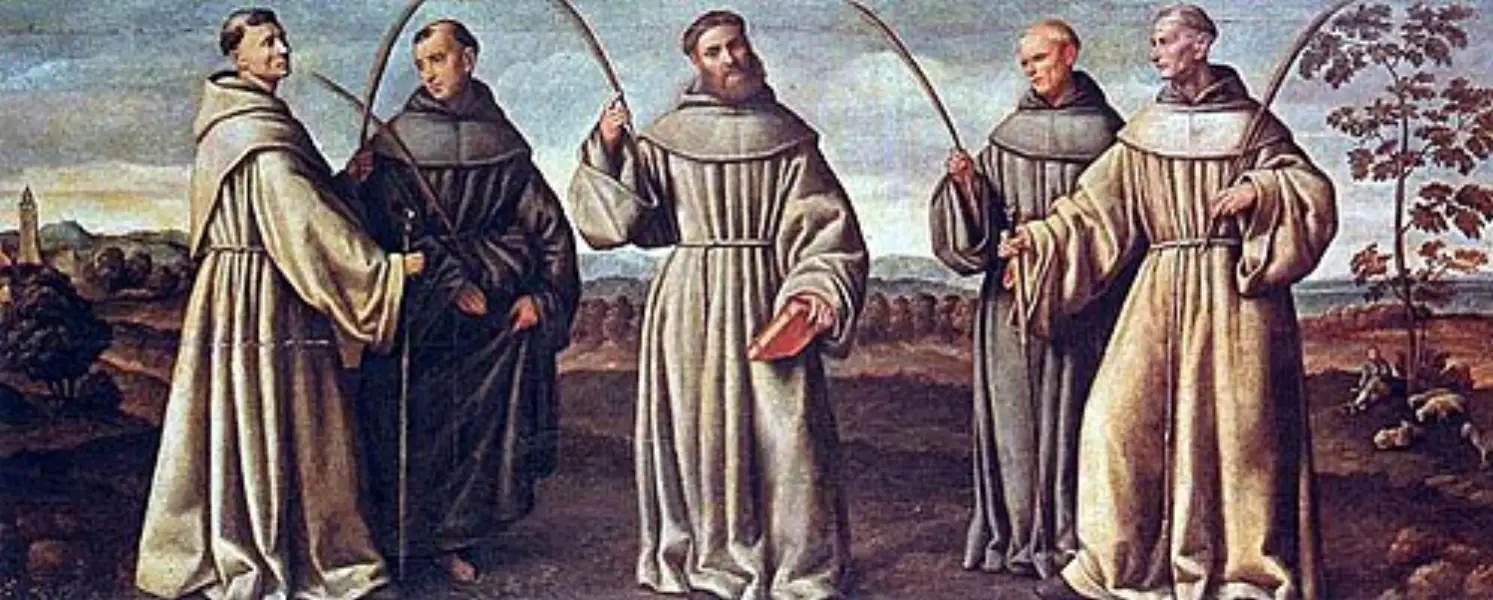
Berard of Carbio and his four companions hold a permanent place in Franciscan history as the Order's first martyrs, the protomartyrs whose blood consecrated the fraternity's missionary vocation. Within the Franciscan Order their shared feast falls on 16 January, the anniversary of the beheading in Morocco, and their major shrine is the Monastery of the Holy Cross at Coimbra in Portugal, where their relics rest. The most celebrated fruit of their witness was indirect: the solemn procession that carried their bodies from Portugal toward Assisi passed before a monastery where a young Portuguese canon regular stood watching, and so moved was he by the sight of the martyrs that he entered the Franciscan Order, becoming known to the world as Anthony of Padua, one of the most beloved saints in the calendar. In this way the deaths of five obscure friars in a North African kingdom redounded within a single generation to the enrichment of the whole Church. Their example established a pattern for later Franciscan missions to Muslim lands, a line that runs through the centuries of the Order's history wherever friars have courted martyrdom by open preaching. The painting of the Martyrs of Morocco by Francisco Henriques, painted in 1508 and preserved in the National Museum of Ancient Art in Lisbon, shows how Portuguese art enshrined their memory not long after the canonization. For the universal Church they remain a witness that the gospel's claim is not regional, and that fidelity may be asked of the preacher at the price of his head.
§ Veneration
Timeline
- 1213
Francis of Assisi received him into the Order of Friars Minor, then newly founded.
§ Life
- 1219
After the Second General Chapter, chosen by Francis with four companions to evangelize Morocco.
§ Life
- 16 Jan 1220
Beheaded by the Moorish king on this day after imprisonment and repeated expulsions, winning the title of Franciscan protomartyr.
§ Life
- 7 Aug 1481
Canonized with his companions by Pope Sixtus IV in Rome.
§ Veneration
In Their Own Words
Now at least do I have true Friars Minor!
The Record
- Symbols
- Franciscan habit·scimitar or executioner's sword, as a martyr
- Canonization
- Canonized on 7 August 1481 in Rome by Pope Sixtus IV
Prayer
Bibliography
Show 6 sources
- Jones, Terry. "Berard". Patron Saints Index.
- Donovan, Stephen. "St. Berard of Carbio." The Catholic Encyclopedia Vol. 2. New York: Robert Appleton Company, 1907.
- Arnald of Sarrant, Chronicle of the Twenty-Four Generals of the Order of Friars Minor, trans. Noel Muscat, OFM (TAU Franciscan Communications, 2010).
- Attwater, Donald and Catherine Rachel John. The Penguin Dictionary of Saints. 3rd edition. New York: Penguin Books, 1993.
- "Saint Berard and Companions", Franciscan Media.
- Herbermann, Charles, ed. (1913). "St. Berard of Carbio". Catholic Encyclopedia. New York: Robert Appleton Company.
Profile text adapted from the Wikipedia article, licensed CC BY-SA 4.0.
Pray with this saint every day
Save St. Berard of Carbio to your favorites, read the full profile, and get feast-day reminders in the Saints app.
Get the Saints AppFree on the App Store for iPhone and iPad