
died 1123·Feast December 19
St. Berardo
Bishop of Teramo and patron of the city
Overview
Berardo, who died on 19 December 1123, is an Italian saint and the principal patron of the city and diocese of Teramo in the Abruzzo. He was born in the eleventh century to the da Pagliara nobility, lords of the castle beside Isola del Gran Sasso, and his life is documented in the ancient church records of that region and in the chronicles of Sassone, the bishop who succeeded him. As a young man he entered the monastery of Montecassino and was later associated with the Abbey of San Giovanni in Venere. His reputation for good works brought him, after the death of Bishop Uberto, the call to pastoral care of the territory of Teramo; he took up the office in 1116 and served for seven years, devoting himself to the poor and to making peace among the warring factions of the citizenry. He died in 1123 and was laid in the chapel now called St. Anne's, within the old cathedral, one of the few places spared when the Norman commander Roberto di Loretello sacked and burned the city. His remains were translated to the new cathedral around 1174 and again in 1776, and his feast is kept each 19 December.
The Complete Life
A Son of the Pagliara
Berardo was born in the eleventh century to the da Pagliara nobility, lords of the castle that took its name from the family and rose beside Isola del Gran Sasso in the Abruzzo. That mountain country of his boyhood was a borderland of baronial fortresses and monastic foundations, a country in which a nobleman's son could expect either the saddle or the cloister, and Berardo's family gave the Church more than one servant. The record of his early years survives in sources of unusual local depth: the ancient church records of the region around Pagliara preserve the outlines of his life, and the chronicles of Sassone, the bishop who succeeded him at Teramo, carried the story forward. From these materials a consistent portrait emerges of a young noble who turned from the world of his fathers toward the most rigorous religious houses of the age. Whatever ambitions his castle may have held for him, he exchanged them early, and the decision directed him toward Montecassino, the cradle of Italian monasticism, where he would be formed in the discipline that shaped so much of the medieval Church's leadership in the southern kingdoms.
§ Life
Montecassino and San Giovanni in Venere
As a young man Berardo entered the monastery of Montecassino, the abbey founded by Benedict himself and still the most prestigious religious house in the Italian peninsula. Formation there meant the whole Benedictine pattern of prayer, reading, and obedience, and it marked him for life. His path later brought him into association with the Abbey of San Giovanni in Venere, the great Benedictine house on the Adriatic coast of the Abruzzo, which held extensive lands through the region of his birth. Between the two monasteries, Berardo acquired the combination the age required of its bishops: contemplative training of the old school joined to practical administration of a great estate. He earned wide fame for his charitable works, and such fame, in the ecclesiastical politics of the early twelfth century, was itself a form of office. When Bishop Uberto of Teramo died, the eyes of the church's leadership turned toward the monk of Pagliara. He was asked to take up the pastoral care of the territory of Teramo, a city whose bishops bore the weight of guarding a contested frontier, and he accepted what his biographers present as a burden rather than an honor, entering on the work in 1116.
§ Life
Seven Years of Peace in Teramo
Berardo's episcopal service in Teramo lasted seven years, from 1116 until his death, and the sources condense it into two labors: the poor and the peace. He focused his efforts on helping the destitute of the city and its territory, and on making concord among the warring factions of the local citizenry. Teramo, the ancient Interamna of the Praetutii, was in his day a chronically divided town, its noble houses given to private warfare, and its bishop stood as almost the only figure whose authority rose above the quarrels. The chronicle of his successor Sassone, the chief witness for this period, evidently remembered a prelate who spent his office not on building or litigation but on reconciliation. The work was dangerous as well as difficult: Teramo lay exposed to the ambitions of the Norman lords who were consolidating their hold over the Abruzzo and the neighboring counties. Berardo did not live to see the worst of it. He died in 1123, while the storm the city feared was still gathering, but the memory of a bishop who had given himself to the poorest and to the peace of factions became, after his death, the seed of the city's deepest religious devotion.
§ Life
Death, Burial, and the Burning of the City
Berardo died on 19 December 1123, and his body was laid in the chapel now called St. Anne's, within the old cathedral of Santa Maria Aprutiensis, the church known today as Sant'Anna dei Pompetti. The resting place proved providential. When the Norman commander Roberto di Loretello besieged Teramo and put it to the torch, the chapel of the saint was among the very few places in the city that escaped destruction, and the survival of his tomb amid general ruin was read by the Teramo people as a first sign of his protection. Around 1174, at Bishop Attone's prompting, his relics entered the just-finished cathedral of Teramo, lodged first in a crypt, where they rested for six hundred years. In 1776, under Bishop Pirelli, the people of Teramo built a chapel in his honor, and the relics were moved to it, giving the saint a shrine commensurate with his standing as the city's patron. The date of his death, 19 December, became and remains his feast day, celebrated each year in commemoration of the day he died, and the silver bust and blessing arm commissioned in later centuries testify to the devotion his tomb has never lost.
§ Life
Miracles, Images, and a City's Patron
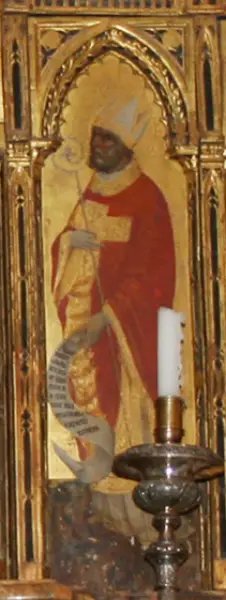
Teramo's devotion to Berardo filled its cathedral with his image. A sixteenth-century silver bust and a seventeenth-century silver likeness of his arm extended in blessing stand in the cathedral today; a stone statue that once covered his crypt now crowns the chapel raised in his honour; and the sacristy holds a seventeenth-century altarpiece by the Polish painter Sebastiano Majeski entitled The Miracle of Saint Berardo. Nearby hangs a canvas by Giuseppe Bonolis showing the Virgin Mary and the saint delivering the city from the siege of the Duke of Atri, together with numerous other pictures of his life. Several miracles are attributed to him, and the engravings and prints connected with his cult were so numerous that Raffaele Aurini catalogued them in 1973, producing a comprehensive biographical and iconographical record. The civic religion of Teramo long included the yearly kindling of a large candle in his honour, a custom the municipal authorities took up and abandoned by turns over the generations. As patron of the city and diocese, Berardo remains the one figure in whom the ecclesiastical and civic histories of Teramo meet: bishop, protector in siege, healer, and the saint whose feast on 19 December the city still keeps.
§ Cult, miracles, and icons
Timeline
- 1116
Assumed pastoral care of the territory of Teramo after Bishop Uberto's death, beginning seven years of service.
§ Life
- 19 Dec 1123
Died at Teramo and was buried in St. Anne's chapel of the ancient cathedral of Santa Maria Aprutiensis.
§ Life
- 1174
At Bishop Attone's prompting, his relics entered the just-finished cathedral of Teramo, lodged first in a crypt.
§ Life
- 1776
His remains were moved to a chapel built in his honour by the people of Teramo during the leadership of Bishop Pirelli.
§ Life
The Record
- Patron of
- Teramo, Italy
- Canonization
- Pre-congregation; venerated since the twelfth century as principal patron of the city and diocese of Teramo.
Prayer
Bibliography
Show 6 sources
- Baronio, Cesare. Annales ecclesiastici, Tomus XII. Ticini: Typ. H. Bartoli, 1641, p. 149.
- Palma, Niccola. Storia ecclesiastica e civile della regione più settentrionale del regno di Napoli... oggi città di Teramo e diocesi aprutina, 5 vols. Teramo: Angeletti, 1832-1836; vol. I, pp. 138-151.
- de' Mutij, Mutio. Della storia di Teramo dialoghi sette, with notes by Giacinto Pannella. Teramo: Tip. del Corriere Abruzzese, 1893, dialogo primo, par. 15.
- Savini, Francesco, ed. Il Cartulario della Chiesa Teramana. Codice Latino in pergamena del sec. XII dell'Archivio vescovile di Teramo. Roma: Forzani, 1910, pp. 70-83.
- Gremigni, Vincenzo Gilla. "Berardo, Vescovo di Teramo, santo." Bibliotheca Sanctorum, vol. II, col. 1271. Roma: Istituto Giovanni XXIII, 1962.
- Aurini, Raffaele. "Berardo da Pagliara." Dizionario bibliografico della gente d'Abruzzo, vol. V. Teramo: Edigrafital, 1973.
Profile text adapted from the Wikipedia article, licensed CC BY-SA 4.0.
Pray with this saint every day
Save St. Berardo to your favorites, read the full profile, and get feast-day reminders in the Saints app.
Get the Saints AppFree on the App Store for iPhone and iPad