
died 15 May 733·Feast May 15
St. Bercthun of Beverley
Eighth-Century Abbot of Beverley and Bede's Informant
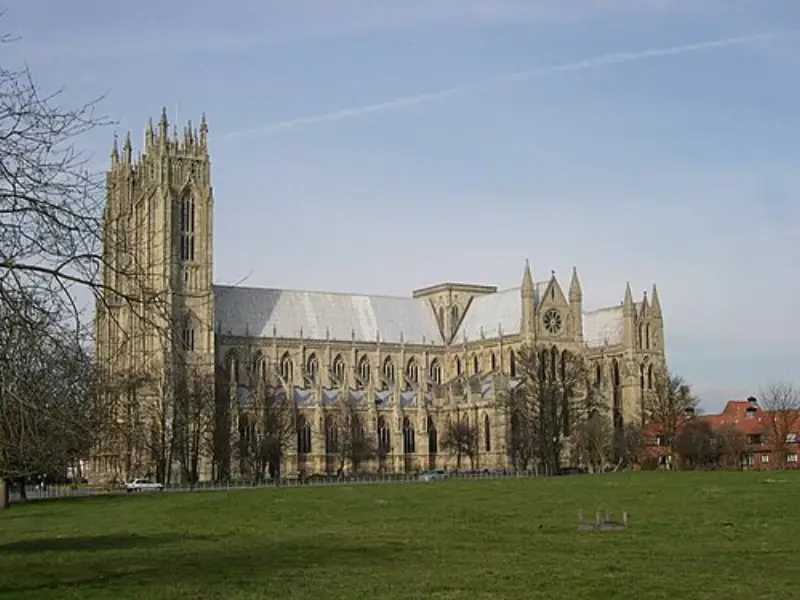
Overview
Bercthun of Beverley, who died on 15 May 733, was an eighth-century Anglo-Saxon saint also known as Bertin, Britwin, Berhthu, and Beorhthun. A Benedictine monk of Beverley in Northumbria, he was a disciple of John of Beverley, the bishop and saint whose community at Beverley Minster he served, and he became in later life the abbot of that house. His chief claim on the attention of historians is literary: he was Bede's informant about much of the history of Beverley that appears in Bede's Ecclesiastical History, so that a portion of the most important source for Anglo-Saxon Christianity reached the great historian through this monk's testimony. He is also known from the secgan, the Old English lists of saints and their resting places. He kept the rule of Benedict at Beverley under a master famed for holiness, and after John's death he continued and led the community as its abbot. He died on 15 May 733, the day on which his feast was kept locally in his honour. A bust thought to represent Bercthun is believed to be kept in the British Library, a rare material survival connected with an Anglo-Saxon monk known otherwise almost entirely through Bede's acknowledgment of him and the local liturgical observance of his memory.
The Complete Life
Disciple of John of Beverley
Bercthun's vocation unfolded at Beverley in the East Riding of Yorkshire, where John of Beverley, bishop of Hexham and then of York, had founded a religious community beside the minster church he built in the early eighth century. Bercthun was a Benedictine monk of that house and a disciple of John, one of the men formed in the daily round of office and work under a master whom the whole English Church came to venerate. The relation of disciple to holy bishop meant everything in the eighth-century Northumbrian church, for the monasticism of the age lived largely in the shadow of great episcopal saints, Cuthbert at Lindisfarne, Wilfrid at Ripon and Hexham, and John at Beverley, whose communities inherited their founders' discipline and their relics. To be John's disciple at Beverley was to stand in the second generation of Northumbrian Benedictine life, receiving a tradition at its source. Bede's acknowledgment gives Bercthun his enduring significance. In the Ecclesiastical History, Bede names him as the informant for much of his material regarding Beverley, so that the miracles and memories of John of Beverley reached the historian's page through this monk's careful testimony. A monk who could serve as Bede's source was a man of credit and precision, whose account of his own house's past was trusted by the most scrupulous historian of the age, and that trust is itself a portrait of character.
§ Bercthun
Abbot Remembered at Beverley
In the later part of his life Bercthun became the abbot of Beverley, the head of the community he had entered as a disciple of its founder, and so the man charged with carrying John's heritage forward after the bishop saint's death. His own death came on 15 May 733, and on that day a feast was celebrated locally in his honour, the simple liturgical recognition by which the Anglo-Saxon church marked its holy dead before any formal process of canonization existed. His name also survives in the secgan, the Old English hagiographies that list the saints of England and the places where their bodies rest, a genre of literature that records the geography of sanctity as the early medieval church understood it. Beyond text and liturgy there may survive an object: the British Library is thought to preserve a bust of Bercthun, a rare material relic associated with a monk whose life is otherwise known through a handful of sentences. The whole of his legacy is contained in these traces, the local feast, the secgan entry, the possible bust, and above all Bede's use of him as a source, which made an obscure Northumbrian monk a permanent, if discreet, contributor to the Ecclesiastical History of the English People, the book on which all later knowledge of the early English Church depends.
§ Bercthun
The Record
- Symbols
- Benedictine habit·abbot's crozier
- Canonization
- Pre-congregation; a feast was celebrated locally in his honour on the day of his death
Prayer
Bibliography
Show 5 sources
- "Bercthun" in The Oxford Dictionary of Saints. Oxford University Press, 2011.
- Farmer, David Hugh (1992). The Oxford Dictionary of Saints (Third ed.). Oxford University Press.
- Saint Bercthun of Beverley at Saints.SQPN.com.
- Bercthun at Catholic Online.
- Bede, H.E., v. 2; N.L.A., i. 160-1.
Profile text adapted from the Wikipedia article, licensed CC BY-SA 4.0.
Pray with this saint every day
Save St. Bercthun of Beverley to your favorites, read the full profile, and get feast-day reminders in the Saints app.
Get the Saints AppFree on the App Store for iPhone and iPad