
died c. 702·Feast February 3
St. Berlinda of Meerbeke
Disinherited noblewoman who became a Brabantian abbess
Overview
Berlinda, also rendered Berlindis or Berlenda and sometimes called Bellaude, was a Benedictine nun of noble descent who died around 702. She was born in Meerbeke, now a district of Ninove in East Flanders, the daughter of the wealthy Count Odelard, squire to Duke Wiger of Lorraine, and his devout wife Nona. Her father possessed wide estates reaching from Antwerp toward Liège, among them the castle of Ombergen and property at Assche. Orphaned of her mother at twelve, she cared tenderly for her father when he came home from the war against the Normans embittered and leprous, while she guarded herself prudently against infection. Legend relates that, mistaking her caution for disgust, Odelard disinherited her in favour of the monastery of Saint Gertrude at Nivelles. She then entered the monastery of St. Maria in Moorsel as a Benedictine. After her father's death she buried him beside her mother in the church of St. Peter, returned to the family home, and there founded her own convent and church with several local women, living a strict ascetic life in service of the poor. Many miracles were attributed to her intercession. Her highly legendary vita was composed around 900 by Hubert, a monk of Lobbes, and she remains among Belgium's most popular saints, invoked especially against diseases of cattle and honoured as protectress of trees.
The Complete Life
A Noble Childhood in the Denderstreek
Berlinda was born in Meerbeke, a place also recorded as Meerbeche or Marbec, in the Low Countries; today it is a district of Ninove in the Denderstreek of East Flanders, Belgium. Her family belonged to the highest nobility of the region. Her father, Count Odelard, was a wealthy man who served as squire to Duke Wiger of Lorraine, and her mother, Nona, is remembered as a holy woman who was herself later honoured among the saints of Brabant. The family's possessions were extensive, stretching across the centre of present-day Belgium between Antwerp and Liège. They included the castle of Ombergen, situated between Ghent and Ninove, and property at Assche between Aalst and Brussels. Into this world of castles and estates Berlinda was born, a daughter among children who would be sorely tested by war and disease. Her mother died when Berlinda was twelve years old, an early loss that left the household exposed to the griefs that followed. The hagiographical tradition, recorded long after the events, paints her upbringing amid privilege but also amid the violence of an age when Norman raiders pressed upon the Frankish lands and when leprosy could strike down even a great count in his own hall. What the sources agree upon is that from this noble stock came a woman who would renounce wealth for poverty and a castle for a convent.
§ Life
Disinherited for Christ at Moorsel
Trouble entered Berlinda's story through her father's illness. Count Odelard had campaigned against the Normans, defeated at last with aid from Arnold of Carinthia, yet the triumph ruined him: Eligard, his only son, fell in the fighting, and on reaching Meerbeke again Odelard discovered leprosy in his own body. Sorrow upon sorrow soured his temper. His daughter nursed him lovingly, though, being sensible as well as tender, she took every care not to catch the disease herself. The legend then tells how the count, fancying one day that he detected in her some distaste for his condition, and concluding that she meant to desert him, cut her off and settled his favour upon the monastery of Santa Gertrude de Nivelles. Robbed of her inheritance by her own parent, Berlinda uttered neither complaint nor despair. She went instead to the monastery of St. Maria in Moorsel and made her profession as a Benedictine, exchanging a count's daughter's portion for the obedience of the cloister. Whatever history may lie beneath the tale, it catches the essential shape of her holiness: loss received as a calling, humiliation turned into religious profession. The woman who might have commanded estates chose the habit and the rule, and in that choice found a liberty no property could have given her. Her profession at Moorsel joined her to the great Benedictine current then flowing through the Low Countries.
§ Life
A Convent in Her Father's House
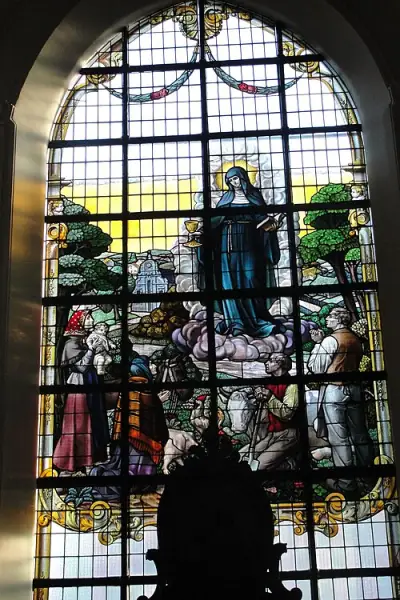
News of her father's passing changed the direction of Berlinda's life once more. She came back to the family lands, saw Odelard laid to rest beside her mother within the parish church of St. Peter, and then had to decide her own future. Moorsel did not see her again. Gathering several neighbourhood women around her, she established a convent and a church of her own inside her parents' dwelling, turning the rooms of her childhood into a religious house. Until her death she gave herself to relieving the poor and the needy while keeping a harshly ascetic rule, and report credited her intercession with many wonders. In that double discipline, voluntary poverty joined to works of mercy, her later reputation took root. The folk of the Denderstreek came to know a woman of prayer and practical pity, and her house became a place of relief for the needy. Her example also set a pattern of local female religious life that would echo for centuries through Brabant and Flanders. The tomb in which her body was laid at Meerbeke drew pilgrims, and the church that carries her name there, Sint-Pieter en Sint-Berlindiskerk, still shows her in stained glass. Her mission proved, in the end, of the humblest and most lasting sort: one household made a house of God, one woman's loss made a wellspring of charity.
§ Life
Formal Recognition by Urban VIII
Devotion to Berlinda long preceded any formal recognition of it. Around the year 900 a Lobbes monk named Hubert wrote her life, a heavily legendary piece, resting on information supplied by his client Gerhard, then provost of Meerbeke. That vita, composed roughly two hundred years after her death, fixed the image of the disinherited noblewoman that has reached us, and modern scholarship openly concedes its legendary character. Formal canonisation came much later: in 1625 Pope Urban VIII confirmed her cult at Rome, giving Meerbeke's ancient local devotion standing within the universal church. The Roman Martyrology remembers her with words to the effect that at Meerbeke in Brabant, in present-day Belgium, the virgin Berlinda lived a live of poverty and charity. Urban VIII's reign was a period of systematic confirmation for northern saints whose cults had flourished for centuries without a papal process, and into that company Berlinda was received. Her feast was set upon 3 February, kept with special warmth in the Benedictine Order and throughout the diocese of Ghent, sometimes in company with the sisters Celsa and Nona, Brabantine virgins whose bodies were discovered buried close to hers and of whom little else is known.
§ Veneration
Patroness of Trees and of Cattle
Within Belgium, Berlinda ranks among the most beloved and widely honoured saints. She is regarded as a special protectress against sickness among animals, cattle above all, and for that reason agricultural districts hold her particularly dear, since there the health of the herd decides between plenty and ruin. Trees, too, fall under her protection, a patronage her iconography makes plain: artists show her as a Brabantine nun attended by a cow and carrying a pruning hook or else a branch, and sometimes place her beside Saints Nona and Celsa. Each year around Pentecost, bands of pilgrims out of Flanders, Brabant and Hainaut journey to Meerbeke to pray at her tomb, a living custom that has carried her name across better than a thousand years. Both the Roman Catholic and the Eastern Orthodox churches record veneration of her. Flemish scholarship continues to examine her legend critically, studying the Lobbes hagiographical tradition and its ties to the region's counts, even while the farms and villages of Brabant keep the older devotion alive. Her lasting appeal lies in the combination her life suggests: nobility set aside, sickness tended with courage, poverty embraced freely, and mercy practised without pause, all within the compass of a single dwelling turned into a sanctuary.
§ Veneration
Timeline
- 702
Dies at Meerbeke after years of ascetic living and care for the poor in the convent she founded in her parents' home
§ Life
- 900
Hubert, a monk of Lobbes, composes her highly legendary life around this date from material supplied by provost Gerhard of Meerbeke
§ Veneration
- 1625
Canonized at Rome by Pope Urban VIII, confirming the long-standing devotion of Flanders, Brabant and Hainaut
§ Veneration
The Record
- Major works
- Convent and church founded in her parents' home at Meerbeke, with several women of the neighbourhood
- Patron of
- Protectress of trees·Invoked against cattle diseases and diseases of animals·Popular patroness of agricultural regions of Belgium
- Symbols
- Depicted as a Brabantian nun with a cow·Shown with a pruning hook or branch·Sometimes portrayed with Saints Nona and Celsa
- Canonization
- Canonized in 1625 in Rome by Pope Urban VIII
Prayer
Bibliography
Show 6 sources
- Fusconi, Gian Michele. "Santa Berlinda di Meerbeke", Santi e Beati, August 30, 2011
- Saint Patrick Catholic Church: Saint of the Day, February 3
- Odden, Per Einar. "Den hellige Berlinda av Meerbeke (d. 702)", Den katolske kirke, November 28, 2015
- "Santa Berlinda di Meerbeke", Santo del Giorno
- Van Droogenbroeck, F. J., 'Hugo van Lobbes (1033-1053), auteur van de Vita Amalbergae viduae, Vita S. Reinildis en Vita S. Berlendis', Eigen Schoon en De Brabander 94 (2011) 367–402.
- Van Droogenbroeck, F. J., 'Paltsgraaf Wigerik van Lotharingen, inspiratiebron voor de legendarische graaf Witger in de Vita Gudilae', Eigen Schoon en De Brabander 93 (2010) 113–136.
Profile text adapted from the Wikipedia article, licensed CC BY-SA 4.0.
Pray with this saint every day
Save St. Berlinda of Meerbeke to your favorites, read the full profile, and get feast-day reminders in the Saints app.
Get the Saints AppFree on the App Store for iPhone and iPad