
1844-1879·Feast April 16
St. Bernadette Soubirous
Visionary of Lourdes
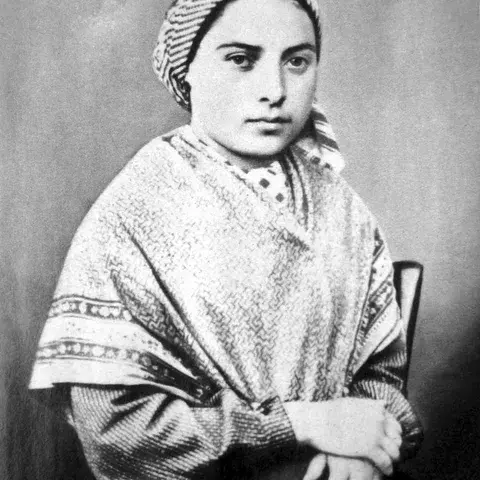
Overview
Marie-Bernarde Soubirous, called Bernadette, was born at Lourdes in the Hautes-Pyrénées on 7 January 1844, eldest of the nine children of François Soubirous, a miller, and Louise Casteròt. Hard times reduced the family to a single basement room, a disused jail called le cachot. A sickly child who survived cholera and chronic asthma and grew to barely four foot seven, she spoke the local Occitan and had scarcely learned to read. On 11 February 1858, aged fourteen, gathering sticks by the grotto of Massabielle, she saw a dazzling light and a small white figure she called simply aquerò, 'that thing'. Over eighteen apparitions the lady asked for prayer and penance, pointed her to a spring that began to flow, and requested a chapel and processions. On 25 March the lady answered her repeated question with the words, in Gascon Occitan, 'I am the Immaculate Conception'. Interrogated sharply by clergy and officials, the girl never varied her account. The apparitions were judged worthy of belief in 1862 and Lourdes became one of the world's great pilgrimage shrines. Fleeing attention, Bernadette joined the Sisters of Charity of Nevers in 1866 as Sister Marie-Bernarde, serving in the infirmary and sacristy until tuberculosis of the lungs and bones ended a life of quiet suffering on 16 April 1879, her last words a prayer to the Mother of God.
The Complete Life
Early Life
Marie-Bernarde Soubirous — Bernadette in the Occitan of her family — was born at Lourdes in the Hautes-Pyrénées on 7 January 1844 and baptized two days later at the parish church of St. Pierre. Her father François was a miller, her mother Louise a miller's daughter, and she was the eldest of nine children, several of whom died in infancy. Hard times had fallen on France and harder ones on the Soubirous: the mill failed, and by the late 1850s the family had sunk to living in le cachot, a one-room disused basement jail where they were housed for free by a cousin of her mother. Bernadette's health was frail from the start: cholera struck her as a toddler, and severe asthma troubled her for the remainder of her life; she never grew beyond about four foot seven and, contrary to the Hollywood version, spoke the local Occitan and learned only a little French, and that after the age of thirteen. She attended the day school of the Sisters of Charity and Christian Instruction of Nevers, but illness made her schooling fragmentary, and she could barely read and write.
§ Early life
Mission and Ministry
On 11 February 1858, when she was fourteen, Bernadette went with her sister Toinette and another girl to collect firewood near the grotto of Massabielle. Hanging back to remove her stockings before crossing the stream, she heard a sound of rushing wind, saw a wild rose in a niche of the rock move, and saw come from the alcove behind it a dazzling light and a white figure — the first of eighteen visions of what she called in Gascon Occitan aquerò, 'that thing', and in later testimony 'a small young lady'. The other girls saw nothing. Over the months that followed, the lady's messages were simple: prayer and penance. On 25 February Bernadette was told to drink of the spring, wash in it and eat the herb that grew there; the muddy hole cleared into flowing water by the next day. On 2 March came the request that a chapel be built and processions formed; her persistence with the skeptical parish priest eventually gave rise to the chapels and basilicas of Lourdes. On 25 March, the Annunciation, the lady answered Bernadette's repeated question about her name with the words 'I am the Immaculate Conception' — a phrase, defined by Rome only four years earlier, that the untaught girl did not understand. The authorities interrogated her, the crowds followed her, and the commission of the bishop of Tarbes eventually declared the reports worthy of belief on 18 February 1862.
§ Visions
Spirituality and Teaching
Bernadette's own account of herself was austere and unromantic. The vision, she insisted, was not for her pleasure or her glory; the lady had promised to make her happy 'not in this life, but in the other'. She disliked the attention the apparitions brought and retreated from it as far as she could. In the convent at Nevers, when questioned about Lourdes, she answered plainly and without embellishment, and her recorded remarks are all of a piece: her task had been to report what she saw, nothing more. What her contemporaries admired in her was not mystical giftedness but the ordinary virtues carried to an unusual degree — humility, patience under ridicule and illness, and an exact spirit of truthfulness in describing things she could not explain. Her devotion centred on Saint Bernard, her patron, whose texts she copied out in notebooks and on scraps of paper.
§ Later years
Trial and Final Years
Disliking the crowds, Bernadette went first to the hospice school run by the Sisters of Charity of Nevers at Lourdes, where she had already learned to read and write. She considered the Carmel but her frail health ruled out any strict contemplative order. On 29 July 1866, together with forty-two fellow postulants, she received the habit at the motherhouse of the Sisters of Charity of Nevers at Saint-Gildard, receiving the religious name Marie-Bernarde. The rest of her short life was spent there as assistant in the infirmary and later as sacristan, doing ornate embroidery for altar cloths and vestments. The childhood cholera had left her with chronic asthma, and she developed tuberculosis of the lungs and bones. For several months before her death she could take no active part in community life. She died on 16 April 1879, Easter Wednesday, aged thirty-five, while praying the rosary. Her last words were 'Blessed Mary, Mother of God, pray for me', and in her final sufferings she kept repeating, in the spirit of the lady's message at the grotto, 'all this is good for Heaven'.
§ Later years
Canonization
The process began with the exhumations. In 1909, in the presence of the bishop of Nevers, doctors and the community, her body was found incorrupt — the crucifix and rosary in her hands had oxidized, but the body had not decayed — and this was cited among the evidence for the cause. A second exhumation in 1919 confirmed the preservation, the examining doctor noting the body practically mummified with a notable layer of salts. On 14 June 1925 Pius XI beatified her, and on 8 December 1933 he canonized her — the very feast of the Immaculate Conception. Her feast was at first fixed on 18 February, the day the lady promised her happiness in the next life; it is now kept in most places on 16 April, the day of her death.
§ Introduction
Legacy
Bernadette's legacy is Lourdes. The grotto of Massabielle became the Sanctuary of Our Lady of Lourdes, among the largest pilgrimage sites in the world, drawing some five million pilgrims a year of all denominations; the underground Basilica of St. Pius X alone holds twenty-five thousand and was dedicated by the future John XXIII as nuncio to France. At Nevers the convent became the Espace Bernadette Soubirous, where her body lies exposed for veneration. For the Church's theology of apparitions she is the standing case of the unremarkable witness: no education, no influence, no health, and an account that sixty years of interrogation never shook. She is invoked for illness, for poverty, for shepherds, and for those ridiculed for their piety — the last a patronage she earned in her own lifetime.
§ Introduction
Timeline
- 7 Jan 1844
Born at Lourdes, eldest child of the miller François Soubirous and Louise Casteròt
§ Early life
- 9 Jan 1844
Baptized at the parish church of St. Pierre, on her parents' wedding anniversary
§ Early life
- 11 Feb 1858
While gathering firewood near the grotto of Massabielle she sees the first of eighteen visions of a small white figure
§ Visions
- 18 Feb 1858
The vision bids her return to the grotto each day for a fortnight, promising happiness in the next life
§ Visions
- 25 Feb 1858
Told to drink and wash at the spring and eat the herb there; clear water flows from the mud the next day
§ Visions
- 2 Mar 1858
At the thirteenth apparition the lady asks that a chapel be built and a procession formed
§ Visions
- 25 Mar 1858
At the sixteenth vision, lasting over an hour, the lady names herself in Occitan: 'I am the Immaculate Conception'
§ Visions
- 7 Apr 1858
During a vision her hand feels no burn from a candle flame held for several minutes
§ Visions
- 8 Jun 1858
The mayor of Lourdes orders the grotto barricaded and guarded against public access
§ Visions
- 16 Jul 1858
Watching from the far side of the river, she receives the eighteenth and last apparition
§ Visions
- 18 Feb 1862
After canonical investigation her reports are declared worthy of belief, giving rise to the cult of Our Lady of Lourdes
§ Introduction
- 29 Jul 1866
Takes the postulant's habit with the Sisters of Charity of Nevers at Saint Gildard, receiving the name Marie-Bernarde
§ Later years
- 1876
The Basilica of the Immaculate Conception is consecrated at Lourdes while she lives on at Nevers
§ Later years
- 16 Apr 1879
Dies at Nevers of tuberculosis, aged thirty-five, on Easter Wednesday, while praying the Rosary
§ Later years
- 22 Sep 1909
First exhumation at Nevers finds her body incorrupt, evidence later cited for her canonization
§ Mortal remains
- 3 Apr 1919
A second exhumation confirms the striking preservation of her body, which returns to the chapel of St Joseph
§ Mortal remains
- 14 Jun 1925
Beatified in Rome by Pope Pius XI; that year relics are taken and her body placed in a reliquary
§ Introduction
- 8 Dec 1933
Canonized by Pope Pius XI in Rome on the feast of the Immaculate Conception
§ Sainthood
- 1970
Her convent at Nevers becomes the Espace Bernadette Soubirous, a pilgrimage centre where her body is exposed
§ Mortal remains
In Their Own Words
I am the Immaculate Conception.
The Virgin used me as a broom to remove the dust. When the work is done, the broom is put behind the door again.
One must have faith and pray; the water will have no virtue without faith.
All this is good for Heaven!
I shall spend every moment loving. One who loves does not notice her trials; or perhaps more accurately, she is able to love them.
Why do we have to suffer? For here below pure Love does not exist without suffering.
He who loves, does everything without effort, or loves his effort.
When you obey you are never wrong, always obey with joy.
If we had faith we would see the good God in everything.
The Record
- Patron of
- The sick and poor·Shepherds and millers' families·Lourdes and its pilgrims
- Symbols
- Simple peasant dress or Sisters of Charity habit·Rosary·Grotto of Massabielle and the spring of Lourdes
- Canonization
- Beatified 14 June 1925 by Pope Pius XI; canonized 8 December 1933 by Pope Pius XI
Prayer
Bibliography
Show 12 sources
- 1 2 3 4 5 6 Ruggles, Robin (1999). Apparition shrines. Places of pilgrimage and prayer . Boston: Pauline Books & Media. p. 68 . ISBN 0-81984799-2 .
- ↑ "The Body of Saint Bernadette" . www.catholicpilgrims.com . Retrieved 11 June 2020 .
- ↑ "St. Bernadette Soubirous of Lourdes" . Catholic News Agency . Archived from the original on 22 July 2019 . Retrieved 14 April 2021 .
- 1 2 Media, Franciscan (16 April 2016). "Saint Bernadette Soubirous" . Archived from the original on 25 April 2017 . Retrieved 24 October 2019 .
- ↑ "UPI Almanac for Monday, Jan, 7, 2019" . United Press International . 7 January 2019 . Retrieved 21 September 2019 . Marie-Bernarde Soubirous, who became St. Bernadette and whose visions led to the foundation of the shrine at Lourdes, Fra
- 1 2 3 4 " "Saint Bernadette Soubirous", Lives of Saints , John J. Crawley & Co., Inc" . Retrieved 24 October 2019 .
- ↑ Taylor (2003) , p. 42.
- ↑ Taylor (2003) , pp. 59–60.
- ↑ Taylor (2003) , pp. 62–63.
- ↑ Taylor (2003) , pp. 68–69.
- ↑ Taylor (2003) , p. 84.
- 1 2 3 "Biography of Bernadette Soubirous" . Biography Online .
Profile text adapted from the Wikipedia article, licensed CC BY-SA 4.0.
Pray with this saint every day
Save St. Bernadette Soubirous to your favorites, read the full profile, and get feast-day reminders in the Saints app.
Get the Saints AppFree on the App Store for iPhone and iPad