
c. 1060 – 1133·Feast December 4
St. Bernard degli Uberti
Vallumbrosan abbot, cardinal, and bishop of Parma
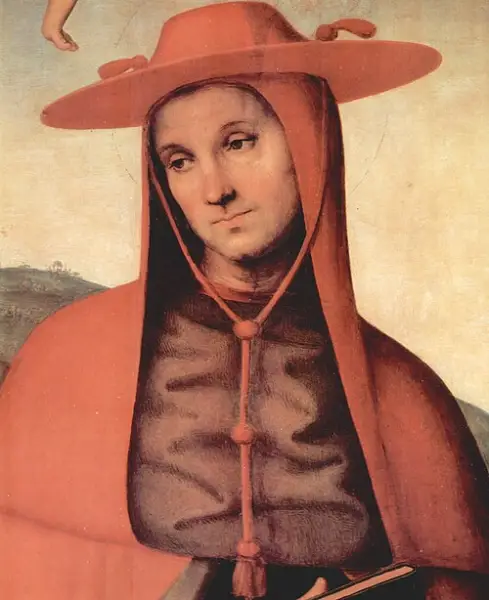
Overview
Bernard degli Uberti, born around 1060 in Florence to the noble Bruno degli Uberti and his wife Ligarda, was an Italian Roman Catholic prelate, a professed member and abbot of the Vallumbrosan Order, and Bishop of Parma from 1106 until his death. A nephew of Pietro Igneo, after his father's death in 1085 he joined the Vallumbrosans, a Benedictine branch. He served as abbot of San Salvi from 1092 to 1099, was named Cardinal-Priest of San Crisogono by Pope Urban II in 1097, and in 1098 was elected Superior-General of the congregation. As papal legate he served successive popes in Lombardy, Grosseto, Milan, and Pavia during their disputes with secular rulers, and he became a close confidant and advisor to the Countess Matilda of Tuscany. Appointed Bishop of Parma at the Council of Guastalla in October 1106 and consecrated by Paschal II the following month, he strove to hold the city for the pope against Emperor Henry V, suffering banishment and imprisonment. He died in his sleep on 4 December 1133 and was buried in Parma cathedral. Miracles were said to recur constantly at his grave, and Innocent II enrolled him among the saints in 1139. With Benedict of Nursia and Giovanni Gualberto he is frequently counted the third founding father of the Vallumbrosan Order.
The Complete Life
A Noble Florentine House
Bernard degli Uberti was born around 1060 in Florence, then part of the Tuscan Margrave, into one of the great noble houses of the city. His father was Bruno degli Uberti and his mother Ligarda; his paternal grandfather was Corbizo. The Uberti name carried weight in Florentine politics and society, and Bernard's upbringing would have been that of an aristocratic youth of the eleventh century, formed amid the factional life of a rising commune. Sanctity ran in the family: he was the nephew of Pietro Igneo, himself a celebrated Vallumbrosan cardinal and reformer remembered for his trial by fire against simony. That connection likely shaped the young man's direction, for the Vallumbrosan Order, a branch of the Benedictines founded by Giovanni Gualberto, drew heavily on the Tuscan nobility and embodied the reforming ideals then challenging a corrupt and worldly church. Bernard's father died sometime in 1085, and the loss became the occasion of his formal entry into religion. On 1 July 1085 he gave a gift to the San Salvi convent for his father's soul's rest, and with it he became a Vallumbrosan monk. On 26 April 1089 came a second gift, offered this time on behalf of father and grandfather together, evidence both of lasting care for his dead and of a steady loosening of his hold on the family estates. The nobleman had thus become a monk within the walls of a Florentine convent.
§ Life
Abbot, Cardinal, and Superior-General
Bernard's ascent within his order was swift. From 1092 to 1099 he governed San Salvi as abbot, ruling the very house his own gift had endowed. Rome soon heard of him: Urban II in 1097 raised him to the cardinalate as Cardinal-Priest of San Crisogono, and until 1101 he laboured at the Lateran. Then, upon the death of Abbot Almarius of Vallambrosa in 1098, the congregation chose him for Superior-General, setting the entire Vallumbrosan family beneath his charge. On 7 March 1100 he convened and presided over an assembly of all the order's abbots, called to settle weighty questions of organisation and discipline, which shows that his rule was legislative no less than administrative. His career thus joined the three great offices of the medieval church within a single life, abbot, cardinal and general, each continuing to claim him while the others went on. Such an accumulation was unusual, made possible by an age whose reforming popes drew their strongest helpers out of the monastic orders. Bernard's calling was not that of a recluse but of a builder, a man charged with ordering his own congregation's inner life while the church at large battled for its liberty. He would spend his remaining decades passing between cloister, curia and city, and the discipline he laid upon the Vallumbrosans proved lasting enough that he is often numbered the order's third founding father, after Benedict of Nursia and Giovanni Gualberto.
§ Life
Legate and Advisor in the Age of Reform
From 1101 onward Bernard's life became an exercise in papal diplomacy. Named legate to Lombardy, he began at the same time to counsel the Countess Matilda of Tuscany, the great upholder of the reform papacy, and a trusted intimate she found in him ever after. To Grosseto he went as legate on 7 April 1101, and on 4 May he stood beside Matilda at Governolo, where on his advice she handed certain lands back to the pope. The year 1102 found him in Milan as legate, superintending the choice of Grosulano as archbishop, and later that year, on 18 August, in Pavia on the same errand of legation. Panzano saw him at the countess's side on 18 October 1102, and in March 1103 he travelled with her to Castro Panciano, a companionship all but continuous in the field. At Cosogno and Modena in September 1104 he advised her again, and on 20 March 1105 he signed a papal bull within the Lateran Palace. That August he tried to get back into Parma to raise troopers for the pope against the German king, an effort that failed. His mission, in sum, was to hold northern Italy for the Gregorian reform against imperial power, deploying persuasion, law, and where needed the weight of Matilda's sword. It demanded courage and tact together, and across a decade of ceaseless journeying Bernard supplied both.
§ Life
A Bishop in Exile and a Peaceful Death
The bishopric of Parma came to Bernard in October 1106, announced by the pope at the Council of Guastalla, and in the following month Paschal II himself conferred episcopal consecration on him at Parma. That city would prove the great trial of his later years. Already on 15 August 1104, while labouring to hold the Parmense to the pope in the contest with Emperor Heinrich V and the Antipope Maginulf, he had been expelled into exile, and certain sources relate that he was actually hauled from the cathedral's altar in a violent scene. February 1111 saw him and the Roman Curia carried out of Rome and thrown into prison at the emperor's instance; the pope himself was captive too, and only the Countess Matilda managed to procure their freedom. Paschal II then resolved to crown the emperor, and on 13 April 1113 Bernard was present in Rome at that event, a reluctant witness to compromise. Two decades on, when after Innocent II's election a schism threatened and the antipope Anacletus II strove for control, the aged bishop stood by the lawful pontiff. A second banishment fell to him in 1127, incurred for resisting Conrad II's proclamation. Through gaol, expulsion, and the slow attrition of the investiture struggle, he never in spirit forsook his see. He fell asleep in death on 4 December 1133, some seventy-three years old, and was laid in Parma's cathedral, though one early life records him wide awake and receiving the last sacraments at the end.
§ Life
Canonized Six Years After His Death
So great did Bernard's fame for holiness become that his tomb in Parma cathedral was said to witness miracles constantly. That reputation set the church in motion with unusual speed: Innocent II proclaimed him a saint on 3 December 1139, a mere six years after his death at Parma, solemnising the canonization within Old Saint Peter's Basilica at Rome. Swiftness so marked was rare even by twelfth-century standards, when formal procedure remained fluid and popular acclaim weighed heavily, and it measures the strength of the devotion that had grown about the bishop's grave. The chosen date, the eve of his dies natalis on 4 December, fixed his liturgical celebration next to the anniversary of his death. Later popes went on honouring him within his own church: both Alexander VII and Clement IX extended his liturgical feast for the diocese of Parma, enlarging the local observance of a saint who belonged to that city in a special way. His cult thus flowed in two channels, the universal recognition won by papal canonization and the warmer domestic devotion of the Parmense, who remembered a bishop twice banished for their loyalty. The Vallumbrosan Order kept his memory too, as one of its own, a monk raised to the scarlet who stayed a monk at heart, and his 4 December feast stands in the tradition of the Roman Martyrology.
§ Canonization
Third Founder of the Vallumbrosans
Within his order Bernard degli Uberti is often considered the third founding father, alongside Benedict of Nursia, from whom the Vallumbrosans descend as a branch of the Benedictines, and Giovanni Gualberto, their immediate founder. The judgement reflects the constitutional work of his generalate: the meeting of abbots he presided over on 7 March 1100 settled resolutions on organization and discipline that gave the congregation durable shape, and his own career demonstrated how far a Vallumbrosan monk could rise in the service of the church without leaving the order behind. As Bishop of Parma he is remembered as the patron of the diocese, and his tomb in the cathedral remained a centre of devotion where miracles were said to occur frequently. His friendship with Countess Matilda placed him beside the most formidable woman of the investiture era, and his legations carried papal authority through Lombardy, Milan, Pavia, and Tuscany in the years when the freedom of the church hung in the balance. Artists kept his face for posterity: Bernardino Gatti and Pietro Perugino both painted him, and his coat of arms survives among the monuments of Florence. For the modern church his life offers a model of the union of contemplative discipline and public courage, a man equally at home signing a papal bull, governing monks, and facing a hostile crowd that would drag him from his own altar.
§ Life
Timeline
- 1060
Born at Florence around this year into the noble Uberti house, son of Bruno and Ligarda, nephew of Pietro Igneo
§ Life
- 1 Jul 1085
After his father's death that year he gives a donation for the father's repose to San Salvi convent and becomes a Vallumbrosan monk
§ Life
- 26 Apr 1089
Offers a further gift for the souls of his father and grandfather
§ Life
- 1092
Becomes abbot of San Salvi, an office he holds until 1099
§ Life
- 1097
Pope Urban II creates him Cardinal-Priest of San Crisogono; he serves at the Lateran until 1101
§ Life
- 1098
Elected Superior-General of the Vallumbrosan congregation after Abbot Almarius dies
§ Life
- 7 Mar 1100
Presides over a gathering of all the order's abbots to settle resolutions on organization and discipline
§ Life
- 7 Apr 1101
Appointed papal legate to Lombardy and advisor to Countess Matilda; sent to Grosseto on this date
§ Life
- 18 Aug 1102
Legate to Milan for Grosulano's election as archbishop, and to Pavia on this date
§ Life
- 15 Aug 1104
In Parma to keep the people loyal to the pope against Henry V and Antipope Maginulf, he is driven into exile
§ Life
- Oct 1106
Named Bishop of Parma by Pope Paschal II at the Council of Guastalla
§ Life
- Nov 1106
Receives episcopal consecration from Paschal II himself at Parma
§ Life
- Feb 1111
Removed from Rome with the Curia and imprisoned at the emperor's command; Countess Matilda secures their release
§ Life
- 13 Apr 1113
Attends in Rome the coronation of the emperor by Paschal II
§ Life
- 1127
Banished a second time for opposing the proclamation of Conrad II
§ Life
- 4 Dec 1133
Dies in his sleep at Parma and is buried in the cathedral there
§ Life
- 3 Dec 1139
Canonized by Pope Innocent II at Old Saint Peter's Basilica in Rome, six years after his death
§ Canonization
The Record
- Major works
- Resolutions on organization and discipline for the Vallumbrosan Order, from the abbots' meeting of 7 March 1100
- Patron of
- Diocese of Parma·Vallumbrosan Order
- Symbols
- Benedictine habit·Cardinal's attire
- Canonization
- Canonized on 3 December 1139 at Old Saint Peter's Basilica, Rome, by Pope Innocent II, only six years after his death
Prayer
Bibliography
Show 8 sources
- Miranda, Salvador. "Uberti, O.S.B.Vall., Bernardo degli (ca. 1060-1133)". The Cardinals of the Holy Roman Church. Florida International University Libraries. OCLC 53276621.
- Miranda, Salvador. "Aldobrandini, O.S.B.Vall., Pietro Igneo (?-1089)". The Cardinals of the Holy Roman Church. Florida International University Libraries.
- Butler, Alban. Butler's Lives of the Saints, Vol. 12. A&C Black, 1995, p. 44.
- Benigni, Umberto. "Diocese of Parma." The Catholic Encyclopedia. Vol. 11. New York: Robert Appleton Company, 1911.
- Kehr, Paul Fridolin (1906). Italia Pontificia Vol. V: Aemilia, sive Provincia Ravennas: Parma. Berlin: Weidmann. pp. 412–440.
- Affò, Ireneo (1788). Vita di San Bernardo degli Uberti abate gen. di Vallombrosa cardinale di s. chiesa e vescovo di Parma. Parma: Presso Filippo Carmignani.
- Donizo, "Vita Mathildis Comitissae", in Georgius Henricus Pertz, ed. (1856). Monumenta Germaniae historica, Scriptorum Tomus XII. Hannover. pp. 348–409.
- Chronicon Parmense. Monumenta historica ad provincias Parmensem et et Placentinam pertinenti, Volume 5a. Parma: ex officina P. Fiaccadori, 1855. pp. 491–515.
Profile text adapted from the Wikipedia article, licensed CC BY-SA 4.0.
Pray with this saint every day
Save St. Bernard degli Uberti to your favorites, read the full profile, and get feast-day reminders in the Saints app.
Get the Saints AppFree on the App Store for iPhone and iPad