
1090 – 1153·Feast August 20
St. Bernard of Clairvaux
Mellifluous Doctor and last of the Fathers
Overview
Bernard of Clairvaux, born in 1090 at Fontaine-lès-Dijon to the Burgundian nobles Tescelin de Fontaine and Alèthe de Montbard, was a French abbot, mystic, and the driving force behind the reform of the Benedictines through the young Cistercian Order. Educated at Châtillon-sur-Seine and drawn to the religious life after his mother's death, he entered the new monastery of Cîteaux in 1113 with thirty other young noblemen, many of them his relatives. Two years later he founded Clairvaux Abbey in the Diocese of Langres and governed it as abbot for the rest of his life; more than sixty daughter houses followed in his lifetime, and he helped found 163 monasteries across Europe. Honoured as a mystic and co-founder of the Knights Templar, for whose Rule he drew the outlines at Troyes in 1128, he championed Pope Innocent II against the Antipope Anacletus II, opposed Peter Abelard at the council of 1141, preached against the Henricians and Cathars in southern France, and in 1146 preached the Second Crusade at Vézelay before a vast multitude. The title Doctor Mellifluus came to him through his writings, above all the Sermons on the Song of Songs and the De consideratione. Forty years of monastic life closed with his death at Clairvaux on 20 August 1153; canonization followed in 1174 and the title of Doctor of the Church in 1830.
The Complete Life
A Burgundian Nobleman's Son
Bernard came into the world around 1090 at Fontaine-lès-Dijon in Burgundy, born to the duchy's highest nobility. Tescelin de Fontaine, his father, was lord of Fontaine-lès-Dijon; his mother, Alèthe de Montbard, belonged to a house that would in time give the Knights Templar one of its founders, since André de Montbard, a half-brother of Bernard's mother, stood among that order's first members. Of seven children, six of them sons, Bernard was the third. At nine years old he went to school at Châtillon-sur-Seine under the secular canons of Saint-Vorles, and there kindled a lasting delight in literature and rhetoric, the instruments that would one day make him the twelfth century's most celebrated preacher. While he was still a youth his mother died, and the loss went deep; schooled among priests, he often entertained the thought of orders himself. The decisive outside event came earlier: in 1098 Robert of Molesme and a group of followers had established Cîteaux Abbey near Dijon, resolved upon a literal reading of the Rule of St. Benedict, and their new administrative arrangements among monasteries effectively brought a new order into being, named from that first abbey the Cistercians. Once his mother was gone Bernard resolved on Cîteaux, and in 1113 he and thirty companions of the young Burgundian nobility, kinsmen among them, won admission to the young monastery. So persuasive was his example that scores of others, his own father included, followed him into religion, which is why he is looked upon as the patron of religious vocations.
§ Early life (1090–1113)
Founder and Abbot of Clairvaux
Cîteaux's little band of reformed Benedictines multiplied quickly, and within three years of profession Bernard was sent out at the head of twelve monks to plant a new house in the Vallée d'Absinthe, within the Diocese of Langres. To this place he gave the name Claire Vallée, Clairvaux, on 25 June 1115, and afterwards the names of abbot and abbacy were never parted. William of Champeaux, bishop of Châlons-sur-Marne and a professor of theology at Notre Dame of Paris who had founded the abbey of St Victor, installed him as abbot, and between the two men there grew a firm friendship. The first years were hard, and the abbot harder on himself than on anyone: from his noviciate onward illness had visited him often, the fruit of extreme fasting. Candidates for religion nevertheless crowded to him, and before long Clairvaux was sending out colonies of its own. In the diocese of Châlons rose Trois-Fontaines in 1118; in the Diocese of Autun, Fontenay in 1119; near Vervins, Foigny in 1121. More than sixty further abbeys followed within his lifetime, though certain of them were houses transferring to Cistercian observance rather than fresh foundations. In 1128 he sat at the Council of Troyes, where the Rule of the Knights Templar took shape under his hand, an ideal of Christian nobility soon after. Jean-Baptiste Chautard described him as the most contemplative and at once the most active man of his age; Bernard's own phrase for himself was the chimera of his age.
§ Abbot of Clairvaux
Healer of the Church's Schism
The death of Pope Honorius II in 1130 split the church through the election of two popes, Innocent II and the Antipope Anacletus II. Banished from Rome by his rival, Innocent found shelter in France, where Louis VI gathered the French bishops in national council at Étampes. Called there by the bishops, Bernard received the duty of judging between the claimants, and his verdict fell for Innocent, settling the course of all his remaining years. He passed on into Italy, bringing Pisa and Genoa to agreement and Milan back to the pope, and stood at Innocent's side at the Council of Reims. In Aquitaine he laboured for years to loosen Duke William X from Anacletus, writing along the way to Gerard of Angoulême, whom he would afterwards name the ablest opponent the schism gave him, and celebrating Mass in the church of La Coudre at which he warned the duke not to hold God in the contempt he showed God's servants. William gave way, though not finally before 1135. In 1132 Bernard went with Innocent into Italy, where at Cluny the pope cancelled the dues Clairvaux had been paying, kindling a twenty-year quarrel between the White Monks and the Black. Offered the see of Milan, he refused it, and in 1137, under papal orders, he journeyed to Palermo and brought Roger II of Sicily to acknowledge Innocent's rights. Anacletus died in 1138, and the schism died with him; what remained of his following was condemned outright at the Second Lateran Council of 1139.
§ Schism
The Poet of Love and the Doctor of Prayer
In his spirituality Bernard set himself deliberately against the schools. Where the scholastics reasoned their way toward God, he preached as a poet, moving emotion and conversion toward an immediate experience of faith, and he is accounted a master of Christian rhetoric, his handling of language perhaps his most universal legacy. He supplied lyrics to the Cistercian Hymnal, and as a master of prayer he set store by a personal, experiential friendship with Christ. Preached first to his monks at Clairvaux, his sermons on the Song of Songs break off incomplete at eighty-six and carry, in the twenty-sixth, an autobiographical lament for his brother Gerard, whose death laid him low and gave rise to one of his most affecting discourses; after him the English Cistercian Gilbert of Hoyland carried the series forward. As a mariologist Bernard broke little new ground yet spread devotion to Christ's mother with unmatched effect, his preaching gathering great audiences; he stressed Mary's lowliness and her standing at the centre of theology, unfolded her part as Co-Redemptrix and mediator, and gave her the enduring name of an aqueduct of grace. Dante assigns him a profound Marian prayer opening the thirty-third canto of the Paradiso, and Goethe's Faust shows him as a devoted Doctor Marianus before the Virgin. To Eugene III, his own monk raised to Peter's chair, he addressed the oft-quoted De consideratione, urging that the reform of the church begin with the pope and that piety and meditation come before action.
§ Doctor of the Church
Heresy, Crusade, and a Sorrowful Old Age
The church's battles filled Bernard's last decade. From his overcrowded monastery he had been sending out companies of monks, into Germany, Portugal, Sweden and England, into Switzerland, Ireland and Italy; from Tre Fontane, one of these houses, Eugene III came forth in 1145. Summoned next against heresy, he went south through France in June 1145 at Cardinal Alberic of Ostia's invitation, where his preaching, seconded by his ascetic appearance and plain clothing, helped destroy the Henricians and Petrobrusians, and where he lifted his voice against the Cathars too. With Peter Abelard he waged a different contest: having denounced Abelard's teaching before pope and cardinals, he met him at Sens in 1141, where the council, assembled at Abelard's own urging, heard Bernard open and watched Abelard retire without a word of answer; Abelard submitted and died at Cluny under Peter the Venerable's protection in 1142. After Edessa fell to the Seljuk Turks, Eugene III in 1144 commissioned Bernard to preach the Second Crusade, granting the same indulgences Urban II had granted the First. On 31 March 1146, with King Louis VII looking on, he addressed a vast crowd in a field at Vézelay in the speech of his life; the cloth for crosses gave out among the recruits, and Conrad III of Germany with his nephew Frederick Barbarossa afterwards took the cross from Bernard's hand. In the Rhineland he defended the Jews against the fanatic Radulf, whom he silenced at Mainz. The crusade's failure shadowed his final years, and he ascribed it to the crusaders' sins. Suger died in 1152, and Conrad III and his son Henry in the same year. Bernard himself passed away on 20 August 1153, sixty-three years old, forty of them spent in monastic life.
§ Final years (1149–1153)
Canonized in Twenty-One Years and Declared Doctor
So great was Bernard's name for holiness that the church moved with striking speed once he lay in his grave. On 18 January 1174 Alexander III enrolled him among the saints at Rome, only twenty-one years after his passing at Clairvaux, an interval extraordinarily short for a medieval saint and a measure of the devotion his memory commanded throughout Europe. Troyes Cathedral became his major shrine, for when French revolutionaries destroyed his remains in 1792, what could be recovered was carried thither. A higher honour followed centuries on: in 1830 Pius VIII named him a Doctor of the Church, setting his writings among the church's authoritative teachers. Confirmation and enlargement came in 1953, when, upon the eight hundredth anniversary of his death, Pius XII gave over an entire encyclical to him, Doctor Mellifluus, the Mellifluous Doctor, and named the abbot the last of the Fathers, the figure who closes the patristic age and opens the road to the medieval theology after him. Modern scholarship may own him a difficult saint, yet his influence has never faded since his death, and he is honoured not in the Catholic Church alone but in the Anglican Communion and in Lutheranism, his feast falling on 20 August, the day he died.
§ Doctor of the Church
Dante's Last Guide and a Reorientation of Theology
Across Europe Bernard helped bring 163 monasteries into being, and among early Cistercians the order honours him as one of the greatest. His 20 August feast is kept widely in the West. For the Divine Comedy's final guide Dante chose him, setting him in the Empyrean in Beatrice's place and entrusting to him the great prayer to the Virgin that closes the poem, proof of how entirely Bernard had come to stand for mystical contemplation. Scholars credit him with a fundamental reorientation of medieval theology, shifting its centre of gravity from dialectic toward love and the lived experience of God. At Fontaine-lès-Dijon, his birthplace, stands the Couvent et Basilique Saint-Bernard, buildings of the twelfth, seventeenth and nineteenth centuries gathered together, and churches and chapels without number across the world take him for patron, from Gibraltar to the Philippines. His works circulated so far that a whole literature of pseudo-Bernardine writing grew up about his name, among it the Meditatio, the hymn Jesu dulcis memoria and even the Memorare, none from his hand; the modern critical edition of what is genuinely his, the Sancti Bernardi opera edited by Jean Leclercq, fills eight volumes in nine published between 1957 and 1977. Of his letters 547 survive, together with 125 sermons on the liturgical year and the incomparable sequence on the Song of Songs.
§ Legacy
Timeline
- 1090
Born at Fontaine-lès-Dijon in Burgundy, third of seven children of Tescelin de Fontaine and Alèthe de Montbard.
§ Early life (1090–1113)
- 1098
A group led by Robert of Molesme founds Cîteaux Abbey near Dijon to live the Rule of St Benedict literally, creating the Cistercian Order.
§ Early life (1090–1113)
- 1113
Enters Cîteaux accompanied by thirty young noblemen of Burgundy, many of them kinsmen; his example draws scores more, his father included, into monastic life.
§ Early life (1090–1113)
- 25 Jun 1115
Sent with twelve monks to found a new house in the Vallée d'Absinthe, which he names Clairvaux on 25 June; William of Champeaux makes him abbot.
§ Abbot of Clairvaux
- 1118
Clairvaux founds a daughter house, Trois-Fontaines Abbey, in the diocese of Châlons.
§ Abbot of Clairvaux
- 1119
Fontenay Abbey is founded in the Diocese of Autun.
§ Abbot of Clairvaux
- 1121
Foigny Abbey is founded near Vervins.
§ Abbot of Clairvaux
- 1128
Attends the Council of Troyes, where the Rule of the Knights Templar takes its shape from him.
§ Abbot of Clairvaux
- 1130
On the death of Honorius II a schism breaks out; summoned to the council at Étampes, Bernard judges in favour of Pope Innocent II over Antipope Anacletus II.
§ Schism
- 1132
Accompanies Innocent II into Italy; at Cluny the pope abolishes the dues Clairvaux had paid, sparking a twenty-year quarrel between White and Black Monks.
§ Schism
- 1135
William X, Duke of Aquitaine, the hardest holdout of the schism, finally pledges allegiance to Innocent II.
§ Schism
- 1138
Anacletus II dies of grief and disappointment, and the schism ends after Bernard convinces Roger II of Sicily at a conference in Palermo.
§ Schism
- 1139
Assists at the Second Council of the Lateran; Malachy, Primate of All Ireland, visits Clairvaux and a close friendship begins.
§ Schism
- 1141
At the council at Sens, called at Abelard's urging, Bernard's opening statement leads Abelard to retire without answering; the council finds for Bernard.
§ Conflict with Abelard
- 1144
Pope Eugene III commissions him to preach the Second Crusade, granting the same indulgences Urban II had given the First.
§ Second Crusade (1146–1149)
- 1145
His disciple Bernard of Pisa becomes Pope Eugene III; in June Bernard preaches in southern France against the Henricians and Petrobrusians.
§ The challenge of heresy
- 31 Mar 1146
Preaches the Second Crusade on 31 March to an enormous crowd at Vézelay with King Louis VII present, then in Germany wins Conrad III and Frederick Barbarossa to the cross.
§ Second Crusade (1146–1149)
- 1147
Writes the letter advocating subduing the Wends, proclaimed widely by decree at Frankfurt so that it functioned as a sermon.
§ Wendish Crusade (1147)
- 1148
Malachy of Ireland dies at Clairvaux; at the Council of Reims Bernard's manoeuvring against Gilbert of Poitiers offends the cardinals and no verdict is rendered.
§ The challenge of heresy
- 20 Aug 1153
Dies on 20 August at Clairvaux aged sixty-three, after forty years of monastic life, and is buried in the abbey.
§ Final years (1149–1153)
- 18 Jan 1174
Canonized by Pope Alexander III in Rome on 18 January, twenty-one years after his death.
§ Doctor of the Church
- 1792
French Revolutionaries destroy his remains, which are later translated to Troyes Cathedral.
§ Final years (1149–1153)
- 1830
Pope Pius VIII declares him a Doctor of the Church.
§ Doctor of the Church
- 1953
Marking eight hundred years since his death, Pope Pius XII devotes the encyclical Doctor Mellifluus to him, calling him the last of the Fathers.
§ Doctor of the Church
In Their Own Words
Cities and castles are now empty. There is not one man left to seven women, and everywhere there are widows to still-living husbands.
If there is any precious vase adorning the palace of the King of Kings, it is the soul of the venerable Suger.
Believe me, you will find more lessons in the woods than in books. Trees and stones will teach you what you cannot learn from masters.
The reason for loving God is God Himself; and the measure of our love for Him is to love Him without measure.
Among us on the earth there is His memory; but in the Kingdom of heaven His very Presence. That Presence is the joy of those who have already attained to beatitude; the memory is the comfort of us who are still wayfarers, journeying towards the Fatherland.
God cannot suffer, but is not without compassion.
For there are some who want knowledge for the sole purpose of knowing, and this is unseemly curiosity. And there are some who seek knowledge in order to be known themselves; and this is unseemly vanity.
The Record
- Major works
- De gradibus humilitatis et superbiae (The Steps of Humility and Pride), c. 1120·Apologia ad Guillelmum Sancti Theoderici Abbatem (Apology to William of St. Thierry), defending the Cistercians against Cluny·De conversione ad clericos sermo seu liber (On the Conversion of Clerics), 1122·De gratia et libero arbitrio (On Grace and Free Choice), c. 1128·De diligendo Deo (On Loving God)·Liber ad milites templi de laude novae militiae (In Praise of the New Knighthood), 1129·De praecepto et dispensatione libri (Book of Precepts and Dispensations), c. 1144·De consideratione (On Consideration), c. 1150, addressed to Pope Eugene III·Liber De vita et rebus gestis Sancti Malachiae (The Life and Death of Saint Malachy)·Sermones super Cantica Canticorum (Sermons on the Song of Songs)·Sermones per annum (125 Sermons on the Liturgical Year)·Five hundred and forty-seven surviving letters
- Patron of
- Cistercians·Burgundy·Beekeepers·Candlemakers·Gibraltar·Algeciras·Queens' College, Cambridge·Speyer Cathedral·Knights Templar·Binangonan, Rizal·Patron of religious vocations
- Symbols
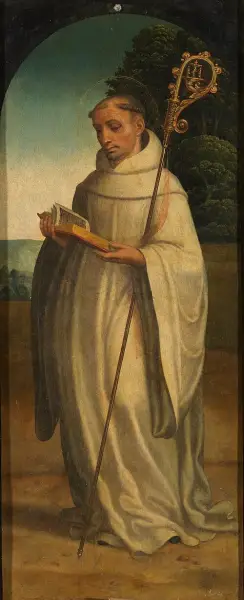
- Cistercian habit·Book·Crosier
- Canonization
- Canonized on 18 January 1174 in Rome by Pope Alexander III, only twenty-one years after his death; declared a Doctor of the Church by Pope Pius VIII in 1830
Prayer
Bibliography
Show 12 sources
- Gildas, Marie (1907). "St. Bernard of Clairvaux". In Herbermann, Charles (ed.). The Catholic Encyclopedia. Vol. 2. New York: Robert Appleton Company.
- Evans, Gillian R. (2000). Bernard of Clairvaux (Great Medieval Thinkers). Oxford University Press. ISBN 0-19-512525-8.
- McGuire, Brian Patrick (1991). The Difficult Saint: Bernard of Clairvaux and His Tradition. Cistercian Publications. ISBN 978-0-87907-626-9.
- McGuire, Brian Patrick (2013). "Bernard of Clairvaux". Oxford Bibliographies. Oxford University Press. doi:10.1093/OBO/9780195396584-0088.
- Pius XII (1953). "Doctor Mellifluus". Holy See.
- Bernard of Clairvaux (1957–1977). Leclerq, Jean; Talbot, Charles H.; Rochais, Henri Marie (eds.). Sancti Bernardi Opera. Rome: Éditions cisterciennes.
- Bernard of Clairvaux (1998). The Letters of St Bernard of Clairvaux. Translated by Bruno Scott James. Kalamazoo, MI: Cistercian Publications. ISBN 9780879071622.
- Cristiani, Léon (1977). St. Bernard of Clairvaux, 1090–1153. Translated by M. Angeline Bouchard. St. Paul Editions. ISBN 978-0-8198-0463-1.
- Botterill, Steven (1994). Dante and the Mystical Tradition: Bernard of Clairvaux in the Commedia. Cambridge: Cambridge University Press.
- Kemp, E. W. (1945). "Pope Alexander III and the Canonization of Saints: The Alexander Prize Essay". Transactions of the Royal Historical Society 27: 13–28.
- Runciman, Steven (1987). The Kingdom of Jerusalem and the Frankish East, 1100–1187. A History of the Crusades, Vol. 2. Cambridge: Cambridge University Press.
- Phillips, Walter Alison (1911). "Bernard, Saint". In Encyclopædia Britannica, 11th ed. Vol. 3. Cambridge University Press. pp. 795–798.
Profile text adapted from the Wikipedia article, licensed CC BY-SA 4.0.
Pray with this saint every day
Save St. Bernard of Clairvaux to your favorites, read the full profile, and get feast-day reminders in the Saints app.
Get the Saints AppFree on the App Store for iPhone and iPad