
1605 – 1667·Feast January 12
St. Bernard of Corleone
Sicilian swordsman turned gentle Capuchin brother
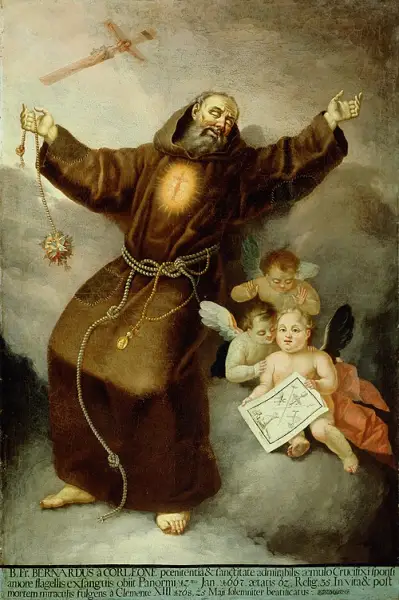
Overview
Bernard of Corleone, born Filippo Latini on 6 February 1605 in Corleone, Sicily, was a Capuchin lay friar remembered for a conversion as dramatic as any in Franciscan history. Third among six children of Leonardo and Francesca Latini, he never went to school and followed his father's trade of cobbler, the elder Latini being so compassionate that the poor were welcome in his house to wash and to eat. After his father died in March 1620, Filippo became a soldier, took up fencing, and earned a formidable name through his boiling temper, challenging to single combat all who gave offence to him or to his causes, though he also defended old and helpless persons against violence and kept a lamp burning before a local crucifix. In the summer of 1624 a duel with the professional assassin Vito Canino cost his opponent an arm, won him the nickname of the finest blade in Sicily, and shook him to the core; fleeing the avengers, he sought refuge with the Capuchins in Palermo, where he repented his violent life. On 13 December 1632 he began the novitiate at Caltanissetta under the name Bernardo. His penance became severe, sleeping three hours on a board, fasting on bread and water, and scourging himself weekly, and he grew into a man known for gentleness, serving as a cook with special concern for the sick and carrying minestrone through the streets to the poor, dying in Palermo on 12 January 1667; John Paul II canonized him in 2001.
The Complete Life
A Cobbler's Son in Corleone
The future Bernard of Corleone first drew breath as Filippo Latini on 6 February 1605 in Corleone, a town of the Sicilian interior. Third in a family of six children born to Leonardo and Francesca Latini, he was baptized within a few hours of birth. His siblings were godly people, and one brother rose to the priesthood, but Filippo himself never sat in a school of any sort. Leonardo was a shoemaker, and the boy picked up the craft at his father's bench; more than a trade, however, he took in the older man's pity for the unfortunate, since Leonardo's heart was so open that the poor of the town might come into his home to wash themselves and be fed. That pattern of hands-on mercy, learned in a poor craftsman's household, would bear fruit again in the friar's later years. When Leonardo died in March 1620, Filippo, then fifteen, kept on with the trade a while to support his mother, but a cobbler's settled life could not hold a boy who had already gone off to be a soldier on 1 May 1618. Fencing next claimed him, and in it he grew proficient, gaining a soldier's competence together with a fighter's pride. Yet religion never entirely let him go: even in his wildest season he came often to a local crucifix, saw to it that a lamp burned there continually, and held Francis of Assisi in devotion.
§ Life
The Duel That Broke a Swordsman
As a soldier Latini was a man of boiling blood, ready to call out any man who affronted him or the causes he held dear. At the later beatification hearings two witnesses singled out his one fault, observing that at the least provocation his sword left its sheath, and those years of his were not distinguished by moral conduct, so that a formidable name attached to him through the towns of Sicily. Even so the portrait is not uniformly black. Devout he was not, but old people and other helpless and defenceless folk could count on his protection against violence, for he would place himself between the weak and anyone who meant them harm. The turning point arrived in summer 1624, when a duel set him against Vito Canino, a killer by profession. Canino came away from the encounter short of an arm, a great crowd looked on, and the ensuing uproar fixed on Filippo the byname of Sicily's finest blade, a title of dreadful pride. Flying from Canino's avengers, he threw himself upon the Friars Minor Capuchin, though the deeper reason was that the affair had shaken him to his very foundations. Among those friars he set about reviewing his life and repenting his years of wrath and violence. In time he begged pardon of Vito Canino in person, and the two became friends once their quarrel was settled. On 13 December 1632, asking admission as a religious, he entered the order's novitiate at Caltanissetta, taking the habit and the name in religion Bernardo.
§ Life
Kitchens, Cloisters, and a Pot of Minestrone
Brother Bernardo exercised his mission through the lowliest offices of Capuchin existence. Simply he lived, passing from friary to friary about the Sicilian province in the order's wandering fashion. Corleone held him from 1635 to 1636; Bivona came next, then Castronovo, Castelvetrano and Sambuca, the last amounting to just over a decade in all, before Bisaquino, Ciminna, Chiusa and a second spell at Castronovo followed. After Agrigento came Castronovo for a third time, then Caltabellotta, Burgio, Chiusa again, and finally Partinico, until the last fifteen years of his life were spent at Palermo. Within the friaries his office was that of cook or assistant cook, and towards the end he took charge of washing and managing the brethren's clothing, the gentlest conceivable inversion for a swordsman's hands. Long hours he worked, and his care for the sick was special; at Castronovo he would shoulder a great pot and make his way through the streets doling out minestrone to the poor, an image stamped forever upon the memory of his cult. The friar who had once fed upon honour now fed the hungry; the arm once trained to strike now bore soup through the town. Where his father had once welcomed the poor under his own roof, the son carried the pot to their doors, completing in a religious habit the charity first learned in a cobbler's workshop.
§ Life
Penance, the Madonna, and the Infant Jesus
Brother Bernardo's interior life belonged to the severe old Sicilian school. His devotion turned strict almost past bearing: weekly, seven times over, he scourged himself; nightly he allowed himself three hours of sleep upon a narrow board, a block of wood set beneath his head for a pillow; and his fasting ran mostly to bread and water. Of the habits available he would put on the most threadbare, and he slept in the least comfortable cell the house afforded. One fruit of this lifelong penance was the rheumatism that plagued much of his later life, a bodily inscription of the austerity he had freely embraced. Yet rigour was never the whole of him. Out of such discipline there grew a person marked by gentleness and compassion, the sword's anger burned away across four decades of penitential living. Strong was his devotion to the Madonna, and he stirred others toward it as well; his biographers relate that the Blessed Mother appeared to him and laid the Infant Jesus within his arms, the mystical crowning of a life given to humble service. They claim, further, that she let him know the date of his death four months beforehand, so that the friar who had once lived by a blade's timing now awaited a day appointed by heaven. His attachment to Francis of Assisi, formed even in his violent years, reached its fulfilment in the Capuchin habit, and the love of the crucifix that had kept a lamp burning through his turbulence became the centre of his prayer.
§ Life
Fifteen Years in Palermo and a Desired Death
Palermo, the city that had first made his reputation, received Brother Bernardo for the final fifteen years of his life, and there that reputation was sealed. In this period he met again the man he had once maimed, Vito Canino, in 1654 and twice afterwards, in 1659 and 1663; assassin and penitent swordsman, now reconciled, kept up a friendship that stands as the plainest token of the grace which had transformed both the duel and everything after it. By the end his charge among the friars was the washing and care of their clothing, the lowliest labour of the house, performed by a man whose hands had once been accounted the most dangerous in Sicily. On 7 January 1667 he was carried into the convent's hospital wing, and there, five days on, he died at two o'clock in the afternoon on 12 January, sixty-one years old. Upon his deathbed he went on repeating the words 'let's go', in expectation of his dies natalis, his birth into heaven, a date that, on his biographers' claim, had been made known to him four months earlier. The funeral cortege was a long one, so great was the renown he had gathered in his lifetime, and the people of Palermo turned out for the friar who had cooked for them, washed for them and carried food out to their poor. At his grave numerous wonders were reported and duly recorded, opening the long road that ran from a Palermo convent infirmary to the altars of the universal church.
§ Life
A Cause of Three Centuries
The process that lifted Brother Bernardo to the Church's honours proved one of the longest conceivable, running from the seventeenth century into the twenty-first. It opened at Palermo with an informative inquiry begun in 1673, six years after his death, which concluded at some later date; upon that an apostolic process followed, opened in 1681 and closed at the decade's end on 16 December 1689. Benedict XIII formally introduced the cause on 18 December 1725, whereby Latini received the style of Servant of God. Once his heroic virtue stood confirmed, Clement XIII was able to declare him Venerable on 2 February 1762, and it was Clement again who beatified him, on 29 April 1768, in a ceremony connected with Saint Peter's. The cause for sainthood was formally set under way on 11 December 1773, and there it rested for rather more than two hundred years. A last miracle was wanted, and one such came under investigation in its home diocese: the Congregation for the Causes of Saints ratified the proceedings on 22 May 1998; the doctors' panel then approved, on 12 May 1999, the theologians following on 24 September of that year and the Congregation itself on 21 March 2000. John Paul II approved the miracle on 1 July 2000, appointed the day in a consistory of 13 March 2001, and on 10 June 2001, in Saint Peter's Square, numbered Latini among the saints.
§ Veneration
Timeline
- 6 Feb 1605
Born Filippo Latini at Corleone, third of the six children of Leonardo and Francesca Latini, and baptized within hours
§ Life
- 1 May 1618
Leaves home to become a soldier on this date, soon mastering fencing and gaining a duelist's reputation
§ Life
- Mar 1620
His father Leonardo dies; Filippo plies the cobbler's trade a while longer to support his mother
§ Life
- 1624
A summer duel costs the assassin Vito Canino an arm and wins Filippo renown as Sicily's finest blade; he flees to the Capuchins
§ Life
- 13 Dec 1632
Enters the Capuchin novitiate at Caltanissetta, receiving the habit and the religious name Bernardo
§ Life
- 1635
Stationed at Corleone, the first of two decades of simple moves from friary to friary across the province
§ Life
- 1637
At Castronovo he carries a great pot through the streets, serving minestrone to the poor
§ Life
- 1651
Assigned to Partinico after postings at Bivona, Castelvetrano, Sambuca, Bisaquino, Ciminna, Chiusa, Agrigento, Caltabellotta and Burgio
§ Life
- 1654
Reunited with his former opponent Vito Canino, now a friend, meeting him again in 1659 and 1663
§ Life
- 7 Jan 1667
Moved into the convent's hospital wing as his final illness advances
§ Life
- 12 Jan 1667
Dies at Palermo at two in the afternoon, repeating 'Let's go', after a vast funeral procession
§ Life
- 1673
An informative beatification process opens in Palermo
§ Veneration
- 1681
An apostolic process is opened in the cause
§ Veneration
- 16 Dec 1689
The apostolic process closes at the end of the decade on this date
§ Veneration
- 18 Dec 1725
Pope Benedict XIII formally introduces the cause, giving Latini the title of Servant of God
§ Veneration
- 2 Feb 1762
Pope Clement XIII confirms his heroic virtue and titles him Venerable
§ Veneration
- 29 Apr 1768
Beatified by Pope Clement XIII
§ Veneration
- 11 Dec 1773
The cause for his sainthood is formally opened
§ Veneration
- 10 Jun 2001
Canonized by Pope John Paul II in Saint Peter's Square
§ Veneration
In Their Own Words
He was quick to draw his sword at the slightest provocation
Let's go
The Record
- Patron of
- Mafia victims·Expectant mothers
- Symbols
- Franciscan habit
- Canonization
- Beatified by Pope Clement XIII in 1768; canonized by Pope John Paul II on 10 June 2001 in Saint Peter's Square
Prayer
Bibliography
Show 7 sources
- "Bernardo da Corleone (1605-1667)". Holy See.
- "Saint Bernard of Corleone", Capuchins in Korea.
- "Saint Bernard Latini of Corleone", Capuchin Franciscan Friars Australia.
- "Saint Bernard of Corleone". Saints SQPN, 12 January 2017.
- "Saint Bernard of Corleone". Santi e Beati.
- "St. Bernard of Corleone, OFM Cap.", Capuchin Franciscans, Western American Province.
- Index ac status causarum beatificationis servorum dei et canonizationis beatorum (in Latin). Typis polyglottis vaticanis, January 1953, p. 36.
Profile text adapted from the Wikipedia article, licensed CC BY-SA 4.0.
Pray with this saint every day
Save St. Bernard of Corleone to your favorites, read the full profile, and get feast-day reminders in the Saints app.
Get the Saints AppFree on the App Store for iPhone and iPad