
c. 923 – 1008·Feast May 28
St. Bernard of Menthon
Archdeacon of Aosta and founder of the Great St Bernard Hospice
Overview
Saint Bernard of Menthon, also called Bernard of Aosta or Bernard of Montjoux, was a Catholic priest born around 923, most probably on Italian soil, into what legend describes as a wealthy and noble family of the Château de Menthon near Annecy. Schooled in Paris, he turned from a marriage his father had arranged and gave himself to the Church instead, forming himself under Peter, the archdeacon of Aosta, by whom he was ordained priest. His learning and evident virtue led to his own appointment as archdeacon of the cathedral, a post that made him the bishop's deputy in governing the diocese and charged him with the poor and with travellers crossing the Alps. For forty-two years he preached in the mountain villages and in many cantons of Lombardy, winning numerous conversions. His enduring monument is the hospice and community of canons regular he planted at the summit of the Great St Bernard Pass, followed by a second house on the Little St Bernard Pass, both placed under the patronage of Nicholas of Myra after papal approval secured during a visit to Rome. He died at Novara in 1008 while reconciling two quarrelling noblemen and was buried in the monastery of Saint Lawrence. Canonized by Pope Innocent XI in 1681, he is honoured as patron of the Alps and of mountaineers, skiers, snowboarders and backpackers.
The Complete Life
A noble son of the mountains
Tradition places Bernard's birth at the Château de Menthon above Annecy, in the County of Savoy, then part of the Kingdom of Burgundy, though the story has been disputed and the evidence suggests he was in fact born in Italy. Whatever the exact spot, legend agrees that his family was rich and noble and that he received a thorough education, sent to Paris for his schooling. On reaching adulthood he resolved to serve the Church, declining the honourable marriage his father had negotiated on his behalf. A pious tale attaches to that decision: he is said to have made his escape from the castle the very night before the wedding, and in his flight to have leapt from a window, angels catching him and bearing him gently down unhurt to the earth forty feet below. Modern scholarship reads these details as legend rather than history, yet they preserve the substance of the memory: a young man of privilege who exchanged inheritance and bride for the priesthood. Neither the names of his parents nor the exact course of his Paris studies survive in the record. What is certain is that he passed from the world of the Savoyard aristocracy to the church of Aosta, where the next stage of his life unfolded under a superior whose office he would one day inherit, and where the mountains that had cradled him would become the field of his labour.
§ Early life
Ordination and the archdeaconry of Aosta
Bernard put himself under the direction of Peter, the archdeacon of Aosta, and advanced so quickly under that guidance that he was ordained priest and sent to work as a missionary in the villages of the Alps. When his gifts of learning and character made themselves felt, he was chosen to follow his teacher into the office of archdeacon of the cathedral. This was no honorary dignity: it entrusted him with a share in governing the diocese, directly beneath the bishop, and laid on him the care of the poor and of travellers. That final responsibility would prove decisive for everything that followed. The alpine routes across his territory were walked by French and German pilgrims making for Rome, and the archdeacon learned at first hand what they faced: snow lying seven or eight feet deep along the old path, drifts heaped to forty, and spring avalanches that could swallow a party without warning. The people of these heights became the work of the second half of his life. Over forty-two years of preaching he carried the Gospel through the mountain parishes and into many cantons of Lombardy, and the sources credit his ministry with numerous conversions as well as with miracles. A vocation that began in obedience to a superior thus matured into a mission written into the very geography of the Alps.
§ Priesthood
Hospices at the summit of the passes
Bernard's most lasting achievement was to build where the Alps were most lethal. At the highest point of the Great St Bernard Pass, some eight thousand feet above the sea, he established a canonry and a hostel to shelter and protect those moving between the Aosta Valley and the Swiss canton of Valais. Some years on he added a second house on the Little St Bernard Pass, a saddle of the Graian Alps at 7,076 feet. Both foundations were entrusted to communities of canons regular, after Bernard had gone to Rome and obtained papal approval, and the new congregation was given Nicholas of Myra, the heavenly patron of travellers, as its own protector. The hostels won renown for the generous welcome they offered on both the Great and the Little St Bernard, which took the founder's name. In every season, and above all in heavy snowstorms, the canons — joined in later centuries by the well-trained herding dogs of Valais, attested as St Bernards from the seventeenth century — went out to look for those who had succumbed to the weather. They gave food, clothing and shelter to the living and cared reverently for the dead, sustaining themselves on gifts and collections. Modern rescue has largely moved to helicopters and the tunnel has drawn traffic away from the pass, but the congregation endures, numbering about thirty-five professed members in 2012, most of whom live at the hostel while others serve neighbouring parishes.
§ St Bernard's Passes
A sanctity of shelter and search
The shape of Bernard's holiness can be read directly from his office. As archdeacon he answered for the poor and for travellers, and he refused to treat the charge as paperwork: he met it with buildings, beds and bread planted at the top of the passes. His preaching ran for over four decades through the mountain villages and into Lombardy, and tradition records many conversions and miracles as its harvest. Even his leaving of the world fits the pattern. The closing act of his life, the sources relate, was the reconciliation of two noblemen whose feud was heading toward a fatal end; he died in the midst of that work of peace. The record preserves no ecstatic mysticism and no controversy over doctrine. His was a hospitable and practical sanctity, expressed in shelters kept open through the worst weather the Alps could deliver, in canons sent out into storms to look for strangers who might still be breathing, and in a regular life of prayer under Nicholas of Myra. The dogs that later made the hospice famous were never the point of the foundation. The point was that no traveller should lie dead or dying in the snow with no one searching. That blend of liturgical prayer, canonical discipline and relentless charity remains the spiritual inheritance of the congregation he called into being, and the reason his cult spread from the valleys of Savoy and the Aosta to the whole Church.
§ Priesthood
From local cult to the universal calendar
Bernard was honoured locally from the eleventh century onward, at Aosta, Novara and Brescia among other places of northern Italy, yet his formal canonization came only in 1681, when Pope Innocent XI inscribed him among the saints at Rome. His liturgical commemoration carries a small complication: the feast is generally kept on 28 May, while 15 June is the date the Roman Martyrology assigns to his burial. A late fifteenth-century fresco at the Oratorio di Santa Maria in Garbagna Novarese gives a glimpse of the iconography that had gathered about him by that time. In 1923 Pope Pius XI formally confirmed him as the heavenly patron of the Alps. His protection stretches over the pastimes and labours of the mountains — skiing, snowboarding, hiking, backpacking and mountaineering — and his image stands on the flags of certain detachments of the Tyrolean Alpine Guard. The chronology of his earthly life was never settled with certainty. Alban Butler, in his Lives of the Saints, and the Catholic Encyclopedia both give 923 as the year of his birth and 1008 as that of his death, figures repeated by many traditional sources with occasional variations. The gap of more than six centuries between his death and his canonization is itself testimony to how firmly his memory held the valleys and passes he had served.
§ Veneration
The name on the passes and on the dogs
The two crossings where Bernard raised his hospices bear his name — the Great and the Little St Bernard — as does the congregation of canons that carried his work forward. The dogs bred at the hospice, recorded under the name St Bernards from the seventeenth century onward, carried his fame far beyond the Alps and became one of the most recognizable emblems of rescue in European culture. The work for which they were bred has now largely passed to other hands. The tunnel driven beneath the Great St Bernard, together with modern equipment, has cut the demand for rescue work at the summit; the animals were offered for sale in 2004 once their upkeep had grown too costly, and foundations created for that very purpose promptly purchased them. Some of the dogs remain on the site as pets and as a delight for tourists, while helicopters now perform the rescues. The human community endures alongside them: the congregation of canons regular continues its life, with most members resident at the hostel and the remainder giving pastoral care to parishes nearby. His name has travelled overseas as well. Saint Bernard's Catholic Church in Saranac Lake, New York, and St Bernard's Catholic Church and school in New Washington, Ohio, are both placed under his patronage, while in France the Église Saint-Bernard de Menthon at Ferrette in Alsace preserves his memory in stone.
§ Legacy
Timeline
- 923
Born around this year, probably in Italy, though legend places his birth at the Château de Menthon near Annecy
§ Early life
- 1000
Veneration of him arises in northern Italy from the eleventh century, at Aosta, Novara and Brescia
§ Veneration
- 15 Jun 1008
Dies at Novara, his last act the reconciliation of two feuding noblemen; the Roman Martyrology gives this date for his burial in the monastery of St Lawrence
§ Priesthood
- 1681
Canonized at Rome by Pope Innocent XI, long after his local cult had taken root
§ Veneration
- 1923
Pope Pius XI confirms Bernard as patron saint of the Alps
§ Veneration
- 2004
The famous St Bernard dogs are put up for sale on cost grounds and bought by foundations formed for their keeping
§ Legacy
- 2012
The congregation counts about thirty-five professed members, most resident at the hospice
§ Legacy
The Record
- Major works
- Great St Bernard Hospice and canonry at the summit of the pass·Hospice on the Little St Bernard Pass in the Graian Alps·Canons Regular of the Hospitaller Congregation of Great Saint Bernard
- Patron of
- Mountaineers and hikers·Skiers, snowboarders and backpackers·The Alps and mountain travellers
- Symbols
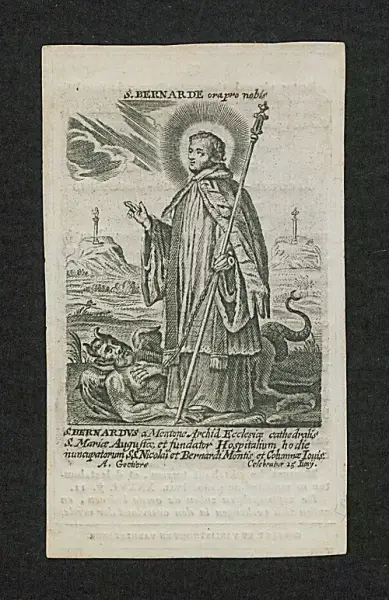
- Depicted in mountain scenery, often with a dog
- Canonization
- Canonized by Pope Innocent XI in 1681 in Rome.
Prayer
Bibliography
Show 6 sources
- Walter Woodburn Hyde, "The Great St. Bernard Pass and Its Hospice", Isis 27 (2), August 1937, pp. 306–320.
- Alban Butler, "Blessed Bernard of Menthon, Confessor", Lives of the Fathers, Martyrs, and Principal Saints, 1866.
- C. J. Hamilton, "The Legend of St. Bernard of Menthon", The Month, vol. 99, May 1902, p. 480.
- Barnabas Dieringer, "St. Bernard of Menthon", in Catholic Encyclopedia, vol. 2, New York: Robert Appleton Company, 1907.
- "Canons Regular of the Hospitaller Congregation of Great Saint Bernard (CRB)", GCatholic.
- Congrégation du Grand-Saint-Bernard, "Saint Bernardo de Menthon" (in French).
Profile text adapted from the Wikipedia article, licensed CC BY-SA 4.0.
Pray with this saint every day
Save St. Bernard of Menthon to your favorites, read the full profile, and get feast-day reminders in the Saints app.
Get the Saints AppFree on the App Store for iPhone and iPad