
1046 – 1117·Feast April 27
St. Bernard of Thiron
Hermit founder of Tiron Abbey and the Tironensian Order
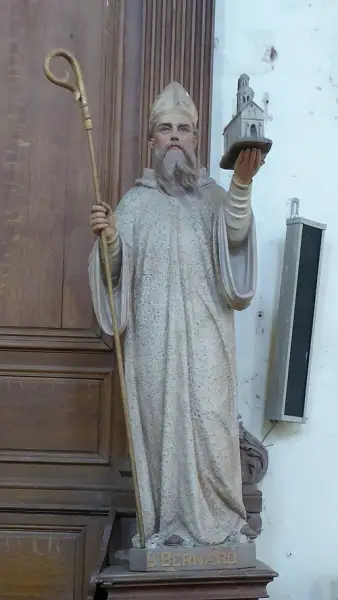
Overview
Saint Bernard of Thiron, also remembered as Bernard of Ponthieu and Bernard of Abbeville, was born near Abbeville in 1046 and became one of the notable monastic founders of his generation. Received into the monastery of Saint-Cyprien near Poitiers at the age of nineteen, he later served as prior of Saint-Savin-sur-Gartempe and carried the burden of superior there after the abbot was found guilty of simony in 1082. When Cluny and Pope Paschal II declined to confirm his nomination as abbot, he gave up his monastic career entirely and went apart to live as a hermit — first beside Peter of l'Etoile, then among the followers of Vital of Savigny at Dompierre, and afterward in a cave on the island of Chausey — earning his bread as a woodworker. Disciples collected around him wherever he settled, and after a stretch at Fontaine-Géhard near Châtillon-sur-Colmont he was called back to Saint-Cyprien and appointed abbot, attending the Council of Poitiers, where together with Robert of Arbrissel he pronounced the excommunication of King Philip I of the Franks. Longing for a harsher observance, he withdrew once more, and in 1114, on land granted by Bishop Ivo of Chartres at Thiron-Gardais and helped by donations from royal and noble patrons in three kingdoms — France, England and Scotland — he raised the Abbey of the Holy Trinity of Tiron, mother house of the Tironensian Order. He remained there until his death on 14 April 1117.
The Complete Life
A Ponthieu boy in the cloisters of Poitou
Bernard was born in 1046 near Abbeville, in the county of Ponthieu on the Channel coast of France. At nineteen he was received into the monastery of Saint-Cyprien, outside Poitiers, and there he passed the next ten years of monastic formation. Around 1075 he was moved to Saint-Savin-sur-Gartempe, famed for its painted church, to take up the office of prior. In 1082 disaster struck the community when its abbot was convicted of simony, the buying and selling of holy things, and Bernard stepped into the breach, assuming the responsibilities of superior and steering the house through the scandal. He remained in that charge for two further decades, until the question of his own elevation to the full abbacy arose — and failed. Both Cluny, whose influence then reached across most of the great French houses, and Pope Paschal II himself declined to confirm the nomination. Rather than fight the decision, Bernard did the thing that would define the rest of his life: he surrendered his post and went out of the monastery altogether. A man twice refused the mitre, he would spend the coming years proving that what he sought was neither dignity nor jurisdiction, but God alone in solitude.
§ Early life
The hermit of Dompierre, Chausey and Fontaine-Géhard
Bernard's flight from office took him first to the hermit Peter of l'Etoile, and then to the earlier eremitical community that Vital of Savigny had gathered at Dompierre near Passais. There, modelling himself on the Desert Fathers, he embraced a life cut loose from the world, marked by great poverty and strict penance, supporting his own body by the labour of woodworking. Restless still, his next stopping place was Saint-Médard, in the country around Saint-Mars-sur-la-Futaie, where he stayed a short season as a hermit before monks from his old house of Saint-Savin discovered him. Unwilling to be taken back to his former responsibilities, he fled once more, this time to the island of Chausey lying between Jersey and Saint-Malo, where he endured genuinely harsh conditions and made his home in a cave. At length he yielded to the pleading of his former companions, returned to the mainland, and settled at Fontaine-Géhard near Châtillon-sur-Colmont. There his example proved magnetic. Many were drawn to his way of life, among them Adelelmus of Flanders, and the settlement grew into a genuine centre for hermits, with disciples building their cells around his own.
§ Life as a hermit
Preacher, abbot and pilgrim of reform
Bernard's growing fame reached the monastery of Saint-Cyprien, whose abbot, Renault, summoned him to return and to bring his new followers with him. Bernard obeyed, resumed the habit, and was designated Renault's successor; in 1100 he was elected abbot of Saint-Cyprien. That same year he sat in the Council of Poitiers, where he and Robert of Arbrissel — the wandering preacher who would later found Fontevraud — pronounced the excommunication of Philip I, king of the Franks, for his repudiation of his lawful wife. The Council also exposed the reach of Cluniac power, for Paschal II placed Saint-Cyprien in subordination to Cluny. Bernard chafed under the arrangement, and in 1102 travelled to Rome to press his monastery's claims against the order. The pattern of withdrawal and return continued: after another brief retirement to Chausey he formed a fresh hermit community at Chennedet, separate from Vital of Savigny's earlier foundation. The years of movement were not years of idleness. Together with Robert of Arbrissel and Vitalis of Savigny, Bernard preached through Normandy in 1101, and the company of these three reformers — hermit, preacher and founder — did much to prepare the soil of northern France for the great monastic flowering of the twelfth century.
§ Later life and founding of Tiron Abbey
Poverty, penance and the work of hands
Everything the record tells of Bernard points to a single conviction: that the Gospel is best kept in hardship and in labour. Twice he held authority, and twice he laid it down — once when his nomination as abbot was refused, once when he resigned the abbacy of Saint-Cyprien itself — because office, however lawful, was not what his soul was seeking. At Dompierre he modelled his life on the Desert Fathers, those fourth-century solitaries of Egypt and Syria, embracing detachment from the world, deliberate poverty and severe penance. He asked no one to keep him: a skilled woodworker, he put his hands to the trade and earned his own bread. Even his final and greatest foundation was built on the same principles. The Tironensian Order that grew from the abbey at Thiron-Gardais rested on an austere reading of the Rule of Saint Benedict and on a marked stress on manual labour, placing the monk at the workbench as firmly as at the choir stall. It was a spirituality for the countryside, austere, practical and uncluttered, and it answered a hunger in the church of its time: daughter houses multiplied from Tiron across France and the British Isles, and the order's artisans and farmers became as characteristic of it as its liturgy.
§ Life as a hermit
Thiron-Gardais and a death in the cloister
In 1107, desiring a life of still greater austerity, Bernard and his friend Geoffrey — who would later become abbot of Tiron — built a small house in a solitary spot near Fougères, and a community began to gather around them. Its very success bred trouble. The Cluniac monks of Saint-Denis of Nogent-le-Rotrou grew jealous of the new settlement and asserted claims to tithes and burial fees from it. Rather than submit the young community to a draining dispute, Bernard moved it. On adjacent land at Thiron-Gardais, granted to him by Bishop Ivo of Chartres — the great canonist bishop who corresponded with Bernard's contemporaries among the reformers — he refounded his monastery and established the house that would become the Abbey of Tiron. The foundation flourished beyond expectation. Backed by gifts from royal and noble houses in France, England and Scotland, Bernard raised, in 1114, the abbey known as the Holy Trinity of Tiron, and daughter houses soon multiplied from it. Bernard remained at Tiron for the rest of his life, dying there on 14 April 1117, and was laid to dead rest in the abbey he had built, at Thiron-Gardais in the Perche.
§ Later life and founding of Tiron Abbey
The Tironensian Order
Bernard's monument is not a shrine but a congregation. From the Abbey of the Holy Trinity of Tiron, raised between 1114 and his death in 1117, there spread a family of daughter houses that carried the young order's particular charism across France and beyond — into Wales and Scotland among other lands, where Tironensian monks are recorded among the immigrant monastic communities of the twelfth century. What distinguished them was the combination their founder embodied: a strict, even austere, observance of the Rule of Saint Benedict joined to an unusual emphasis on manual labour, so that work of the hands was honoured alongside the opus Dei of the choir. In an age when Cluny represented the splendid, liturgical summit of Benedictine life, Tiron offered the counterweight of the workshop, the forest and the field, and it drew recruits accordingly. Bernard's own itinerary — Poitiers, the Gartempe valley, the hermitages of Passais and the Mayenne, the cave of Chausey, Fougères, and finally the Perche — maps the restless reforming energy of the generation before Cîteaux, in which he moved alongside Robert of Arbrissel and Vital of Savigny. His feast is kept on 27 April, and his memory endures above all at Thiron-Gardais, where the abbey church still stands over the buried outline of his foundation.
§ Later life and founding of Tiron Abbey
Timeline
- 1046
Born near Abbeville in Ponthieu.
§ Early life
- 1082
Takes on the duties of superior at Saint-Savin after the abbot is convicted of simony.
§ Early life
- 1100
Elected abbot of Saint-Cyprien; with Robert of Arbrissel excommunicates Philip I at the Council of Poitiers, while Paschal II places Saint-Cyprien under Cluny.
§ Later life and founding of Tiron Abbey
- 1101
Leaves his monastery after Cluny and Paschal II refuse his nomination; preaches through Normandy with Robert of Arbrissel and Vitalis of Savigny.
§ Later life and founding of Tiron Abbey
- 1102
Journeys to Rome to argue Saint-Cyprien's cause against the Cluniacs; soon after, begins a hermit community at Chennedet.
§ Later life and founding of Tiron Abbey
- 1107
Builds a small house in solitude near Fougères with his friend Geoffrey, the future abbot of Tiron.
§ Later life and founding of Tiron Abbey
- 1114
Establishes the Abbey of the Holy Trinity of Tiron on land granted by Bishop Ivo of Chartres, with royal and noble donations.
§ Later life and founding of Tiron Abbey
- 14 Apr 1117
Dies at Tiron Abbey on 14 April.
§ Later life and founding of Tiron Abbey
The Record
- Major works
- Abbey of the Holy Trinity of Tiron, founded 1114·Tironensian Order, observing a strict reading of the Rule of Saint Benedict
- Canonization
- Pre-congregation; venerated as the founder of Tiron Abbey.
Prayer
Bibliography
Show 7 sources
- Friedrich Wilhelm Bautz, "Bernard of Thiron", in Biographisch-Bibliographisches Kirchenlexikon (BBKL), vol. 1, Hamm: Bautz, 1975, col. 536.
- "Saint Bernard de Thiron", Nominis.
- "Tironensian", Monastic Wales.
- Geoffrey Grossus, The Life of Blessed Bernard of Tiron, Washington: The Catholic University of America Press, 2009.
- "S. Bernard and his Foundation", The Benedictines of Caldey, The Abbey, Isle of Caldey, 1912.
- Kathleen Thompson, The Monks of Tiron: A Monastic Community and Religious Reform in the Twelfth Century, Cambridge: Cambridge University Press, 2014.
- Alphonse-Victor Angot and Ferdinand Gaugain, Dictionnaire historique, topographique et biographique de la Mayenne, Goupil, 1900–1910.
Profile text adapted from the Wikipedia article, licensed CC BY-SA 4.0.
Pray with this saint every day
Save St. Bernard of Thiron to your favorites, read the full profile, and get feast-day reminders in the Saints app.
Get the Saints AppFree on the App Store for iPhone and iPad