
778 – 842·Feast January 23
St. Bernard of Vienne
Soldier, abbot of Ambronay and archbishop of Vienne
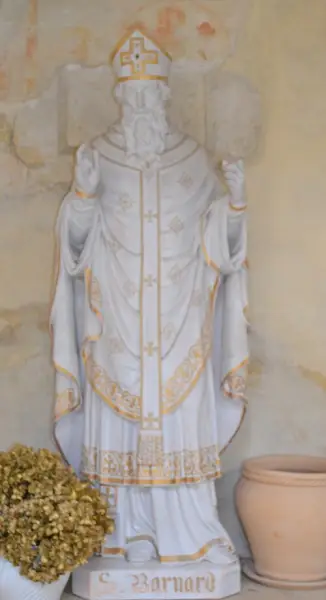
Overview
Saint Bernard of Vienne, known in French as Barnard de Romans or Bernard of Romans, was born at Lyon in 778 and served as a soldier in the armies of Charlemagne before turning to the religious life. The death of his mother and father, coming after seven years of military service, shook him deeply and set the direction of the rest of his life: he distributed his entire wealth in three parts, giving one to the Church, one to the poor and one to his own children, and purchased the monastery of Ambronay, over which he then ruled as abbot. Consecrated bishop by Leidrad in 810, he became archbishop of Vienne only after resistance and governed that see for the remaining three decades of his life. Like many churchmen of his generation he stood for the unity of the Frankish Empire and took the side of Lothair I against the emperor Louis the Pious, an allegiance for which the Synod of Thionville deposed him, though the sentence was never carried into effect. Toward the close of his life he retired to a hermitage beside the river Isère, at the site of the present-day town of Romans, and there he died on 23 January 842, in his mid-sixties. His cult was formally confirmed in 1907; his feast is kept on 23 January and he is honoured as a patron of agricultural workers.
The Complete Life
A soldier of Charlemagne
Bernard was born at Lyon in 778, in the heart of the Frankish kingdom over which Charlemagne then ruled. His first career was arms: he served as a soldier under the great emperor himself, in the armies that held the vast Carolingian empire together. He gave seven years to military service, at the end of which both his mother and his father died. Their deaths marked him profoundly, and it was out of that grief that his conversion of life took shape. The precise form it took is recorded with unusual clarity for so early a figure. He liquidated everything he possessed and divided the whole into three parts: one portion went to the Church, one to the poor, and one to his own children. The detail is revealing. Bernard was evidently a married man or a widower with a family, a man of property and standing, and his embrace of religion did not pretend that his obligations vanished with his vocation. He provided for those dependent on him even as he gave the rest away. It is the piety of a soldier: accounts settled, dependants secured, and the remainder surrendered to God before he himself followed it.
§ Biography
From Ambronay to the see of Vienne
The wealth Bernard set apart for the Church was put to immediate use. He bought the monastery of Ambronay, in the country between the Ain and the Rhône north of Lyon, and became its abbot — purchasing a house in order to give himself to it, as only a man of means disposing of a fortune could. His years at Ambronay evidently gave him the reputation that recommends an abbot to higher office, for when the metropolitan see of Vienne fell to be filled, Bernard was the choice. He became archbishop only after resistance — whether his own reluctance or that of others is not said, though reluctance is the more common reading of such phrases in hagiography. What is certain is the date and the hand that ordained him: he was consecrated bishop by Leidrad, the learned bishop of Lyon whom Charlemagne had placed over that city, in 810. A former officer of the emperor, consecrated by one of the emperor's own appointees, now governed the ancient see of Vienne on the Rhône. He would hold it for the rest of his life, a tenure of some thirty-two years spanning the whole unhappy succession crisis that followed Charlemagne's death.
§ Biography
Archbishop in an age of division
Bernard's episcopate coincided with the dismemberment of the empire he had served as a young man. After Charlemagne's death in 814 the Frankish realm passed to Louis the Pious, and in the 830s it descended into open war between the emperor and his sons. Like many other clerics of his generation, Bernard supported the unity of the Frankish Empire and, when unity failed, took his stand with Lothair I against the emperor Louis the Pious, his own father. The cost was real: the Synod of Thionville deposed him from his see. The sentence, however, was never carried out, and Bernard remained archbishop of Vienne until his death — a sign either of the synod's weakness, of the balance of forces in the struggle, or of the personal standing that made him hard to unseat. The episode places him squarely among the churchmen of the Carolingian crisis, those bishops who believed that the unity of the Christian empire was itself a good worth defending even at the risk of deposition. His pastoral achievements within the see are little commemorated; what remains is the political and moral contour of a long episcopate exercised in the most turbulent decades the Frankish church had yet known.
§ Biography
Retreat on the Isère
Toward the end of his life Bernard withdrew from the government of his see to a retreat beside the Isère, where the town of Romans now stands. The retirement completes the pattern of the man: having once left a soldier's life for the cloister of Ambronay, he now left a metropolitan's throne for the solitude of a riverbank, ending where the hermits end. Romans-sur-Isère lies some forty miles downstream from Vienne, in the country between the Rhône and the Alpine foothills, and the association of the saint with the town was strong enough to fix his French name, Barnard de Romans. There he died on 23 January 842, in the sixty-fourth year of his age, still formally archbishop of Vienne. He had governed the see for thirty-two years, through the whole of the catastrophe of the Carolingian succession, and had survived a deposition that was never enforced. Little can be known of his last days beyond the retreat itself, but the gesture speaks: an old soldier and old bishop, setting down his burdens at the water's edge, and waiting there for the end that came at the turn of the year.
§ Biography
A cult confirmed after a millennium
Bernard belongs to the vast company of early medieval saints whose veneration grew up locally and organically, without any process of canonization in the modern sense. Honoured at Vienne and at Romans from shortly after his death, he entered the calendars of the region and remained there through the centuries, receiving the cult of the Catholic Church and of the Eastern Orthodox Church as well. The formal gesture came only in 1907, when his cultus was confirmed — the ordinary Roman procedure by which the Holy See recognizes and authorizes an ancient local veneration rather than conducting a new investigation. His feast is kept on 23 January, the anniversary of his death, and his figure is preserved in art, notably in the statue of Saint Bernard at Ambronay, the monastery he once bought and governed. For a man who had been deposed by a synod in his own lifetime, however ineffectually, the confirmation of his cult a thousand years later is a quiet vindication: the judgement of the Church at prayer has outlasted the judgement of the Church in council, and the soldier-abbot-archbishop of the Rhône valley is numbered among the saints.
§ Biography
Patron of those who work the land
Bernard's principal legacy in the Church's devotional life is his patronage of agricultural workers. The association is a fitting one for a ninth-century Frankish aristocrat who gave his fortune away, governed a rural monastery, and ended his life on a riverbank in farm country: the saint of the Carolingian court has become the saint of the plough. His memory is attached above all to the two places that frame his life — Ambronay, the abbey he purchased and ruled as abbot, and Romans on the Isère, whose name he carries in French — and to the see of Vienne, which he held for three decades. Much that a fuller biography would tell — his building, his councils, his correspondence, the character of his preaching — has simply not survived. What remains is the outline of a remarkably complete life: a soldier who became a monk, a monk who became an archbishop, an archbishop who became a hermit, and a hermit whom the Church, after ten centuries, acknowledged as a saint.
§ Biography
Timeline
- 778
Born at Lyon in Francia.
§ Biography
- 810
Consecrated by Leidrad and, after resistance, becomes archbishop of Vienne.
§ Biography
- 23 Jan 842
Dies at Vienne on 23 January, aged about sixty-three, after retiring to the banks of the Isère.
§ Biography
- 1907
His ancient cultus is formally confirmed.
§ Biography
The Record
- Major works
- Purchased and governed the monastery of Ambronay as its abbot
- Patron of
- Agricultural workers
- Canonization
- Cultus confirmed in 1907.
Prayer
Bibliography
Show 4 sources
- "Saint Barnard", Nominis (in French).
- Jean-Irénée Depéry, Histoire hagiologique de Belley ou recueil des vies des saints et des bienheureux nés dans ce diocèse, édition Bottier, 1834, pp. 113–198.
- Laurent Jacquot, Romans — Traces d'histoire, coll. "Les Patrimoines", ed. Dauphiné Libéré, 2008.
- Charles Herbermann (ed.), "St. Bernard", in Catholic Encyclopedia, New York: Robert Appleton Company, 1913.
Profile text adapted from the Wikipedia article, licensed CC BY-SA 4.0.
Pray with this saint every day
Save St. Bernard of Vienne to your favorites, read the full profile, and get feast-day reminders in the Saints app.
Get the Saints AppFree on the App Store for iPhone and iPad