
1380 – 1444·Feast May 20
St. Bernardino of Siena
Franciscan Apostle of Italy and preacher of the Holy Name
Overview
Saint Bernardino degli Albizzeschi, a Franciscan friar of the Observant branch, was born at Massa Marittima in the Republic of Siena on 8 September 1380, the son of the town's governor. Orphaned at six and raised by a pious aunt, he studied civil and canon law before joining a Marian confraternity attached to Siena's great hospital of Santa Maria della Scala, where he and ten companions took entire charge of the wards for four months during the plague of 1400. He entered the Observant Franciscans in 1403, was ordained priest in 1404 and commissioned to preach in 1405. For more than thirty years he walked the length of Italy, preaching at dawn in market squares for three and four hours at a time, and became the most celebrated preacher of the early Italian Renaissance, the man later called the Apostle of Italy for his part in reviving the faith of the peninsula. He was devoted to the Holy Name of Jesus, spreading the IHS monogram, and was tried for heresy at Rome in 1426 and acquitted. He three times refused a bishopric. A systematizer of scholastic economics, he wrote On Contracts and Usury, defended the social usefulness of the entrepreneur and helped prepare the way for the Monti di Pietà. As vicar-general of the Italian Observants from 1438 he saw the movement grow from some hundred and thirty friars to over four thousand. He died at L'Aquila on 20 May 1444 and was canonized only six years later.
The Complete Life
Governor's son, orphan, hospital servant
Bernardino degli Albizzeschi was born on 8 September 1380 at Massa Marittima, in the Metalliferous hills of the Sienese contado, where his father Albertollo, of the noble Albizzeschi family, was serving as governor. Left an orphan at the age of six, he was brought up by a pious aunt, and the shape of his early life was set by grief and by care for the sick. After completing a course of study in civil and canon law, he joined in 1397 the sodality of Our Lady that served the hospital of Santa Maria della Scala, one of the greatest hospitals of medieval Europe, which stood facing the cathedral of Siena. When plague struck the city three years later, the young confrater went to work. Assisted by ten companions, he took upon himself for four months the entire charge of the hospital, nursing the plague-stricken at close quarters. He survived the contagion but was so drained that a fever laid him low for several months afterwards. In 1403 he entered the Observant branch of the Friars Minor, embracing a strict keeping of the Rule of Saint Francis; he was ordained priest in 1404 and commissioned as a preacher the year following. Around 1406, according to the report, the Dominican Vincent Ferrer pointed him out at Alessandria in Piedmont as the one on whom his own mantle would fall.
§ Early life
A preacher sent to the piazzas
The vocation Bernardino received was not the cloister but the road. Before his time, most preachers either read out a prepared discourse or delivered a rhetorical oration, and they spoke chiefly within the liturgy and the walls of the church. Bernardino instead went out and addressed the public directly, in the squares, at first light, in the ordinary language of the people of Siena. The texts of his sermons, as his modern biographer Cynthia Polecritti observes, are counted masterpieces of colloquial Italian: his style was simple, familiar, populist and dense with imagery, and he drew his subjects not out of the day's liturgy but from what pressed most on his hearers. Everything about his method was physical and demanding. All his journeys were made on foot; he remained nowhere longer than a few weeks; he usually preached at dawn like Vincent Ferrer before him; and the sermons themselves often ran three or four hours. Crowds came from far-off villages and arrived early to secure standing room; where they overflowed, a pulpit had to be erected in the marketplace, and invitations frequently came from the civil authorities rather than the ecclesiastical, for the towns made money from the visitors. Women made up the greater part of his audiences. Though his voice was weak and hoarse, he was accounted among the greatest preachers of his age.
§ Preaching style
Bonfires, campaigns and contested converts
For more than thirty years Bernardino preached across Italy, and his mission was a campaign. At Ferrara in 1424 he attacked luxury and immodest dress; at Bologna he denounced gambling to the open displeasure of the manufacturers and sellers of playing cards; back in Siena from April 1425 he preached for fifty consecutive days. At his sermon sites the famous bonfires of the vanities were lit, into which people threw mirrors, high-heeled shoes, perfumes, false hair, cards, dice, chessmen and other frivolities to be burned. He urged his hearers to give up blasphemy, indecent talk and games of chance, and to keep the feast days. The campaigns had a darker edge that the modern record no longer softens. He characterized some women as witches, called for sodomites to be driven out of the human community, and preached with approval of the executions of men convicted of homosexual acts in Verona, Genoa and Venice; in Siena in 1425 and 1427 he preached whole sermons against sodomy, tying it to fears of depopulation, and after one of them four irate men tried to beat him with clubs. At Orvieto in January 1427 he blamed the poverty of local Christians on Jewish moneylending and called for Jews to be banished and cut off from the wider community, a call his hearers used to justify segregation. Historians now count him a major protagonist of Christian anti-Semitism, and a champion of what Robert Moore termed the persecuting society.
§ Preaching style
The Holy Name of Jesus
The devotion at the centre of Bernardino's spirituality was the Holy Name of Jesus. The symbol he made his own was IHS — the opening three letters of the name of Jesus as written in Greek — set in Gothic letters upon a blazing sun. The device had a deliberate civic purpose: it was meant to displace the badges and insignia of the factions, the Guelphs and Ghibellines above all, whose vendettas tore the Italian cities apart. As the devotion took hold, the monogram began to appear on churches, houses and public buildings, a visible sign of a loyalty higher than party. To his opponents it looked like a dangerous innovation, and in 1426 a summons to Rome reached him to answer a heresy charge for promoting it. Theologians, Paul of Venice among them, gave their opinions; he was found innocent, and so impressed Pope Martin V that the Pope asked him to preach in the city, which he did every day for eighty days. Cardinals continued to press first Martin V and then Eugene IV to condemn him, and both popes almost instantly acquitted him, as did a trial at the Council of Florence. His preparation was as notable as his delivery — he would work through as many as four drafts of a sermon before beginning to speak — and the discipline of that labour, joined to the friar's poverty he kept all his life, was the engine beneath the fame.
§ Trial in Rome
Vicar-general, resignation and the last journey
Bernardino had laboured to build up the Observant movement from the beginning of his religious life. He was no founder of the movement — the Zelanti traced their beginnings to the mid-fourteenth century — but he became to the Observants what Bernard had been to the Cistercians, their chief support and tireless propagator. In 1438 he was named vicar-general of the Italian Observant Franciscans, an office that curtailed his preaching while multiplying his administration. Under his care the Italian Observance grew from some one hundred and thirty friars at his reception into the order to more than four thousand shortly before his death; at least three hundred convents owed their founding or reform to him; missionaries went out under his direction to different parts of Asia; and thanks chiefly to him, envoys of several schismatic nations appeared at the Council of Florence, where he spoke to the gathered Fathers in Greek. In 1442 he won the Pope's consent at last to lay down the vicariate and give his whole strength to the road again. A bull of Eugene IV in 1443 commissioned him to proclaim the crusade indulgence against the Turks, yet nothing records that he undertook it. In 1444, his infirmities growing, and wanting no corner of Italy left unvisited by his voice, he set out for the Kingdom of Naples. He died that year at L'Aquila in Abruzzo and was buried in the Basilica of San Bernardino; tradition held that his grave leaked blood until the two factions of the city were reconciled.
§ Franciscan Vicar General
Six years from death to the altars
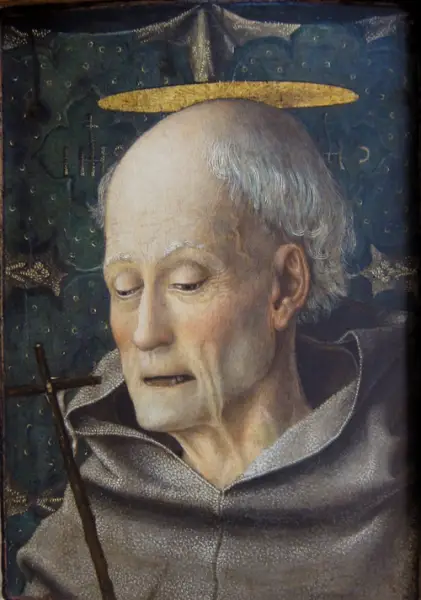
Reports of miracles multiplied rapidly after Bernardino's death, and the Church moved with unusual speed. He was beatified on 24 November 1449 and canonized by Pope Nicholas V at Rome on 24 May 1450, only six years after he had died at L'Aquila. Catholics keep his memorial on 20 May, the date on which he died. The iconography that fixed his appearance developed almost at once, and for a reason unique to his moment in history. As Franco Mormando observes, Bernardino's lifetime coincided with the blossoming of realistic portraiture as a distinct genre, which may explain why he seems to be the earliest saint of the Church whose face survives in an unquestionably authentic painted likeness; many of the earliest likenesses were presumably based on his death mask. He also lived into the earliest days of print, and portraits and a death mask were copied into printed images, making him one of the first saints with a fairly consistent look in art — although Baroque treatments, El Greco's among them, idealize him by comparison with the realistic pictures made in the decades after his death. The Franciscans then promoted a programme for spreading his image that no one in the order but Francis himself rivalled. Late medieval and Renaissance painters usually showed him small and thin, with three mitres at his feet for the sees he had refused, holding the radiating IHS monogram that was his chief attribute.
§ Canonisation and iconography
The Apostle of Italy and his afterlife
Bernardino's legacy is double, and honest memory holds both halves. He was the driving force of the Italian Observant reform and the most effective popular preacher of his century, a man who walked the peninsula for three decades calling cities back from vendetta, gambling and blasphemy; he was also, in the judgement of modern historians, a major protagonist of Christian anti-Semitism whose sermons left a legacy of resentment and segregation, and a champion of the persecuting instincts of late medieval Europe. The Church honours him as the Apostle of Italy and invokes him as patron of advertisers, advertising, public relations work, compulsive gamblers and ailments of the chest, as well as of Aquila, of the Diocese of San Bernardino in California, of Carpi, of Bernalda and of San Bernardino in Switzerland, whose Alpine pass bears his name. Siena College in New York is placed under his patronage. In 1453 John of Capistrano carried his cult to Poland, founding in Kraków the first Observant house in the country under his name, from which the Polish-Lithuanian Observants came to be called Bernardines. His cult reached England early as well, spread by Observant friars settled at Greenwich from 1482. As an economist he endures in the histories of thought: Murray Rothbard credits his analysis of just value with anticipating the supply-and-cost analysis of the Austrian school by five centuries.
§ Veneration
Timeline
- 8 Sep 1380
Born Bernardino degli Albizzeschi at Massa Marittima, son of the governor of that Tuscan town.
§ Early life
- 1397
After studying civil and canon law, joins the Confraternity of Our Lady at the hospital of Santa Maria della Scala.
§ Early life
- 1400
During the plague at Siena, takes charge of the hospital for four months with the help of ten companions.
§ Early life
- 1403
Enters the Observant branch of the Order of Friars Minor, keeping strict observance of Francis's Rule.
§ Early life
- 1404
Ordained a priest.
§ Early life
- 1405
Commissioned as a preacher the year after his ordination.
§ Early life
- 1406
Vincent Ferrer, preaching at Alessandria, allegedly foretells that his mantle will pass to Bernardino to evangelise Italy.
§ Early life
- 1424
Invited to Ferrara he preaches against luxury, speaks at Bologna against gambling, and devotes three sermons at Florence to condemning sodomy.
§ Preaching style
- Apr 1425
Returns to Siena in April and preaches there for fifty consecutive days, with bonfires of vanities held at his sermon sites.
§ Preaching style
- 1426
Summoned to Rome for trial over his promotion of the IHS devotion; acquitted, he preaches there daily for eighty days and declines the bishopric of Siena.
§ Trial in Rome
- 1427
Called back to Siena to allay bitter factional strife, though he prefers preaching to arbitration.
§ Preaching style
- Jan 1427
At Orvieto he preaches against usury, urging that Jews be banished and isolated from the wider community.
§ Anti-Semitism
- 1431
Tours Tuscany, Lombardy, Romagna and Ancona, helps avert war between Siena and Florence, and declines the bishopric of Ferrara.
§ Trial in Rome
- 1433
Accompanies Emperor Sigismund to Rome for his imperial coronation.
§ Trial in Rome
- 1433
Completes On Contracts and Usury, written 1431–1433, a systematic scholastic treatment of economics.
§ Economic theory
- 1435
Declines the bishopric of Urbino.
§ Trial in Rome
- 1436
Resumes his missionary preaching after retreat at Serracapriola.
§ Franciscan Vicar General
- 1438
Becomes vicar-general of the Observant Franciscans in Italy, curbing his preaching.
§ Franciscan Vicar General
- 1442
Persuades the Pope to accept his resignation as vicar-general so he can devote himself again to preaching.
§ Franciscan Vicar General
- 1443
Pope Eugene IV issues the bull Illius qui se pro divini charging him to preach the crusade indulgence against the Turks.
§ Franciscan Vicar General
- 20 May 1444
Sets out for the Kingdom of Naples despite failing health and dies at L'Aquila; he is buried in the Basilica of San Bernardino.
§ Franciscan Vicar General
- 24 Nov 1449
Beatified.
§ Introduction
- 24 May 1450
Canonized in Rome by Pope Nicholas V, only six years after his death.
§ Canonisation and iconography
- 1453
John of Capistrano carries his cult to Poland, where the first Observant monastery is founded at Kraków and friars take the name Bernardines.
§ Veneration
- 1482
Observant Friars promulgating his cult first establish themselves in England at Greenwich.
§ Veneration
- 1501
First printed edition of his works, mostly sermons, is published at Lyon.
§ Preaching style
In Their Own Words
Whenever you hear sodomy mentioned, each and every one of you spit on the ground and clean your mouth out as well. If they don't want to change their ways by any other means, maybe they will change when they're made fools of. Spit hard! Maybe the water of your spit will extinguish their fire.
You don't understand that [sodomy] is the reason you have lost half your population over the last twenty-five years
The Record
- Major works
- On Contracts and Usury (1431–1433), the first systematic scholastic treatment of economics since Peter John Olivi·Collected sermons, first printed at Lyon in 1501·Some three hundred Franciscan convents founded or reformed
- Patron of
- Advertisers, advertising and public relations personnel·Compulsive gamblers·Those suffering chest and respiratory ailments·Aquila, Italy and the Diocese of San Bernardino, California
- Symbols
- Tablet bearing the IHS monogram on a blazing sun·Three mitres at his feet for the bishoprics he refused
- Canonization
- Beatified on 24 November 1449; canonized by Pope Nicholas V in Rome on 24 May 1450.
Prayer
Bibliography
Show 8 sources
- Paul Thureau-Dangin, Saint Bernadine of Siena, London: J. M. Dent & Co., 1906.
- Paschal Robinson, "St. Bernardine of Siena", in The Catholic Encyclopedia, vol. 2, New York: Robert Appleton Company, 1907.
- Cynthia Polecritti, Preaching Peace in Renaissance Italy: Bernardino of Siena and His Audience, Washington, DC: The Catholic University of America Press, 2000.
- Franco Mormando, The Preacher's Demons: Bernardino of Siena and the Social Underworld of Early Renaissance Italy, Chicago: University of Chicago Press, 1999.
- Murray N. Rothbard, "The Worldly Ascetic", in Economic Thought Before Adam Smith: An Austrian Perspective on the History of Economic Thought, vol. 1, Auburn: Ludwig von Mises Institute, 2009.
- Raymond de Roover, San Bernardino of Siena and Sant' Antonino of Florence, Boston: Harvard Graduate School of Business Administration, 1967.
- Nirit Ben-Aryeh Debby, "Jews and Judaism in the Rhetoric of Popular Preachers", Jewish History 14 (2), 2000, pp. 175–200.
- David Hugh Farmer, The Oxford Dictionary of Saints, 4th ed., Oxford: Oxford University Press, 1997, pp. 56–57.
Profile text adapted from the Wikipedia article, licensed CC BY-SA 4.0.
Pray with this saint every day
Save St. Bernardino of Siena to your favorites, read the full profile, and get feast-day reminders in the Saints app.
Get the Saints AppFree on the App Store for iPhone and iPad