
1530-1616·Feast July 2
St. Bernardino Realino
Priest, Religious of the Society of Jesus
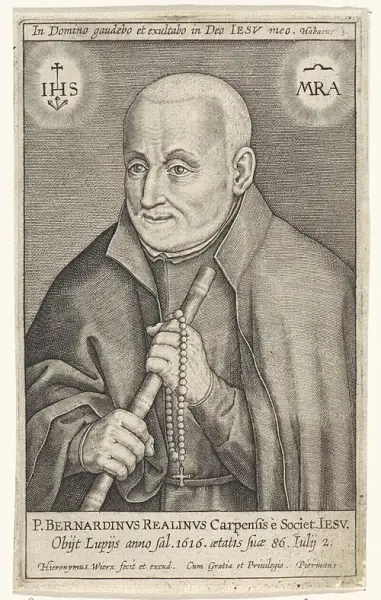
Overview
Bernardino Realino was born at Carpi on 1 December 1530 to noble parents, his father a collaborator of Cardinal Madruzzo. A brilliant student, he began philosophy and medicine at Bologna, then switched to law, a career pressed on him partly by a woman he hoped to marry. Doctorate in both civil and canon law in hand by 1556, he served as podestà, judge, praetor and tax collector across northern Italy, earning a name for learning and honesty, before entering the service of the Marquis d'Avalos at Naples. There a Jesuit preacher's sermon unsettled him; a week-long retreat with the Fathers in August 1564 ended in his joining the Society on 13 October of that year. Ordained in 1567, he served as novice master at Naples under Francis Borgia's appointment, and in 1574 was sent to found the Jesuit house and college at Lecce, the city that would claim him forever. For four decades he preached parish missions, taught catechism, formed diocesan clergy, and visited the slaves chained in the harbor galleys. So gentle was his repute that even enemies of the Jesuits made an exception for him. Asked on his deathbed by the magistrates to be Lecce's patron, he could only nod and whisper the names of Jesus and Mary before dying on 2 July 1616.
The Complete Life
Early Life
Bernardino Realino was born at Carpi on 1 December 1530 to noble parents; his father worked with Cardinal Cristoforo Madruzzo, and the family's standing opened the usual paths of the Italian professions to him. Schooled first at Modena, he began the study of philosophy and medicine at Bologna, but changed course midway to law — a change his biographers attribute, with a certain affection, to a woman he fell in love with, who persuaded him he would be good at it, though the prospect of advancement and wealth can hardly have hurt. He took his doctorate in both civil and canon law at Bologna in 1556. His career then unfolded with remarkable speed: through family influence he was appointed podestà of Cassine and Felizzano in the same year, serving as judge at Felizzano, won a reputation for honesty that made him praetor of Castelleone, acted as chief tax collector at Alessandria, and finally entered the service of Francesco Ferdinando d'Avalos, moving to Naples as superintendent of the marquis's fiefs. He was, by any measure, a successful man in his mid-thirties.
Conversion and Vocation
The conversion came in Naples, through a sermon. A Jesuit preacher so moved Realino that he sought the man out and made his confession; the priest saw at once that he leaned toward the religious life and, with other Jesuits, invited him, in August 1564, to make with them a retreat of a week to discern his call. At the end of it he had no doubts left. He joined the Society of Jesus on 13 October 1564, received into the order by Alfonso Salmeron, one of its earliest members. He made his religious vows in October 1566 and was ordained priest at Naples on 24 May 1567. Francis Borgia, then superior general, appointed him novice master at Naples, the office in which the future of the young province was entrusted to him. It was a mark of unusual confidence in a man not yet forty, and one that the general did not regret.
Mission and Ministry
In 1574 Realino was sent to establish a Jesuit house and college at Lecce in Apulia, and the city became his field for the remaining four decades of his life — hence the name he bears still, the Apostle of Lecce. His work ranged from the pulpit to the galleys: He spent most of his life moving from town to town to preach parish missions, taught catechism to the young, and visited the slaves chained in the harbour of Naples. In 1583 he began a movement among the diocesan clergy of Lecce to foster their virtues and improve their education in moral theology, so that they might become better confessors and preachers — an unusually practical form of reform, aimed not at controversy but at the ordinary competence and holiness of parish priests. His commitment to the poor and his powers of preaching made him, in the memory of the city, less a visitor than a civic institution.
Trial and Final Years
Realino's final trial was the slow one of age and injury. In 1610 he suffered a fall that left him two wounds which never healed; blood taken from one of the leg wounds shortly before his death was kept in glass vials, and his health broke sharply in June 1616. On his deathbed the magistrates of Lecce came to him — twice, the sources insist — to ask that he take the town under his patronage once he reached heaven; he could no longer speak, but nodded his approval, and died whispering 'Gesù... Maria'. The reports began almost at once that the relic of his blood had liquefied, a phenomenon said to have recurred into the mid-nineteenth century and later. News of his death reached Roberto Bellarmino, who had been his provincial, and drew from him the judgement later generations would ratify: that in all his years he had never heard a complaint about Father Realino, even from the enemies of the Society, who seized every chance to speak ill of it and always made an exception for him.
Canonization
The cause moved at the stately pace of the old procedure. Realino was proclaimed Venerable on 31 July 1838, when Gregory XVI confirmed that his life had shown heroic virtue; Leo XIII beatified him at Saint Peter's on 12 January 1896, once two miracles had been confirmed. A decree resuming the cause followed on 1 May 1902; an informative process on two further miracles was validated by the Congregation of Rites on 29 February 1940 and approved by a preparatory committee on 1 April 1941; and Pius XII canonised him on 22 June 1947, confirming two further miracles for the purpose. That December the same pope named him principal patron of Lecce, formally sealing the request made at his deathbed. His remains lie preserved in the Chiesa del Gesù at Lecce, in a chapel that the city, which had claimed him as patron from his deathbed onward, built and keeps in his honour.
Legacy
Realino's legacy is above all local and clerical. He is the patron saint of Lecce, honoured in the city he served for forty-two years, and his body in the Chiesa del Gesù remains a focus of civic as well as religious devotion. For the Jesuits he is the model of the uncomplaining religious — Bellarmino's testimony, that no one ever complained of him and even enemies of the Society excepted him, is the portrait his order has kept. His movement for the better training of diocesan priests anticipated by centuries the reforms that seminaries would make routine, and his ministry to galley slaves and the poor of Naples and Apula recalls that the early Society understood preaching and social mercy as one work. The reported liquefaction of his relic-blood, kept at Lecce into the nineteenth century, belongs to the city's memory of him rather than to any universal cult, which for Realino was always the point: he served a place, and the place remembered.
Timeline
- 1 Dec 1530
Born at Carpi in the Duchy of Modena to a noble family
§ Introduction
- 1556
Gained his doctoral degree in the two branches of law at Bologna
§ Life
- 1556
Appointed podestà of Cassine and Felizzano through family influence, acting as judge at Felizzano
§ Life
- Aug 1564
After a moving Jesuit sermon in Naples, made a week-long retreat with the Fathers to discern his call
§ Life
- 13 Oct 1564
Entered the Society of Jesus, welcomed by Alfonso Salmeron, and began the novitiate
§ Life
- Oct 1566
Made his religious vows as a Jesuit
§ Life
- 24 May 1567
Ordained to the priesthood; Francis Borgia afterwards appointed him novice master at Naples
§ Life
- 1574
Sent to establish a Jesuit house and college at Lecce
§ Life
- 1583
Started a movement among diocesan priests to foster virtue and better moral-theological formation
§ Life
- 1610
Suffered a fall that left two wounds on his legs which never healed
§ Life
- Jun 1616
His health took a sharp decline shortly before his death
§ Life
- 2 Jul 1616
Died at Lecce aged 85, whispering the names of Jesus and Mary
§ Introduction
- 31 Jul 1838
Proclaimed Venerable by Pope Gregory XVI, who confirmed his life of heroic virtue
§ Sainthood
- 12 Jan 1896
Beatified by Pope Leo XIII in Saint Peter's Basilica once two miracles were confirmed
§ Sainthood
- 1 May 1902
A decree was issued for the resumption of his cause
§ Sainthood
- 22 Jun 1947
Canonized by Pope Pius XII after confirmation of two further miracles
§ Sainthood
- 15 Dec 1947
Named patron saint of Lecce by Pope Pius XII
§ Sainthood
In Their Own Words
Gesù... Maria
The Record
- Patron of
- Lecce, Italy
- Symbols
- Priest's cassock
- Canonization
- Venerable 31 July 1838; beatified 12 January 1896 by Pope Leo XIII; canonized 22 June 1947 by Pope Pius XII; named patron of Lecce 15 December 1947
Prayer
Bibliography
Show 5 sources
- 1 2 3 "St. Bernardino Realino" . Catholic Exchange. 2 July 2016 . Retrieved 8 November 2016 .
- 1 2 3 4 5 "Saint Bernardino Realino" . The Jesuit Curia in Rome . Retrieved 8 November 2016 .
- 1 2 3 "Saint Bernardino Realino" . Santi e Beati . Retrieved 8 November 2016 .
- 1 2 3 "Saint Bernadine Realino" . Saints SQPN. 12 June 2016 . Retrieved 8 November 2016 .
- ↑ "Saint Bernardino Realino", Living Space
Profile text adapted from the Wikipedia article, licensed CC BY-SA 4.0.
Pray with this saint every day
Save St. Bernardino Realino to your favorites, read the full profile, and get feast-day reminders in the Saints app.
Get the Saints AppFree on the App Store for iPhone and iPad