
c. 1180 – 1243·Feast October 26
St. Bernat Calbó
Cistercian abbot, bishop of Vich and crusading jurist
Overview
Saint Bernat Calbó, also written Calvó and sometimes rendered Bernard of Calvo, was a Catalan of the late twelfth and early thirteenth centuries whose life ran through nearly every calling his age offered: jurist, bureaucrat, monk, bishop and soldier. Born around 1180 and educated at the family estate of Manso Calvo near Reus, he belonged to the knightly class and began his career in the service of the church as a legal expert and functionary at the curia of the archdiocese of Tarragona. In 1214 he changed course entirely, entering the Cistercian monastery of Santes Creus, where his abilities carried him to the dignity of first abbot of the house. Raised to the see of Vich in 1223 or 1233, he became a bishop of the frontier generation: in 1238 he marched with his episcopal household on the crusade James I of Aragon had opened against Valencia's Muslim taifa, carrying practical help to the besiegers at Burriana and at Valencia; and when the city fell, joining the celebratory first Mass celebrated in its central mosque. Rewarded with extensive land grants in the new Kingdom of Valencia, which he visited again in 1242, he put his legal training at the service of the conquest by helping to publish the Furs of Valencia, the kingdom's law code. He died at Vich on 26 October 1243 and was buried in the cathedral there. Beatified by Alexander IV in 1260, he was canonized by Clement XI in 1710.
The Complete Life
A knight's son trained in the law
Bernat Calbó was born around 1180 and took his name from the estate of Manso Calvo near Reus, in what is now the Catalan province of Tarragona but was then the heart of the Crown of Aragon. His family stood in the knightly class — the minor nobility of soldiers and landholders who staffed the armies and administrations of the expanding Christian kingdoms — and young Bernat received the education such a family expected. He studied law, and the church of his day had pressing use for a trained jurist: in 1214, the very year he entered the cloister, the courts and chanceries of Catalonia were absorbed in the settlement after the battle of Muret, and canon law governed much of daily life. Bernat worked as a legal expert and administrator within the Tarragona archdiocesan curia, the metropolitan see of the whole north-eastern frontier, where he learned the machinery of government, litigation and record-keeping from the inside. No conversion crisis is recorded of him, and none may have been needed: for a man of his background and talents, the move from the archbishop's curia to the Cistercian monastery of Santes Creus was a promotion in the economy of grace rather than a rupture, the legal training simply continuing its service under a different jurisdiction.
§ Bernat Calbó
From curia to cloister to cathedral
In 1214 Bernat became a Cistercian monk at Santes Creus, a monastery founded only three decades earlier in the Conca de Barberà by nobles of the Catalan frontier. The white monks were then at the height of their influence in Iberia, supplying the reconquered and reconquering kingdoms with agriculture, architecture and disciplined religious life, and a man of Bernat's administrative gifts was not likely to remain long in the rank and file. He was eventually elected the first abbot of the house, an abbacy that marked an epoch in its history, and governed it until the wider church claimed him. In 1223, or by some accounts in 1233, he was raised to the see of Vich, the ancient Catalan bishopric in the hills above Barcelona. The ten-year uncertainty in the date is itself a reminder of how thinly documented the episcopal succession of the period remains. What is not uncertain is the character of the appointment: a canonist-abbot, formed in the Tarragona curia and the Santes Creus chapter, set to govern a diocese on the eve of the greatest military and legal enterprise of the reign of James I — the conquest of the Muslim south.
§ Bernat Calbó
Bishop on the Valencia crusade
In 1238 Bernat took the step for which he is chiefly remembered: he marched, together with his episcopal household, in the crusade of Reconquista that James I of Aragon had opened against the taifa of Valencia. The bishop did not go as a spectator. He carried practical help to the two great siege camps of the campaign, at Burriana and before the walls of Valencia itself, applying to the logistics of holy war the same competence he had once spent on the paperwork of an archdiocese. When Valencia fell to the king's forces, Bernat took his place with the rest of the army at the first, triumphant Mass offered in the city's chief mosque — the ritual proclamation that the chief sanctuary of the Muslim city had become a Christian church, with a crusading bishop present in the choir. The rewards followed the service. Extensive estates in the newly won Kingdom of Valencia were granted him, the customary payment by which the crown secured the loyalty of those who had fought, and he returned to the kingdom a second time in 1242. There his original profession came back into play: his legal craft still at his fingertips, he assisted in publishing the Furs of Valencia, the legal charter of the conquered kingdom, forging in law what the army had won by the sword.
§ Bernat Calbó
Death at Vich
Bernat's last years combined the two worlds he had straddled all his life. He remained bishop of Vich, resident in his Catalan see, while holding and administering extensive properties in the Kingdom of Valencia more than two hundred miles to the south, a distance that required repeated journeys — the second visit of 1242 being the last of them that we know. He died at Vich on 26 October 1243 and was buried in the cathedral there, close to the centre of the diocese he had governed for two decades. The date of his death, 26 October, became the feast kept in the diocese of Vich, while the Cistercian order, claiming its own son, celebrates him on 24 October. Nothing is recorded of a deathbed discourse or of final foundations; the bishop simply completed his term and was laid in his cathedral, where his tomb joined the series of Catalan episcopal burials that the cathedral church of Vich accumulated across the medieval centuries. His pontifical ornaments were long preserved and are now held by the Museu Episcopal de Vic, the great museum of Catalan religious art founded in the city he governed.
§ Bernat Calbó
Beatified in 1260, canonized in 1710
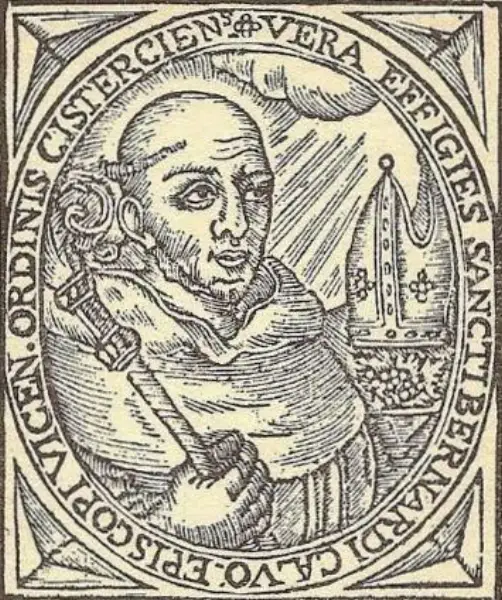
Bernat's progress to the altars was unusually quick at the first step and unusually slow at the second. In 1260, only seventeen years after his death and within living memory of the Valencia crusade, Pope Alexander IV beatified him — a recognition that speaks to the strength of his reputation in Catalonia, where a crusading bishop who had also been a reforming abbot was exactly the kind of saint the frontier church wanted. Full canonization then waited more than four centuries: it was Pope Clement XI who, on 26 September 1710, enrolled Bernat among the saints of the Catholic Church. The eighteenth-century date places him among the baroque canonizations, issued under the procedures that preceded the modern congregation of rites, and it reflects the renewed prestige of the Spanish church in that era as much as the merits of the cause. The double calendar that resulted — 24 October for the Cistercians, 26 October for the diocese of Vich — preserves the double identity of the saint: monk of Santes Creus and bishop of Vich, claimed alike by his order and by his see. Iconographically he is usually shown as a bishop in the Cistercian habit, the two loyalties joined in one figure.
§ Bernat Calbó
Lawgiver of a conquered kingdom
Bernat Calbó's historical importance lies less in miracles than in the fact that he helped write the laws of a kingdom. The Furs of Valencia, whose publication he assisted, remained the fundamental law of the Kingdom of Valencia from the conquest down to the eighteenth century, and the participation of a bishop who had actually served in the campaign tells us something about how the new Christian polity was built: by soldiers, monks and jurists, frequently the same men. His career is a compact summary of the instruments of the thirteenth-century Reconquista — the Tarragona curia that administered it, the Cistercian houses that settled it, the episcopate that sanctified it, and the legal profession that regularized it. In the memory of his own country he stands as one of the notable churchmen of the reign of James I, and his pontifical ornaments survive in the Museu Episcopal de Vic as material witnesses of his dignity. He is remembered chiefly through the scholarship of Robert Ignatius Burns, the historian of the crusader kingdom of Valencia, and through the hagiographic tradition of Santi e Beati — thin sources by comparison with the princes of his age, but enough to keep alive a saint who was also, in the fullest sense, a public servant.
§ Bernat Calbó
Timeline
- 1180
Born into a knightly family at Manso Calvo, near Reus.
§ Bernat Calbó
- 1214
Entered the Cistercian monastery of Santes Creus as a monk, after service as a jurist at the Tarragona curia.
§ Bernat Calbó
- 1223
Raised to the see of Vich, in 1223 or by some accounts 1233; had earlier been elected Santes Creus' first abbot.
§ Bernat Calbó
- 1238
Went with his household on the crusade against Valencia's Muslim taifa, supplying the besiegers at Burriana and before Valencia itself.
§ Bernat Calbó
- 1238
When Valencia fell, joined the celebratory first Mass in the central mosque alongside the troops of James I.
§ Bernat Calbó
- 1242
Visited the Kingdom of Valencia a second time, where he held extensive land grants.
§ Bernat Calbó
- 1243
Helped publish the Furs of Valencia, the law code of the newly conquered kingdom.
§ Bernat Calbó
- 26 Oct 1243
Died at Vich and was buried in the Cathedral of Vic.
§ Bernat Calbó
- 1260
Beatified by Pope Alexander IV.
§ Bernat Calbó
- 26 Sep 1710
Canonized by Pope Clement XI.
§ Bernat Calbó
The Record
- Major works
- Santes Creus monastery, of which he was elected first abbot·The Furs of Valencia, the law code of the Kingdom of Valencia, which he helped publish
- Symbols
- Represented as a bishop wearing the Cistercian habit
- Canonization
- Beatified by Pope Alexander IV in 1260; canonized by Pope Clement XI on 26 September 1710.
Prayer
Bibliography
Show 3 sources
- "Pontifical ornaments of St. Bernat Calbó", Museu Episcopal de Vic.
- Antonio Rimoldi, "San Bernardo Calvó", Santi e Beati, 30 August 2011.
- Robert Ignatius Burns, The Crusader Kingdom of Valencia: Reconstruction on a Thirteenth-Century Frontier, Cambridge, Massachusetts: Harvard University Press, 1967, p. 309.
Profile text adapted from the Wikipedia article, licensed CC BY-SA 4.0.
Pray with this saint every day
Save St. Bernat Calbó to your favorites, read the full profile, and get feast-day reminders in the Saints app.
Get the Saints AppFree on the App Store for iPhone and iPad