
died 19 July 1054·Feast July 19
St. Bernold of Utrecht
Reforming Prince-Bishop of Utrecht and church builder
Overview
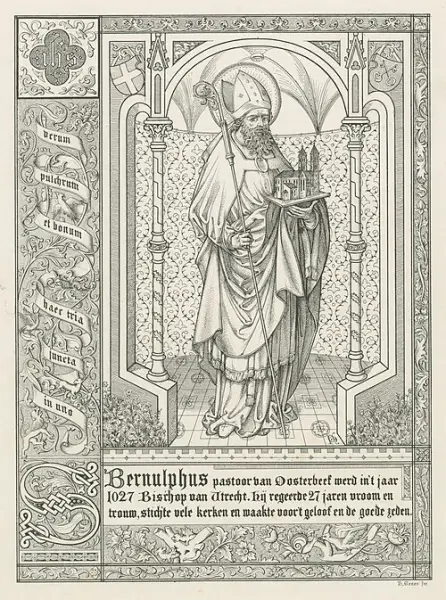
Bernold, whose name also appears as Bernulf, ruled the diocese of Utrecht from 1026 or 1027 until his death in 1054, succeeding the saintly Adalbold at the nomination of Conrad II, Emperor of the Holy Roman Empire. He had most likely served as an official at Conrad's court before receiving the see, which carried the twofold dignity of bishop and secular feudal prince. A firm ally of Conrad and of his son Henry III, Bernold threw his weight behind the ecclesiastical reform of his generation: he restrained the hold of bishops over monastic communities, fostered the Cluniac movement within his territories, and laboured to weaken the control that lay magnates exercised over churches and their endowments. The two emperors repaid his fidelity by enlarging his diocese, a grant renewed at the Council of Aachen in 1049, much to the anger of the regional nobility, whose brief rising in 1046 Henry III suppressed. Bernold was likewise a builder of consequence, raising the collegiate churches of Saint John and Saint Peter and the abbey of Saint Paul at Utrecht, foundations that, with the later church of Saint Mary, trace the outline of the city's celebrated Kerkenkruis. He died on 19 July 1054, the day kept as his feast, and in 1917 was declared patron of the artists' guild of Holland.
The Complete Life
From imperial court to the see of Utrecht
Bernold came to episcopal office not through the cloister but through the court. The record of his earlier life is spare, yet it points to service as an official in the household of Conrad II before the emperor named him to succeed Adalbold at Utrecht on 24 September 1027. The appointment placed him over one of the most consequential sees of the northern Empire, a diocese in which the bishop was also a temporal prince, wielding the rights of a feudal lord alongside his spiritual jurisdiction. Such a post demanded the talents of both prelate and statesman, and Bernold proved equal to the double burden. His elevation bound him closely to the Ottonian and Salian rulers whose court had formed him: he remained a supporter of Conrad to the end of that reign, and he enjoyed the friendship of Henry III even before that prince inherited the imperial dignity in 1046. This intimacy with the throne shaped the whole of his episcopate. It secured for his church the territorial rewards that its neighbors envied, and it exposed him to the reforming circle that gathered around the emperors, whose program of freeing the Church from lay domination Bernold would make his own during nearly three decades of rule.
§ Introduction
A reforming bishop and the Kerkenkruis
Bernold's governance joined the two great causes of his age: ecclesiastical reform and monumental building. On the reforming side he worked to reduce the power that bishops had accumulated over the monastic orders, strengthened the Cluniac houses within his domains, and moved against the customary grip of lay lords upon churches and church lands. These measures aligned him with Conrad II and Henry III, and the emperors answered his loyalty with territory, enlarging his see during their visits to Utrecht in 1040 and 1042 and confirming further gains at the Council of Aachen in 1049. Each extension of the diocese sharpened the displeasure of the local nobility, whose resentment broke into open rebellion in Lorraine in 1046 before Henry III put it down. As a builder Bernold endowed Utrecht with an ensemble of churches whose design still defines the city. He founded the collegiate church of Saint Peter in 1039 and that of Saint John in 1040, and he established the abbey and church of Saint Paul. Together with the later church of Saint Mary, these foundations form the Kerkenkruis, the great cross of churches laid out around the cathedral that remains one of the most striking urban religious schemes of medieval Europe.
§ Introduction
An honoured death at Utrecht
The closing decade of Bernold's life was the period of his greatest standing. With the revolt of the Lorraine nobility crushed in 1046 and the Council of Aachen adding to his see in 1049, the bishop of Utrecht stood higher in the imperial estimation than at any earlier moment, even as the magnates around him watched his accumulated privileges with unease. Bernold had ridden out with Henry III on the Hungarian campaign of 1041 and had twice welcomed the emperor within his walls, and this intimacy of throne and episcopacy was the frame within which his last years were lived. He continued to govern the diocese until the summer of 1054, dying at Utrecht on 19 July of that year. His memory was kept alive in the city he had adorned. A shirt of cloth numbered among his relics, and the veneration shown to him at Utrecht can be traced back at least to the fourteenth century, an unbroken cult that preceded by centuries any formal recognition. His mortal remains stayed in the city that his churches had marked with the sign of the cross, and the day of his death became the day of his feast.
§ Introduction
Patron of Dutch artists
Bernold's most visible monument is the ground plan of Utrecht itself. The churches he founded, the Pieterskerk, the Janskerk and the abbey of Saint Paul, still stand as witnesses to his ambition, and when the church of Saint Mary was begun in 1090 it completed the figure of the Kerkenkruis, four churches set about the cathedral in the shape of a cross. Pilgrims and visitors to Utrecht continue to walk that figure, tracing in pavement and skyline the design of an eleventh-century prince-bishop. His cult endured through the later Middle Ages and found a distinctive modern expression when, in 1917, Holland's guild of artists adopted him as its heavenly patron, an office that has kept his name alive among Dutch craftsmen and artists. The guild of Saint Bernulphus, which flourished around that patronage, carried his cult into the religious art revival of the nineteenth and twentieth centuries. Deniers struck under his authority survive as material reminders of his rule, and the relief work of the church of Saint Peter preserves something of the artistic world he brought into being. A loyal son of the imperial church, he is remembered as a builder who gave his city both its devotional geography and a standard of sacred art.
§ Introduction
Timeline
- 24 Sep 1027
Succeeds Saint Adalbold as Bishop of Utrecht on 24 September, appointed by the Emperor Conrad II
§ Introduction
- 1039
Founds the collegiate church of Saint Peter, the Sint-Pieterskerk, at Utrecht
§ Introduction
- 1040
Founds the church of Saint John, the Janskerk, while the Emperor Henry III is visiting Utrecht
§ Introduction
- 1041
Travels with Henry III on the imperial campaign against the Hungarians
§ Introduction
- 1042
Receives Henry III again at Utrecht, and the boundaries of his see are extended
§ Introduction
- 1046
A short-lived revolt of the Lorraine nobility is crushed by the Emperor Henry III
§ Introduction
- 1049
The Council of Aachen confirms a further enlargement of Bernold's diocese
§ Introduction
- 19 Jul 1054
Dies at Utrecht on 19 July, thereafter kept as his feast day
§ Introduction
- 1917
Is proclaimed patron of the artists' guild of Holland
§ Introduction
The Record
- Major works
- Collegiate church of Saint Peter (Sint-Pieterskerk), Utrecht, founded 1039·Collegiate church of Saint John (Janskerk), Utrecht, founded 1040·St. Paul's Abbey and its church (Sint-Pauluskerk), Utrecht·Deniers struck in his name as bishop of Utrecht
- Patron of
- Dutch artists·Artists' guild of Holland
- Canonization
- Pre-congregation; his cult at Utrecht is attested from at least the fourteenth century
Prayer
Bibliography
Show 4 sources
- Butler, Alban; Burns, Paul (ed.). Butler's Lives of the Saints: July. Continuum International Publishing Group (2000), p. 151.
- Broer, C.J.C. (2000). Uniek in de stad. De oudste geschiedenis van de kloostergemeenschap op de Hohorst sinds 1050 de Sint-Paulusabdij te Utrecht (in Dutch). Utrecht, the Netherlands.
- "Bernulf" in: Allgemeine Deutsche Biographie, herausgegeben von der Historischen Kommission bei der Bayrischen Akademie der Wissenschaften, Band 2 (1875), p. 505.
- Thursday August 6, 2026 / July 24, 2026. Orthodox Calendar. Holy Trinity Russian Orthodox Church, a parish of the Patriarchate of Moscow.
Profile text adapted from the Wikipedia article, licensed CC BY-SA 4.0.
Pray with this saint every day
Save St. Bernold of Utrecht to your favorites, read the full profile, and get feast-day reminders in the Saints app.
Get the Saints AppFree on the App Store for iPhone and iPad