
died c. 757·Feast May 15
St. Bertha of Bingen
Widowed mother of Rupert and solitary of the Rupertsberg
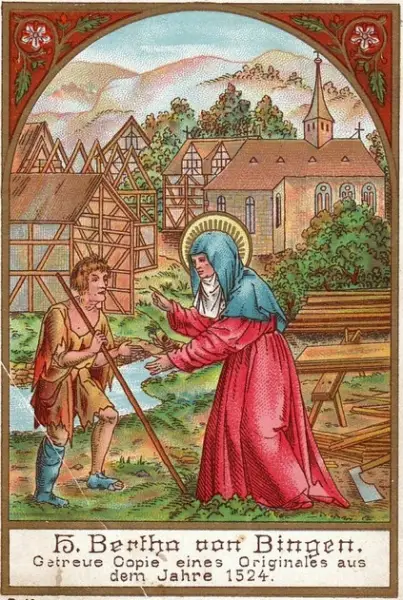
Overview
Bertha of Bingen, remembered in German as the holy Berta, died around the year 757 and is honoured as the mother of Saint Rupert of Bingen. A descendant of the dukes of Lorraine, she owned broad lands beside the Rhine and the Nahe. Her marriage was to Robolaus, an unbaptised man, whose death left Rupert, their three-year-old son, solely in her care with a young child in a borderland of the faith. Bertha then withdrew to the hill later called the Rupertsberg, accompanied by her son and by the priest Wigbert, built a small church there and embraced a secluded life marked by vigil and fasting. She gave part of her wealth to the needy and gradually drew others to imitate her example. Her chief energy went into the education of Rupert; after a pilgrimage to Rome she gave away her remaining possessions and settled near Bingen. Rupert died at twenty, and Bertha outlived him by twenty-five years. Her biography was written by Hildegard of Bingen, who four hundred years later moved her convent to the Rupertsberg and made Bertha's little church the seed of her own foundation. Bertha and Rupert share the feast of 15 May.
The Complete Life
A noblewoman of the Rhine and Nahe
Bertha belonged to the high nobility of the Rhineland, for her line descended from the ducal house of Lorraine, and her estates stretched wide beside the Rhine and the Nahe, the district around modern Bingen. Of her own parents and early years the record is silent, but her standing is beyond question: only a woman of established means could later endow a church, give lavishly to the poor, and still have possessions remaining to surrender after a pilgrimage to Rome. Her marriage set her a harder spiritual task than her rank suggested, for her husband Robolaus was a pagan, and the household of a believing wife with an unbaptised lord in eighth-century Germany stood at the raw frontier of the faith. From this union came one son, Rupert, the companion of all her later life. When Robolaus died, Rupert was only three years old, and Bertha was left a widow with the whole care of a young child, her estates and her conscience. The years that followed would show her to be both a mother devoted to her son's education and a woman drawn irresistibly toward renunciation, two vocations that in her would be resolved into a single life of prayer.
§ Bertha of Bingen
Widowhood on the Rupertsberg
The death of Robolaus released Bertha from a mixed marriage and set her on the path of the solitary. Leaving the world, she retired with her little son and with the priest Wigbert to the hill above the Nahe that would later bear her child's name, the Rupertsberg. There she built a small church with her own means, and around that altar she organised the remainder of her life. Her days were marked by much vigilance and fasting, the classical instruments of the widow's consecration, and by open-handed charity: she gave some of her wealth to the needy who came to her, and her example proved contagious, for gradually other people gathered to the hill to follow her manner of life. It was a household monastery in miniature, without rule or enclosure, held together by one woman's perseverance. The priest Wigbert provided the sacramental ministrations that the little community required. In this double office of mother and foundress Bertha showed that withdrawal from the world need not mean abandonment of responsibility: she had exchanged the management of an estate for the governance of a household of prayer.
§ Bertha of Bingen
Educator of a saint
The centre of Bertha's mission was her son. She devoted her energy to the education of Rupert, forming in him the learning and piety that would make his name outlast her own. In this she acted as the Church's first and most necessary teacher, the mother who instructs a child in the faith before any school or cloister can do so. A pilgrimage to Rome marked the second great renunciation of her life: returning from the thresholds of the apostles, she parted with her remaining goods and settled in the neighbourhood of Bingen, at the place called Rupertsberg after her son. The stripping of her property was complete, and it freed her for the last phase of a life already long given to prayer. Rupert died at the age of twenty, and his early death, which might have broken a mother's purpose, instead confirmed the offering she had made of him. Bertha survived him by twenty-five years, a quarter century of continued prayer, fasting and example on the hill where he had grown up. Mother and son had become together a single foundation, and the place that bore his name preserved her work within his memory.
§ Bertha of Bingen
Hildegard's inheritance
Bertha's place in history owes much to a woman born four hundred years after her. Hildegard of Bingen, living in the same region, wrote Bertha's biography and popularised her cult, drawing on local memory of the widow and her son. The chapel on the Rupertsberg had by then drawn pilgrims and was yet intact when, around 1150, Hildegard brought her nuns over from Disibodenberg and set a monastery upon the ruined castle whose ground held the graves of mother and son. The Vita Sancti Ruperti was written about this time, in part, as scholars judge, to revive the cult of Rupert and to legitimate the vision that had called Hildegard to move there, so that the memory of an eighth-century mother and son became the foundation charter of a twelfth-century abbey. The later fortunes of those relics trace the troubled history of the Rhineland: the monastery was destroyed in 1632 during the Thirty Years' War, and the relics were carried to Eibingen, where Bertha's head is kept in the Hildegard church and Rupert's arm is shown in a reliquary. Other relics returned to Bingen in 1814 and are honoured in the chapel on the Rochusberg, where mother and son share the feast of 15 May.
§ Veneration
Timeline
- 757
Dies at the Rupertsberg, having outlived Rupert by twenty-five years
§ Bertha of Bingen
- 1150
Hildegard of Bingen founds a monastery around Bertha's little church, and the Vita Sancti Ruperti is written
§ Veneration
- 1632
The Rupertsberg monastery is destroyed in the Thirty Years' War; relics move to Eibingen
§ Veneration
- 1814
Other relics are brought back to Bingen and kept in the Rochusberg chapel
§ Veneration
The Record
- Major works
- The small church on the Rupertsberg near Bingen·The community of solitaries gathered around her example
- Canonization
- Pre-congregation; her cult was popularised by Hildegard of Bingen about four centuries after her death
Prayer
Bibliography
Show 6 sources
- Borrelli, Antonio. "Beata Berta di Bingen", Santi e Beati.
- "Bertha von Bingen", Bistum Augsburg (in German).
- Saint Hildegard (1998). Symphonia: A Critical Edition of the Symphonia armonie celestium revelationum. Contributions by Barbara Newman (2nd ed.). Cornell University Press, p. 294.
- Throop, Priscilla (2010). Three Lives and a Rule. MedievalMS.
- King-Lenzmeier, Anne H. (2001). Hildegard of Bingen: An Integrated Vision. The Liturgical Press, p. 122.
- Herbert J. Thurston and Donald Attwater, eds. Butler's Lives of the Saints, vol. 2. Allen, TX: Christian Classics, 1956, p. 322.
Profile text adapted from the Wikipedia article, licensed CC BY-SA 4.0.
Pray with this saint every day
Save St. Bertha of Bingen to your favorites, read the full profile, and get feast-day reminders in the Saints app.
Get the Saints AppFree on the App Store for iPhone and iPad