
c. 565 – in or after 601
St. Bertha of Kent
Frankish queen whose chapel opened England to the Gospel
Overview
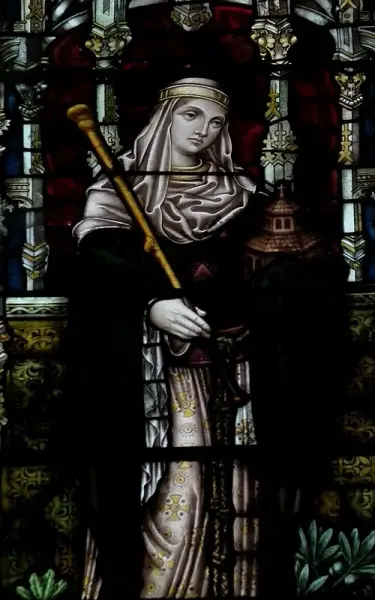
Bertha, also called Aldeberge, was a Frankish princess born around 565 who became queen of Kent and opened England to the Christian mission of 597. Her father was Charibert I, her mother Ingoberga, and through them she was granddaughter of the reigning Chlothar I and great-granddaughter of Clovis I and Saint Clotilde, so that the faith of the first Catholic kings of the Franks ran in her blood. She was raised near Tours. Her marriage in 580 to the pagan king Æthelberht of Kent was contracted on the express condition of her freedom to practise her faith, and her chaplain Liudhard came in her train. A former Roman church just outside Canterbury was restored for her use and dedicated to Martin of Tours, serving as her private chapel before Augustine arrived from Rome. The site is now St Martin's Church, Canterbury, recognised by UNESCO as the oldest church of the English-speaking world in unbroken use. Pope Gregory I urged Bertha to convert her husband and asked her to win him favourably to Augustine's mission; without her support and Æthelberht's goodwill, the cathedral and monastic foundations might have arisen elsewhere. She bore Eadbald and Æthelburg, received a papal letter of praise in 601, and died in or shortly after that year.
The Complete Life
Great-granddaughter of Clovis
Bertha was born around the year 565 into the innermost circle of the Merovingian dynasty. Her father Charibert I ruled as king in Paris; her mother was Ingoberga; and her grandfather Chlothar I was the reigning king of the Franks at the time of her birth. Further back stood the founders of the dynasty's Catholic faith itself, for Bertha was the great-granddaughter of Clovis I, the first barbarian king to receive baptism from a Catholic bishop, and of Saint Clotilde, the Burgundian princess whose persuasion had brought her husband to the font. The faith for which Bertha would become an instrument in England was thus a family inheritance of four generations. She was raised near Tours, the city of Saint Martin, whose cult would follow her across the Channel, and she passed her childhood in the shadow of her parents' troubled court. Her father died in 567 and her mother in 589, leaving Bertha an orphan of both parents while still a young woman. From this milieu of Merovingian piety and power she was drawn, as so many Frankish princesses were, into the marriage diplomacy that linked the Frankish kingdoms to the newly forming realms of the Anglo-Saxons.
§ Life
A Christian queen in a pagan kingdom
In 580 Bertha was married to Æthelberht, king of Kent, a pagan ruler whose kingdom faced the continent across the narrowest water. The match was contracted on an explicit condition: the young queen must be allowed to practise her religion. That clause, remarkable in the diplomacy of the age, made the marriage itself an act of religious witness, for it carried the worship of Christ into a court that did not yet know him. Bertha did not cross alone. With her came her chaplain Liudhard, who served her household with the sacraments, so that mass was celebrated in Kent years before Augustine's arrival. Her first work upon settling was practical and enduring: a disused church from the Roman period standing just outside the walls of Canterbury was restored for her use and dedicated to Martin of Tours, the patron of her childhood near Tours. It served as the queen's private chapel. St Martin's Church, Canterbury, still occupies the site, its chancel retaining Roman walling from the earliest building, a fabric UNESCO recognises as the oldest English-speaking church in unbroken worship since 580.
§ Life
Preparing the way for Augustine
The mission for which Bertha's chapel had quietly prepared came in 596, when Pope Gregory I resolved to send Augustine with a band of monks to restore Christianity to the English. The pope's correspondence shows both his hope in the queen and his impatience with her: Gregory had already urged Bertha to work for the conversion of her husband, and he had upbraided her for not having done so. When the mission was decided, he asked her to incline Æthelberht's heart to give the preachers a favourable reception. Augustine, who was expected to move on after a beginning, instead chose to stay, and on land granted by the king he founded the Abbey of St Peter and Paul beside Canterbury, the seed of English monasticism. Historians judge that without the queen's support and the king's goodwill, the monastic settlements and the cathedral itself would most likely have been developed elsewhere. In 601 Gregory wrote to Bertha, praising her warmly for her faith and no less for her learning, a striking papal tribute to a woman's learning in that age. Her position as the Christian within the palace had made her the hinge of the whole undertaking.
§ Life
Children, chronicles and an uncertain death
Anglo-Saxon records credit Bertha with two children by Æthelberht: Eadbald, who succeeded his father as king of Kent, and Æthelburg, who would herself be sent north as a Christian bride in the continuing conversion of the English kingdoms. Through these children the queen's line remained entwined with the dynastic and religious history of early England, and her name appears in the genealogies of several medieval accounts of what scholars call the Kentish Royal Legend. The last firm document of her life is the papal letter of 601, praising her faith and her learning, and it is with or soon after that year that her death falls. The precise date is disputed, and a tradition placing it in 606 cannot be confirmed; the honest chronicle must rest with the year of Gregory's letter. Her husband, converted after Augustine's coming, ruled on, and the church that had begun in her chapel grew into the cathedral and abbey that made Canterbury the primatial see of England. Bertha did not live to see the full harvest, but the sowing had been hers: a chapel, a chaplain, and a condition written into a marriage contract.
§ Life
Canterbury's queen
Bertha's legacy may fairly be summed up as the Christian conversion of much of England, since her prayers and her chapel prepared the way for the Augustinian mission, and the church that grew from 597 shaped the nation's history for a millennium and a half. Canterbury today keeps her memory with deliberate pride. A trail of fourteen bronze plaques set into the pavements, known as the Bertha trail, runs from the Buttermarket through Lady Wootton's Green to St Martin's Church, leading walkers physically along the queen's story. In 2006 the Canterbury Commemoration Society's project honouring Æthelberht and Bertha saw bronze statues of the royal pair, by the sculptor Stephen Melton, installed on Lady Wootton's Green, where they stand as civic monuments to the marriage that opened the kingdom to the faith. Within St Martin's Church a wooden statue of Bertha watches the south wall of the oldest continuously used church in the English-speaking world. Together with Canterbury Cathedral and St Augustine's Abbey, St Martin's forms the UNESCO World Heritage Site of Canterbury, so that the fabric of the queen's devotion is now protected among the monuments of universal human culture, and pilgrims still trace her path from market to chapel.
§ Legacy
Timeline
- 565
Born a Frankish princess, daughter of Charibert I and Ingoberga, and raised near Tours
§ Life
- 567
Her father Charibert I dies
§ Life
- 580
Marries the pagan Æthelberht of Kent on condition that she may practise her religion, arriving with her chaplain Liudhard
§ Life
- 580
A former Roman church outside Canterbury is restored for her and dedicated to Martin of Tours
§ Life
- 589
Her mother Ingoberga dies
§ Life
- 596
Pope Gregory I decides to send Augustine's mission and asks Bertha to incline her husband's heart to receive it well
§ Life
- 597
Augustine arrives in Kent; on land granted by Æthelberht he founds the Abbey of St Peter and Paul
§ Life
- 601
Pope Gregory writes to Bertha, complimenting her highly on her faith and her knowledge of letters
§ Life
- 601
Her death falls in or shortly after this year; a tradition placing it in 606 cannot be confirmed
§ Life
- 2006
Stephen Melton's bronze figures of Æthelberht and Bertha are set up on Lady Wootton's Green, Canterbury
§ Legacy
The Record
- Major works
- Restoration of the church of St Martin, Canterbury, as her private chapel·Enablement of the 597 Gregorian mission and the Abbey of St Peter and Paul, Canterbury
- Canonization
- Pre-congregation; honoured as the queen whose prayers prepared the conversion of Anglo-Saxon England
Prayer
Bibliography
Show 7 sources
- Nelson, Janet L. (2006). "Bertha (b. c.565, d. in or after 601)". Oxford Dictionary of National Biography. Oxford University Press. doi:10.1093/ref:odnb/2269.
- Gregory of Tours. History of the Franks, Book 4.
- Taylor, Martin. The Cradle of English Christianity.
- Wace, Henry and Piercy, William C. "Bertha, wife of Ethelbert, king of Kent". Dictionary of Christian Biography and Literature to the End of the sixth Century. Hendrickson Publishers, Inc.
- Thurston, Herbert. "Bertha." The Catholic Encyclopedia. Vol. 2. New York: Robert Appleton Company, 1907.
- "Queen Bertha. (539 to about 612) Queen of Kent, Princess of the Franks". Canterbury Historical and Archaeological Society.
- Rollason, D. W. (1982). The Mildrith Legend: A Study in Early Medieval Hagiography in England. Leicester: Leicester University Press.
Profile text adapted from the Wikipedia article, licensed CC BY-SA 4.0.
Pray with this saint every day
Save St. Bertha of Kent to your favorites, read the full profile, and get feast-day reminders in the Saints app.
Get the Saints AppFree on the App Store for iPhone and iPad