
died c. 690·Feast May 1
St. Bertha of Val d'Or
Celibate wife, foundress of Avenay and martyr
Overview
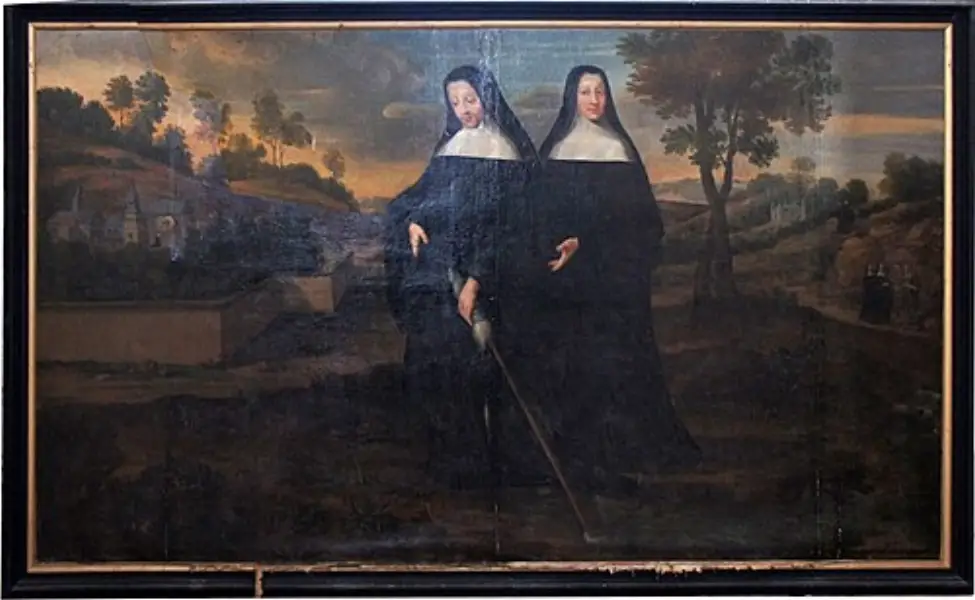
Bertha of Val d'Or, who died around 690, is honoured as an abbess, virgin and martyr of the Champagne country of northeastern France. Her husband was Gombert, Lord of Champenois, a nobleman connected with the royal family of France, and with him she lived a life of continence within marriage. Gombert raised a convent at Avenay for Bertha and her maidens, and then withdrew to a monastery on the coast, where he was later killed by pagan raiders. Directed by a vision, Bertha moved her nuns to the Val d'Or near Avenay. During a drought in the district, the apostle Peter is said to have appeared to her, showing her a garden where a fine spring rose, which she bought for a pound of silver; with her distaff she traced the course of a stream she called Libra, flowing before the convent and serving both nuns and town. In 690 the relatives of her husband, angered that she had given to the poor wealth they hoped to inherit, killed her. Her tradition is acknowledged to be very late and unreliable, resting chiefly on a vita first printed at Toul in 1650.
The Complete Life
A celibate marriage
The tradition of Bertha begins not in a convent but in a marriage consecrated by mutual renunciation. Her husband, Gombert, Lord of Champenois, was a nobleman and a member of the royal family of France, so that the couple stood among the great ones of the Frankish world; yet with his consent she lived as a virgin within the married state, the two keeping continence by common accord. Such marriages of spiritual friendship, though never common, appear more than once in the early medieval record of the Frankish aristocracy, and they mark a moment in which the ascetic ideal of the desert was carried into the highest ranks of society. Bertha's own birth is not recorded, and the place of her upbringing is unknown; what the tradition preserves is the shape of her vocation rather than its chronology. That vocation soon bore institutional fruit. Gombert built a convent for his wife and her maidens at Avenay, in the Champagne country, and then withdrew from the world himself, retiring to a monastery on the coast. Husband and wife thus exchanged one household for two houses of religion, his by the sea and hers beside the river valley that would give her the name history remembers.
§ Introduction
Foundress at Avenay and the Val d'Or
Widowed in religion rather than in fact, Bertha received the news that Gombert had been killed by those the sources call idolaters and pagan marauders, still dwelling on the coasts of the Frankish world. Her response was to secure her community's future. Directed by a vision, she moved her nuns from Avenay to the Val d'Or, the golden valley near the town, where the convent would stand through the centuries that followed. It is uncertain, the record admits, whether the house followed the Dominican Rule, an anachronistic detail that betrays the lateness of the tradition. The best-loved story of her foundation belongs to a time of drought, when the district around the convent lacked water. The apostle Peter, according to the hagiographer Agnes Dunbar, appeared to Bertha, showing her a garden watered by a fine spring. She bought the spring for a pound of silver, and with her distaff traced the line of a stream she named Libra, in memory of the purchase. The water flowed before the gates of her convent and supplied both the nuns and the town, a charism of practical providence that turned a dry hillside into a habitable place of prayer.
§ Introduction
Martyrdom by inheritance
Bertha's death came from the most domestic of motives. In the year 690 the relatives of her dead husband turned against her, indignant that she distributed Gombert's money to the poor and had, in the words of the hagiographer, given away a great deal that they had hoped to obtain for themselves. Charity of exactly this kind, the dispersal of a great estate among the destitute, was the classic occasion of a noble widow's martyrdom, and so it proved here: they killed her, and the Church read her death as witness. The legend gathers darkness around the deed, reporting that the killers were at once possessed by the devil and rent themselves apart, saving only one woman, Nuncia, who was touched by remorse. Bertha appeared to Nuncia asking that Gombert's body be brought to the Val d'Or so that she might be buried with her husband; when Nuncia asked proof that her compliance would be forgiven, blood spouted from her nose and mouth as Bertha had foretold the moment the translation was made. A century after her death Bertha's remains were discovered incorrupt, and when the remains of wife and husband were brought to the place of her killing, her wounds were said to have bled afresh.
§ Introduction
A very late and unreliable tradition
The historian's caution stands at the centre of Bertha's afterlife, for her own tradition is described by the sources that preserve it as very late and unreliable. The vita on which the story rests was written by Laurent Majoret and first published at Toul in 1650, then reissued at Rheims in 1700 and again in 1743, a full millennium after the events it narrates. Yet late traditions are not empty ones, and the cult that such texts serve often preserves a real memory beneath the miraculous accretions: a noble couple of Champagne who lived in continence, a convent at Avenay and then in the Val d'Or, a spring that watered the valley, and a foundress killed by disappointed heirs. Bertha is venerated as a virgin and martyr in the Roman Catholic Church and in the Eastern Orthodox Church, and her feast falls on the first of May, the ancient beginning of summer in the northern lands. Dunbar's dictionary of saintly women, the Catholic Encyclopedia and the modern dictionaries of the saints carry her entry, keeping the martyr of the golden valley in the Church's memory. The stream called Libra remained, in her hagiographer's telling, a standing witness, flowing clear and abundant, and curing many infirmities.
§ Introduction
Timeline
- 690
Killed by her husband's relatives, angry that she gave his money to the poor
§ Introduction
- 790
About a century after her death her body was found incorrupt, and her wounds bled afresh when she and Gombert were moved
§ Introduction
- 1650
Laurent Majoret's vita of Bertha was first published at Toul
§ Introduction
- 1700
Majoret's vita was reissued at Rheims
§ Introduction
- 1743
A further Rheims edition of the vita appeared, revised and corrected
§ Introduction
In Their Own Words
there it flows to this day, an abundant supply of beautiful, clear water, curing many infirmities, and witnessing the truth of the legend of the distaff
gave to the poor a great deal that they hoped to get for themselves
The Record
- Major works
- Convent at Avenay, built by her husband Gombert·Community of nuns settled at the Val d'Or near Avenay·The stream Libra, traced with her distaff to water nuns and town
- Symbols
- Distaff·Spring or stream of water
- Canonization
- Pre-congregation; venerated as a virgin and martyr in the Roman Catholic and Eastern Orthodox churches
Prayer
Bibliography
Show 4 sources
- Walsh, Michael J. (2007). A New Dictionary of Saints: East and West. Collegeville, Minnesota: Liturgical Press, p. 99.
- Catholic Encyclopedia. New York: Appleton, 1907, p. 519.
- Majoret, Laurent (1650). La Vie de Ste Berthe, vierge et martyre... à laquelle sont adjoustées les vies de S. Gombert, ... et de S. Tressain, ... Par le R. P. Dom Laurent Majoret.
- Dunbar, Agnes B.C. (1901). A Dictionary of Saintly Women. Volume 1. London: George Bell and Sons, pp. 117-118.
Profile text adapted from the Wikipedia article, licensed CC BY-SA 4.0.
Pray with this saint every day
Save St. Bertha of Val d'Or to your favorites, read the full profile, and get feast-day reminders in the Saints app.
Get the Saints AppFree on the App Store for iPhone and iPad