
died 1195·Feast March 29
St. Berthold of Calabria
Crusader founder of the Mount Carmel hermits
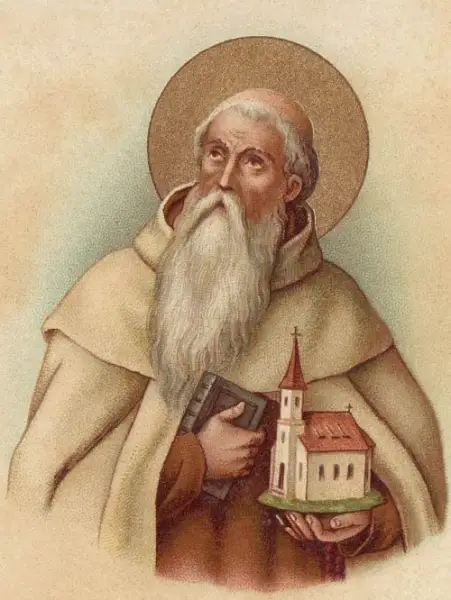
Overview
Berthold of Calabria was a French crusader of the twelfth century remembered as the founder of a hermit colony on Mount Carmel. A son of the Count of Limoges, he was born at Malifaye in southwestern France; the byname Calabrian served in the usage of his era as a literary word for a Westerner rather than a statement of geography. The Latin patriarch of Antioch, Aymeric of Malifaye, was his uncle, a tie that set him within the network of Latin churchmen serving in the crusader East. Journeying to the Holy Land with the crusading armies, he was present at Antioch while it was under siege by Muslim forces and there, tradition holds, received a vision of Christ rebuking the cruelty of the soldiers. Around 1185 he withdrew to Mount Carmel, raised a modest chapel there, and gathered a company of hermits who wished to live beside him in imitation of the prophet Elijah. Later Carmelite writers styled him Saint Berthold of Mount Carmel and counted him a leader of the Order before Brocard, although historians of the Carmelites discount the claim that his settlement gave birth to their Order. He governed the hermits on the mountain until his death in 1195 and is commemorated on March 29.
The Complete Life
A nobleman of Limoges
Berthold was born at Malifaye in the southwest of France, the son of the Count of Limoges, and so belonged by birth to the high aristocracy of the Aquitanian world that sent so many knights on crusade. His family tie to Aymeric of Malifaye, the Latin patriarch of Antioch, connected him to the churchmen who governed the crusader states, and it was through such channels that a young noble of Limoges found his way eastward. The surname by which he is remembered, Calabrian, has misled readers for centuries: in the writing of the period it functioned as a polished euphemism meaning simply a Westerner, a Latin Christian from beyond the mountains, and it says nothing about an Italian birth. Some later accounts, drawing on the tradition preserved by Mariologists and popular hagiographers, describe him as Berthold of Malifaye, a Frenchman, and credit him with ten companions. The sources that survive are slight and late, and the Carmelite historians of the modern era treat them with reserve. What they agree upon is the essential outline: a well-born French crusader, stirred by the events of the Holy Land, who ended his life as a father of hermits on the mountain where Elijah had stood.
§ Berthold of Calabria
A vow beneath the walls of Antioch
Berthold went out to the East with the armies of the Cross and was in Antioch at a time when the city was pressed by besieging Muslim forces. It was there, according to the tradition preserved by Philip Schaff and repeated in the saint literature, that he made a vow: should the Christians prevail, he would give himself to the monastic life for whatever years remained to him. The story belongs to a familiar pattern of crusader piety, in which the violence of campaign awakened a counter-movement of penance and withdrawal. A related and more striking moment is also recorded: during the siege Berthold received a vision of Christ denouncing the evil methods of the soldiers, a rebuke that turned his mind decisively toward the hermit life. Western hermits were scattered through Palestine in those years, some living in ruins, some in caves, drawn to the holy places by the newly opened roads of the crusade. Berthold's response to his vision was not to return home but to join that scattered company, and to gather it into something ordered. His vocation was thus forged at the meeting point of war and contemplation, the soldier becoming a father of solitaries.
§ Berthold of Calabria
The hermits of Carmel
Around the year 1185 Berthold came to Mount Carmel, the ridge above the Mediterranean where the prophet Elijah had contested the priests of Baal. There he built a small chapel and gathered around himself a community of hermits who desired to live at his side in imitation of Elijah, the man of God who stood alone against kings and heard the Lord in the whisper of the wind. The later claim that his settlement produced the Carmelite Order lacks any documentary support, and the historians of the Order set it aside. What is beyond dispute is the fact of the settlement itself, remembered in Carmelite memory and recorded in church histories of the nineteenth and twentieth centuries, which describe a hermit colony instituted on the mountain in 1185 by a crusader named Berthold. Tradition further holds that Brocard, the figure to whom the Carmelite Rule of Saint Albert was originally addressed, accepted Berthold as leader of the hermits, a passing of the mantle that binds the French knight to the earliest formal chapter of Carmelite history. Berthold never left the mountain again.
§ Berthold of Calabria
Memory in the Carmelite tradition
Berthold spent the rest of his life on Mount Carmel, governing the hermit band he had assembled there until his death in 1195, and was honored thereafter with a feast on March 29. His afterlife in literature began late: it was around the fifteenth century that Carmelite writers introduced him as Saint Berthold of Mount Carmel and described him as a general of the Order before Brocard, claims that belong to the Order's effort to imagine its own origins rather than to documented history. Church historians of the modern period nevertheless kept his name alive. Hubert Jedin's survey of the medieval church notes that the Carmelite origins reach back to a hermit colony instituted on Mount Carmel in 1185 by the crusader Berthold, and Juniper Carol's study of Mariology records the tradition of a hermit from Calabria, son of the Count of Limoges, who retired to the mountain with ten companions. The tension between devotion and evidence is itself instructive: the figure of Berthold shows how religious orders remember founders, shaping scattered facts into a lineage. For the reader today he remains a witness to the impulse, as old as Elijah, to seek God on a mountain in the company of a few deliberate souls.
§ Berthold of Calabria
Timeline
- 1185
Comes to Mount Carmel as a crusader, builds a small chapel, and gathers a community of hermits living in imitation of Elijah.
§ Introduction
- 1195
Dies on Mount Carmel, where tradition holds he ruled the hermit community he had founded.
§ Introduction
- 1400
Introduced into Carmelite literature as Saint Berthold of Mount Carmel, said to be a general of the Order before Brocard.
§ Introduction
The Record
- Major works
- Hermit chapel and community on Mount Carmel
- Patron of
- Patron of Carmelite hermit origins
- Symbols
- Mount Carmel·Crusader·Habit of a hermit
- Canonization
- Pre-congregation; honored in Carmelite tradition as Saint Berthold of Mount Carmel
Prayer
Bibliography
Show 5 sources
- Jedin, Hubert, John Patrick Dolan, and David Larrimore Holland. The Medieval and Reformation Church, 1993, p. 104.
- Schaff, Philip. History of the Christian Church, Volume V: The Middle Ages, 1966.
- Rohrbach, Peter-Thomas. Journey to Carith: The Sources and Story of the Discalced Carmelites, 2007, p. 37.
- Carol, Juniper B. Mariology, 1961.
- Stevens, Clifford. The One Year Book of Saints. Our Sunday Visitor, Huntington, Indiana.
Profile text adapted from the Wikipedia article, licensed CC BY-SA 4.0.
Pray with this saint every day
Save St. Berthold of Calabria to your favorites, read the full profile, and get feast-day reminders in the Saints app.
Get the Saints AppFree on the App Store for iPhone and iPad