
died c. 660·Feast May 11
St. Bertille of Thuringia
Merovingian princess and mother of two saintly foundresses
Overview
Bertille of Thuringia was a Merovingian princess and Frankish saint of the seventh century, the daughter of Bercarius, king of the Thuringians. She was married to Walbert IV, a prince of Lower Austrasia whose duchy stretched over Cambrésis, Hainaut, Brabant, Hesbaye and the Ardennes and reached to the Rhine. Of their union two daughters were born, both of whom the Church honors as saints: Waltrude and Aldegund, the latter the foundress of Maubeuge Abbey. Through her family the Christian aristocracy of the Meuse country was knit together; her husband's younger brother Brunulphe was count of the Ardennes, and his daughter was Saint Aye, heiress of the county of Haynau after Waltrude. In her later years Bertille became a nun at Maubeuge Abbey, the house her own daughter Aldegund had founded, exchanging the title of princess for the habit of a religious. She died around the year 660 in the pagus Hainoensis of Austrasia, in what is now Hainaut province in Belgium, and was buried beside her husband in the old church at Cousolre. Their daughter Aldegund set up a community of twelve Benedictine nuns beside the tombs, and when her own death came she too was laid near Bertille and Walbert. The relics of Bertille and Walbert were placed in the church of Saint-Martin at Cousolre in 1661.
The Complete Life
Daughter of the king of Thuringia
Bertille was born in the seventh century, the daughter of Bercarius, king of Thuringia, and she carried the name of that central German kingdom all her life, even though her story belongs chiefly to the Frankish west. Her exact birth year is not recorded, but the chronology of her children places her maturity in the second quarter of the seventh century. To be a princess of Thuringia in that generation was to belong to a royal house whose fortunes had long been bound up with those of the Frankish realms to the west. Marriage was the ordinary instrument of that accommodation, and Bertille's own marriage is the clearest sign of it. The sources that preserve her, chiefly Baring-Gould's collection of the lives of the saints and the older diplomatic and annalistic material of Hainaut, remember her not for any deed of her own youth but for the extraordinary family she raised. That silence is itself historical: for a royal woman of the Merovingian era, biography was written in marriages and offspring, and Bertille's offspring were of a quality that few royal houses could claim.
§ History
Marriage into the house of Lower Austrasia
Bertille was given in marriage to Walbert IV, a prince of Lower Austrasia, and by that union the Thuringian royal line was joined to one of the great territorial principalities of the Frankish northeast. Walbert's duchy covered Cambrésis, Hainaut, Brabant, Hesbaye and the Ardennes, and extended as far as the Rhine, a broad belt of country between the Scheldt and the German river. Two daughters were born to them, Aldegund and Waltrude, and both became saints. Waltrude, born in the 620s at Cousolre, married Vincent Madelgarius and bore four children, Aldetrude, Landry of Soignies, Madelberte of Maubeuge and Dentelin of Mons, before following her mother into holiness. The family web widened further through Bertille's brother-in-law: her husband's younger brother Brunulphe was count of the Ardennes, and his daughter was Saint Aye, who inherited the county of Haynau after Waltrude. Bertille's vocation, in the sense her age understood it, was precisely this: to be the knot at the center of a kindred out of which came abbesses, bishops' collaborators and foundresses, a dynasty whose wealth ended by flowing into churches and monasteries rather than down the generations.
§ History
A nun at her daughter's abbey
In her later years Bertille took a step that closed the circle of her life: she became a nun at Maubeuge Abbey, the monastery founded by her own daughter Aldegund. The gesture has a quiet grandeur. The princess who had been married to bind two realms, and whose daughters had founded houses and filled them with their own children, now entered a cloister herself, taking the place of a subject in an establishment where her own child ruled as foundress. It was a common enough pattern among the Merovingian nobility, in which widowed or aging aristocrats retired to the monasteries their families had built, but it was never a mere formality; the rule observed at Maubeuge was that of Benedict, and the habits of a court did not survive it unbroken. She died around the year 660 in the pagus Hainoensis, the district of Hainaut, in the Frankish kingdom of Austrasia, territory that lies today in the Belgian province of Hainaut. She was buried with her husband Walbert in the old church of Cousolre, husband and wife laid together in the parish that had seen the birth of their daughter Waltrude, a church that was itself destroyed in later ages.
§ Death
A dynasty of relics and saints
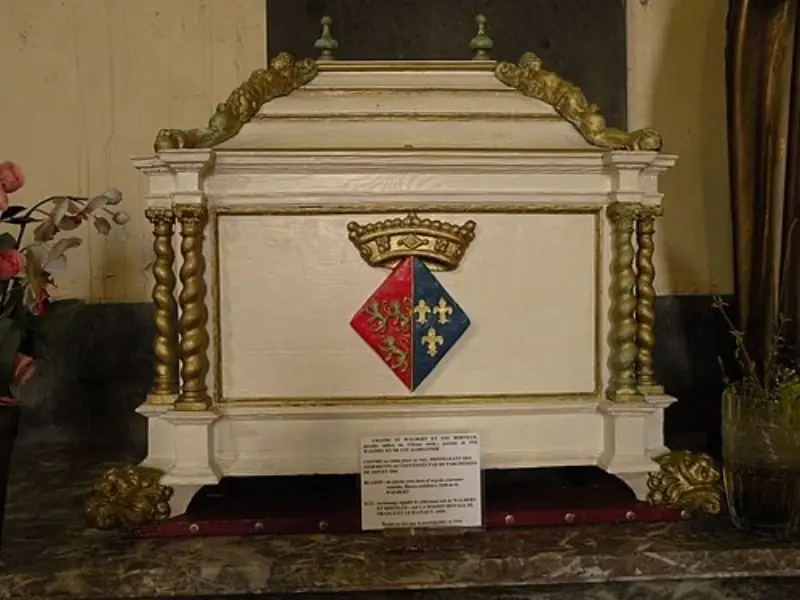
The legacy of Bertille is written in the geography of Hainaut and in the calendar of its saints. Beside the tombs of Bertille and Walbert at Cousolre, their daughter Aldegund planted a community of twelve Benedictine nuns, setting regular life at the graves of her parents. When Aldegund came there in 664 she was overtaken by cancer, died, and was buried near Bertille and Walbert; in 690 her body was translated to Maubeuge Abbey by her niece Saint Adeltrude, who had succeeded her as abbess, so that mother, husband and daughter were for a season the common possession of the country round. On Bertille's death her daughter Waltrude inherited the lands and titles and married Prince Madelgaire; their son Landry and two daughters entered the monastery of Saint Aldegund, and with the death of their son Dentelin the duchy went to their cousin Saint Aye, who turned her inheritance over to the church of Saint Waltrude. The line thus ended not in a throne but in a series of foundations. A tangible memory survived: in 1661 the relics of Bertille and Walbert were placed, preserved, in the church of Saint-Martin at Cousolre, where an oak chest set in that year protected their bones, and both husband and wife are honored as canonized saints, with Bertille's feast kept on May 11.
§ Death
Timeline
- 620
In the 620s her daughter Saint Waltrude was born at Cousolre.
§ History
- 660
Died around this year in the pagus Hainoensis of Austrasia and was buried beside her husband Walbert IV in the old church of Cousolre.
§ Death
- 664
Her daughter Saint Aldegund, visiting the convent raised near the tombs, succumbed to cancer and was buried close to Bertille and Walbert.
§ Death
- 690
Aldegund's body was translated to Maubeuge Abbey by her niece Saint Adeltrude, the new abbess.
§ Death
- 1661
The relics of Bertille and Walbert IV were preserved and set in the church of Saint-Martin at Cousolre.
§ Death
The Record
- Major works
- Religious retirement at Maubeuge Abbey, founded by her daughter Saint Aldegund
- Patron of
- Of the Hainaut country and of Christian mothers of saintly children
- Symbols
- Crown laid aside for the veil·Tomb shared with her husband
- Canonization
- Pre-congregation; Bertille and her husband Walbert IV are both canonized
Prayer
Bibliography
Show 7 sources
- Baring-Gould, S. The Lives of the Saints. London: J. C. Nimmo, 1898.
- Opera diplomatica et historica, 1734.
- Vinchant, F. Annales de la province et comté d'Haynau où l'on voit la suitte des comtes depuis leur commencement. De L'Imprimerie de Jean Havart, 1648.
- Du Tems, H. Le Clergé de France, ou tableau historique et chronologique des archevêques, évêques, abbés, abbesses et chefs des chapitres principaux du Royaume. Paris: Chez Brunet, 1775.
- Gossart, D. Précis de l'histoire des principaux Etablissements religieux de l'arrondissement d'Avesnes. France: Prignet, 1860.
- Waltrude, her life and her works. Wallonia tourism.
- Annuaire statistique du département du Nord, 1836.
Profile text adapted from the Wikipedia article, licensed CC BY-SA 4.0.
Pray with this saint every day
Save St. Bertille of Thuringia to your favorites, read the full profile, and get feast-day reminders in the Saints app.
Get the Saints AppFree on the App Store for iPhone and iPad