
died 3rd century (by tradition)·Feast August 10
St. Bessus
Theban Legion martyr of the Alpine valleys
Overview
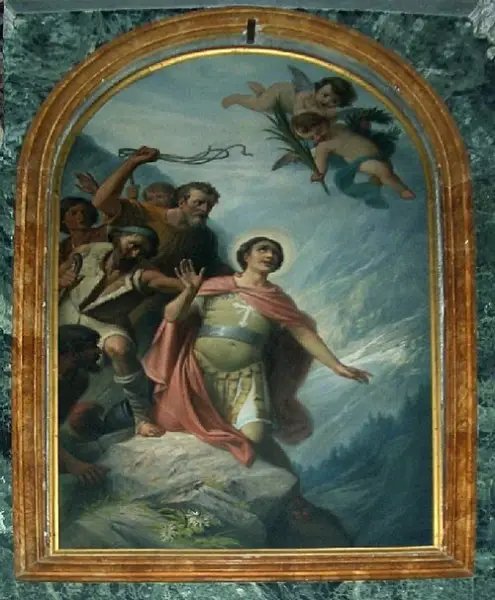
Bessus, known in Italian as San Besso and sometimes as Besse, is honoured as a soldier of the legendary Theban Legion, the corps commanded by Maurice whose members were put to death in the third century rather than renounce their Christian faith. Tradition relates that he escaped the decimation that destroyed his companions and made his way into the mountain country of Aosta and Cogne, where he spent his remaining years preaching to the shepherds of the high valleys and bringing them to Christianity. Around his name gathered a rich cycle of stories: a medieval breviary of 1473 recounts how he denounced cattle thieves at a banquet and was hurled from the cliffs of Monte Fantino, surviving the fall only to be killed by the Roman soldiers who had earlier slaughtered his legion at Agaunum. A folk version collected at Cogne in 1912 pictures him instead as a local shepherd whose prosperity aroused fatal envy. His cult became one of the most popular of any Theban saint after Maurice himself. His relics rest in the cathedral of Ivrea, and every August a mountain pilgrimage carries his statue to the cliff associated with his death.
The Complete Life
A Soldier of the Theban Legion
Bessus belongs to the company of the Theban Legion, the all-Christian corps recruited from upper Egypt and commanded by Saint Maurice. The legion's story tells how its soldiers, ordered at Agaunum to sacrifice to the gods and take part in a persecution, chose instead to suffer; a decimation was carried out, and when the men still refused, the entire corps was put to the sword. According to the tradition that grew up in the Alps, Bessus lived through that slaughter and fled southward into the valleys of Aosta and Cogne, carrying nothing but his faith and his soldier's training. There he found a new commission. Among the isolated hamlets of the high valleys, where the shepherds of Gran Paradiso kept their flocks through summers of brief pasture and winters of deep snow, he gave himself to preaching the gospel and instructing the mountain people in the Christian life. The soldier's obedience that had once been owed to Rome was transferred to his heavenly commander, and the courage that had survived a military execution now served the slower, patient work of conversion. In the popular imagination of Piedmont he remained forever the warrior-saint, and his images show him with the soldier's banner bearing the Mauritian Cross and the palm of martyrdom.
§ Legend
Preacher of the High Valleys and His Martyrdom
The legends attached to Bessus concentrate on his final days among the mountains. A breviary written in 1473 preserves the best-known account: the saint was invited to a banquet by men of Piedmont who had driven off stolen cattle and were feasting on the meat of their theft. When Bessus recognized the crime set before him, he did not keep silent but denounced the thieves openly. Enraged, they pursued him and drove him over the cliffs of Monte Fantino. The fall did not kill him, according to the story, and so the Roman legionaries — the same executioners who had destroyed his legion at Agaunum — completed what the thieves had begun. The rock itself was believed to preserve the imprint of his passage, and on that spot the sanctuary dedicated to the saint was raised, a place of pilgrimage to the present day. Another telling has him conceal himself in the valley of Cogne before the soldiers found him. A third version, part of an oral tradition handed down among the families of Cogne and written down by the scholar Robert Hertz in 1912, makes him no soldier at all but a shepherd of the region, so pious that God prospered his flock with fat and healthy beasts, until neighbours envious of his good fortune forced him from a cliff. All the versions agree on the essential shape: a holy man of the mountains, killed for righteousness at a rock face that still bears his name.
§ Legend
A Cult Old and Deep
The historical identity of Bessus is woven from strands that scholars have long tried to separate. Popular devotion knew two figures of the same name: a bishop of Ivrea put to death for the faith in the eighth century, and a hermit of that name attached to an Alpine sanctuary near Campiglia in the Cogne valley. Ivrea also kept two feast days in his honour, August 10 and December 1, and some have seen in the very name a distant echo of the Egyptian god Bes, a deity likewise invoked for fertility and likewise marked by the ostrich feather that adorns the saint's helmet in his iconography. Whatever the remote origins, the Church of the region received Bessus without hesitation among its martyrs, and his veneration spread more widely than that of any saint of the Theban Legion except Maurice himself. He was honoured as a great worker of miracles and cures, invoked by soldiers facing the perils of war and by couples praying for children. In the thirteenth century the communities of Cogne and Campiglia, once subject to different dioceses, were both brought under the bishop of Ivrea, binding their shared devotion to a single centre and confirming the cathedral of Ivrea as the principal seat of his cult.
§ Veneration
Relics and the Pilgrimage of August
The bodily memory of Bessus travelled the way of so many Alpine saints. Local tradition says the saint's remains were carried away in the ninth century and brought to Ozegna, where they found a resting place in the chapel that now houses the sanctuary of Beata Vergine del Convento e del Bosco. Later, in the reign of the king Arduin, they were translated with solemnity to the cathedral of Ivrea and laid in a Roman sarcophagus; today they rest in a lateral altar in the company of other martyrs of the region. Artists honoured him as well, and an altarpiece by Claudio Francesco Beaumont shows the saint among the treasures of the cathedral. But his most living monument is the yearly pilgrimage. Each August 10, in the mountains of the Gran Paradiso National Park in the Val Soana, a festival draws the faithful up to the cliff of his martyrdom: a statue of the saint is carried in procession to the rock, an honour once so prized that Cogne and Campiglia disputed the right to bear it. His fresco watches from the cathedral of Ivrea, his springs and chapels dot the valleys, and the shepherds' saint still gathers the mountain people every summer as he gathered them in life.
§ Veneration
Timeline
- 1473
A breviary of this year records the legend of his denunciation of cattle thieves and his martyrdom at Monte Fantino.
§ Legend
- 1912
Robert Hertz collected at Cogne an oral tradition presenting Bessus as a pious local shepherd killed by envious neighbours.
§ Legend
The Record
- Patron of
- Ivrea (with St. Sabinus)·Campiglia·Valprato Soana·Cogne·protector of soldiers against the dangers of war·invoked for fertility
- Symbols
- soldier bearing a banner with the Mauritian Cross·palm of martyrdom·spade·helmet with an ostrich feather
- Canonization
- Pre-congregation; venerated as a martyr of the Theban Legion since the early Middle Ages
Prayer
Bibliography
Show 5 sources
- Arduino, Fabio (30 Nov 2006). "San Besso". Santi e Beati.
- "Cogne (Lillaz) - Sanctuary of San Besso". Regione Autonoma Valle d'Aosta.
- "Cathedral of Santa Maria Assunta". Citta e Cattedrali, Regione Piemonte.
- Hertz, Robert. "Saint Besse: a Study of an Alpine Cult". In Saints and their Cults: Studies in Religious Sociology, Folklore and History, ed. Stephen Wilson. Cambridge: Cambridge University Press, pp. 55-100.
- Reis, Marco. "Il mistero di Besso - Tra Cogne e Campiglia le radici di un popolo". Lampi di Stampa, 2006.
Profile text adapted from the Wikipedia article, licensed CC BY-SA 4.0.
Pray with this saint every day
Save St. Bessus to your favorites, read the full profile, and get feast-day reminders in the Saints app.
Get the Saints AppFree on the App Store for iPhone and iPad