
late 6th century – 21 April 640·Feast April 21
St. Beuno
Welsh abbot of Clynnog Fawr and uncle of Winefride
Overview
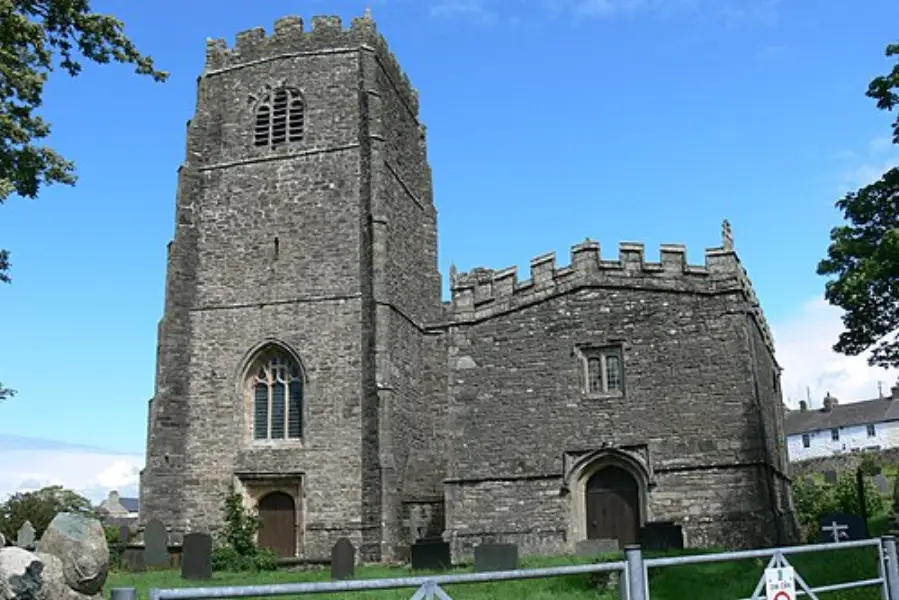
Saint Beuno, Latin Bonus and sometimes anglicised Bono, was a seventh-century Welsh abbot, confessor and miracle-worker, born in the late sixth century at Berriew in the kingdom of Powys. By tradition a prince's grandson, he belonged to the local dynasty that claimed descent from Vortigern, the ill-starred king of Britain. Educated and ordained at the monastery of Bangor in north Wales, he laboured as a missionary under the patronage of Cadfan, king of Gwynedd. Under Cadfan's heir Cadwallon the relationship soured: the new king deceived him over a grant of land and proved unhelpful when the saint pressed for justice; in the aftermath Cadwallon's cousin Gwyddaint made over his own estate at Clynnog Fawr, on the Llŷn peninsula, to God and to Beuno for ever. There Beuno planted his principal monastery and ended his days in peace, on Easter's seventh day, 21 April of the year 640 according to Baring-Gould. Legend credits him with restoring seven dead persons to life, his niece Winefride among them — whose restoration at Holywell became the most famous Welsh pilgrimage of all — and his disciple and cousin Aelhaiarn, and he was said to have received a wondrous vision before his death. Eleven churches carry his name, and his grave chapel at Clynnog still stands.
The Complete Life
A prince's grandson in Powys
Beuno was born at Berriew, in the mid-Wales kingdom of Powys, late in the sixth century, into a family the hagiographers were careful to place high: the tradition counts him a prince's grandson, born into the local ruling house, a lineage whose genealogists carried it back to Vortigern, the British ruler remembered — and blamed — for inviting the Saxon war-bands into Britain. Such genealogies did real work in Welsh society, where sanctity and kinship were woven together, and a saint of royal line strengthened the claims of the monasteries his relatives endowed. The name itself has been examined by philologists: scholars have rebuilt an Old Welsh shape *Bou[g]nou and proposed deriving it from a common Celtic root whose meaning touches on "knowing cattle" — a strikingly rural pedigree for a saint who would later be invoked over herds. Beuno's formation, like that of so many Welsh churchmen of his generation, took place not at home but at Bangor, the great monastery of north Wales, where he was both educated and ordained. From that cloister he emerged as a priest of the monastic, missionary kind that Celtic Christianity produced in numbers: men whose authority rested not on diocesan office but on the holiness of their communities and the fame of their works.
§ Life
Missionary under the kings of Gwynedd
Beuno's active life was spent as a missionary, and he pursued it under Cadfan, king of Gwynedd, the north-Welsh realm whose court at Aberffraw patronised the churches of Llŷn and Anglesey. The partnership of saint and king was the standard engine of Welsh evangelisation: the ruler granted land and protection, the holy man founded a community and prayed for the dynasty. With Cadfan's successor the arrangement broke down. Cadwallon, the son who followed him, deceived Beuno over a parcel of land; and when the saint came to demand what was right, the king proved unsympathetic. The confrontation belongs to a well-known type in Celtic hagiography, in which the saint's curse or blessing becomes a moral verdict on a ruler — Cadwallon, in the wider tradition, was the king who devastated Northumbria and fell at Heavenfield. What followed the quarrel was a restitution from an unexpected quarter: Cadwallon's cousin Gwyddaint made over his own estate at Clynnog Fawr, on the northern coast of the Llŷn peninsula, to God and to Beuno for ever. On that restored and generous ground the saint planted the monastery that would carry his name for thirteen centuries.
§ Life
Clynnog Fawr and the raising of the dead
Clynnog Fawr became Beuno's centre and remained so until his death. The site, facing the sea on Llŷn with Ynys Enlli — the holy island of Bardsey — visible to the west, lay on the pilgrim way to that island of saints, and the community Beuno gathered there served the churches of the surrounding countryside. The miracles for which he was remembered cluster around this period. He was credited with raising seven people from death, a number that marks him as one of the great thaumaturges of the Welsh tradition. Among the restored were two members of his own circle: his disciple and cousin Aelhaiarn, and above all his niece Winefride — Gwenffrewi in Welsh — whose story, in its fuller form, made Beuno the uncle who raised the beheaded girl at Holywell and whose spring there became the most enduring pilgrimage in Wales. Whether the wonders were recorded early or late, they fixed his character: an abbot whose prayers reached past the boundary of death itself. He is said to have received a wondrous vision shortly before the end, the traditional sign given to saints that their departure was near, and he died at Clynnog in peace, on the seventh day of Easter — the date Baring-Gould calculates as 21 April 640.
§ Miracles
The holiness of the Celtic abbot
What the record shows of Beuno is the classic figure of the Celtic church: not a diocesan bishop but an abbot-confessor, whose monastery was at once a school, a hospice, a farm and a power of prayer, and whose sanctity was measured in wonders. His attributes as traditionally depicted — the monastic habit and the insignia of an abbot — say the same thing plainly. The patronages attached to his name belong to the world that made him: he is invoked for sick children, the most defenceless of dependants, and against diseased cattle, the wealth of a peasant society on which survival itself depended. It is a striking coincidence that the philology of his name points toward cattle as well, as though the tradition had absorbed the agricultural sphere into the man. The prodigy most characteristic of him is resurrection: seven raised from the dead, a number asserting the fullness of the power given him. Even the manner of his death is theological — on the seventh day of Easter, as though his life ended inside the octave of the Resurrection he had so often enacted. The wondrous vision vouchsafed beforehand completed a life whose whole texture, as the sources preserve it, was the expectation that God acts through his servants in ways the world cannot account for.
§ Miracles
Death in the Easter octave
Beuno's last years were spent at Clynnog Fawr, the monastery he had built on Gwyddaint's land after the wrong done him by Cadwallon had been righted by another hand. The tradition reports no further journeys, no second foundation, no voyage to Bardsey — only the government of his community, the fame of his miracles, and at the close the wondrous vision that announced his approaching death. He died peacefully, in the habit of his profession, on the seventh day of Easter; Baring-Gould, the great Victorian collector of the lives of the British saints, fixed the date as 21 April in the year 640, and that date became the traditional feast. The Spanish martyrologist tradition and the modern liturgical calendars diverge slightly: in the current Roman Catholic calendar for Wales he is commemorated instead on 20 April, since the 21st is kept for Saint Anselm. He was laid at Clynnog, and although the establishment he founded there was destroyed in the later centuries of war and dissolution, his grave chapel survived, and it stands still beside the church at Clynnog — the one structural remnant, with the shrine of the saint himself, of the seventh-century community over which he presided.
§ Life
Eleven churches and a college of the Jesuits
Beuno's mark on the map of Wales is unusually legible. Eleven churches bear his name, including the church at Clynnog Fawr itself, grown out of his monastery, and a church at Culbone on the Somerset coast, a reminder that the cults of the Welsh saints crossed the Bristol Channel into the West Country. The list stretches across north Wales — Aberffraw, Berriew his birthplace, Bettws Cedewain, Botwnnog, Llanycil, Penmorfa, Pistyll, Trefdraeth — a whole geography of llan sites founded or rededicated in his memory. His major shrine was at Clynnog, and though the monastery is gone, the grave chapel survives as a place of pilgrimage. In the nineteenth century his name passed into a new kind of institution: St Beuno's, at Tremeirchion near St Asaph, was built as a theological college and now serves as a Jesuit spirituality and retreat centre, a house of the same Ignatian tradition that gave the church Gerard Manley Hopkins, who studied there and whose poetry returns again and again to the Welsh landscape Beuno evangelised. Venerated in Orthodoxy, in Roman Catholicism and in the Church in Wales alike, he remains one of the few early Welsh saints whose cult is continuous, local and living.
§ Legacy
In Their Own Words
gave to God and Beuno forever
The Record
- Major works
- Monastery of Clynnog Fawr, Llŷn peninsula, Gwynedd
- Patron of
- Sick children·Invoked against diseased cattle
- Symbols
- Monastic habit·Insignia of an abbot
- Canonization
- Pre-congregation; an ancient Welsh cult centred on Clynnog Fawr.
Prayer
Bibliography
Show 6 sources
- Baring-Gould and John Fisher, The Lives of the British Saints, 1907.
- Patrick Sims-Williams, "Beuno [St Beuno] (d. 653/9)", Oxford Dictionary of National Biography, Oxford University Press, online ed., 2007 [2004].
- Ryan, Patrick W.F., "St. Beuno", The Catholic Encyclopedia, vol. 2, New York: Robert Appleton Company, 1907.
- Arthur Miller, "Beuno", Dictionary of National Biography, vol. 4, London, 1885, p. 444.
- John T. Koch (ed.), Celtic Culture: A Historical Encyclopedia, ABC-CLIO, 2006, p. 206.
- Charles Herbermann (ed.), "St. Beuno", Catholic Encyclopedia, New York: Robert Appleton Company, 1913.
Profile text adapted from the Wikipedia article, licensed CC BY-SA 4.0.
Pray with this saint every day
Save St. Beuno to your favorites, read the full profile, and get feast-day reminders in the Saints app.
Get the Saints AppFree on the App Store for iPhone and iPad