
7th century·Feast April 24
St. Beuve
First abbess of Saint-Pierre-les-Dames in Reims
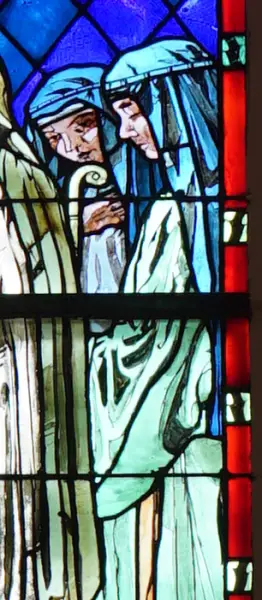
Overview
Saint Beuve — also written Bove and Bova — was a seventh-century Frankish abbess who, with her brother Balderic (Baudry), founded the Abbey of Saint Pierre de Reims, sometimes called Saint-Pierre-les-Dames, and served as its first superior. Her royal ancestry was debated even in the Middle Ages: Flodoard, the canon of Reims who recorded the tradition three centuries after her death, made her and Balderic children of Sigebert I, king of Austrasia, while the modern prosopographer Christian Settipani argues that their father was far more probably Sigobert the Lame, the king of Cologne who died in 507 — a reconciliation that explains the family's other known members, including their niece Doda. Beuve began her religious life in the women's monastery at Reims established in earlier times by Queen Clotilde and Saint Remigius; because it stood outside the city walls, Balderic built a house for the nuns within them and went on to found the Abbey of Montfaucon. Though she wished to remain a simple nun, Beuve was named abbess of Saint-Pierre, imposed the Rule of Saint Benedict on the community, and practised long fasts, prayers and vigils. She educated her niece Doda, who was veiled to escape a marriage forced upon her and later succeeded her as abbess. Her feast is kept on 24 April.
The Complete Life
A disputed royal lineage
Everything about Beuve's origins rests on genealogy, and the genealogy was contested. The tradition was written down by Flodoard, the tenth-century canon of Reims whose history of the church of that city preserved, three centuries after the fact, an oral account of the abbey's founders: Beuve and her brother Balderic passed for children of a king Sigebert, whom Flodoard equated with Sigebert I of Austrasia, the Merovingian ruler. Many early historians followed him. Christian Settipani, working over the prosopography of the Frankish aristocracy, found that the identification cannot stand. The documented family of Sigebert I comprised a son, Childebert II, together with daughters married off to known husbands — Ingund, Clodesinde, and probably another wedded to Duke Chrodoald — while under Salic law the death of a Frankish king saw all his sons share the kingdom, which makes an otherwise unknown son very hard to credit. Settipani's solution is elegant: the father was Sigobert the Lame, king of Cologne, a different Sigebert altogether, who died in 507 and whose other known children, Chlodéric and possibly an unnamed daughter, fit the rest of the family evidence. On that reading Beuve was a princess of the Rhineland Cologne line, not of the great Austrasian house.
§ Family
A nun of Reims
Beuve's religious life began in a house older than her own family's fame: the monastery for women at Reims established by Queen Clotilde, the widow of Clovis, together with Saint Remigius, the bishop who had baptised the Frankish king. To enter that community was to attach oneself to the very fountainhead of Frankish Christianity, in the city where the baptism of the Franks was remembered as the founding act of the nation. The house, however, stood outside the city walls — the normal situation for early monasteries, but a standing anxiety in a century of war and raiding. It was her brother Balderic who answered the problem: he built a house for the nuns within the walls of Reims, so that the community might have the protection of the city's defences, and went on to found the Abbey of Montfaucon besides. The local tradition of the sisters dates the establishment of the convent for Beuve to the year 639. Within this family enterprise Beuve held the religious rank and Balderic the material role — a division of labour utterly characteristic of Merovingian monastic foundation, in which a brother's wealth and a sister's profession together created an enduring house of prayer.
§ Life
Abbess against her will
The most revealing fact in Beuve's recorded character is that she wished to remain a simple nun. The church of her century had a well-developed theology of unwilling dignity: the monk or nun who fled office was often the one the community most needed, and reluctance was read as a sign of suitability rather than a disqualification. Beuve was named abbess of the monastery of Saint-Pierre regardless of her preference, and she governed it as its first superior. Her programme there is stated in the sources: she established the Rule of Saint Benedict in the abbey — no small act in the seventh century, when many women's houses still lived by looser customs — and she practised in her own person the austerities she asked of others, described as many fasts, prayers and vigils. Nor did she rule alone or remotely. Her brother the abbot came often from his own house, to counsel and encourage his sister, and the two houses, his and hers, formed a single family project. On one of those visits Balderic fell ill and died at Saint-Pierre itself; buried first in the abbey, he was afterwards translated to his own foundation at Montfaucon. The partnership ended in death, as the best ones do, inside the community they had built.
§ Life
Doda, the niece and successor
Beuve's last years were bound up with her niece Doda, whom modern prosopography identifies as the granddaughter of Sigobert the Lame through an unnamed daughter, born in Sigobert's last years, around 505–508. Beuve undertook the girl's education herself, raising her inside the enclosure of Saint-Pierre. When the time came, Doda was veiled to escape a marriage forced upon her — the legend, as transmitted, says she had been promised to a lord at the court of Sigebert I — and the aunt who had taught her received her vows. The succession was thus kept in the family, as Merovingian custom expected: upon Beuve's death Doda became abbess of Saint-Pierre in her turn, and the dynasty of holy women continued. Doda's own recorded act was practical and farsighted: she obtained from a prince named Pepin — identifiable only as Pepin of Landen, mayor of the palace of Austrasia — letters of protection for the community, securing the young house against the exactions of the court. Settipani's careful arithmetic of generations, working from Doda's probable birth around 545 to Pepin's earliest possible mayoralty in 613, is what allows the family to be pieced together at all; Beuve's death is undated, but it falls within the seventh century her whole story inhabits.
§ Life
Saint-Pierre-les-Dames
The house Beuve governed has entered history under the name Saint-Pierre-les-Dames, the ladies' Saint-Peter's, a title that itself preserves the memory of the aristocratic women for whom it was built. As first abbess she stands at the head of a community that would remain one of the significant nunneries of northern France through the medieval centuries, linked by blood and patronage to the highest levels of the Frankish aristocracy — the sources add that she and Balderic were said to be related to King Dagobert as well. Her brother's parallel foundations, Montfaucon above all, extend the family's mark on the monastic map. Her cult belongs to the pre-congregation era: honoured locally at Reims, she was never the object of a papal process, and her feast, kept on 24 April, is the calendar's whole testimony to her. What the modern reader knows of her comes largely through two channels — Flodoard's tenth-century church history, preserving the oral tradition of the abbey, and the twentieth-century prosopography of Settipani, which quietly moved her from the lineage of the kings of Austrasia to that of the kings of Cologne and in doing so made the fragments of her life, her sisterhood with Balderic and her mothering of Doda, fit together at last.
§ Life
The Record
- Major works
- Abbey of Saint Pierre de Reims (Saint-Pierre-les-Dames), as first abbess·Introduction of the Rule of Saint Benedict at Saint-Pierre, Reims
- Symbols
- Abbess's crozier and habit
- Canonization
- Pre-congregation; venerated at Reims as the first abbess of Saint-Pierre.
Prayer
Bibliography
Show 5 sources
- Christian Settipani, "L'apport de l'onomastique dans l'étude des généalogies carolingiennes", Onomastique et Parenté dans l'Occident médiéval, Oxford, Linacre College, Unit for Prosopographical Research, Prosopographica et Genealogica, 2000, p. 219.
- Flodoard, Historia ecclesiæ Remensis, book IV, chapter XXXVIII.
- Christian Settipani, La préhistoire des Capétiens, 481–987, Nouvelle histoire généalogique de l'auguste maison de France, vol. 1, Villeneuve d'Ascq: P. Van Kerrebrouck, 1993, pp. 78–82.
- "Sainte Beuve de Reims", Vie des Saints et des Bienheureux selon l'ordre du calendrier, vol. 4 (April), Librairie Letouzey et Ané, 1946.
- Jane Tibbetts Schulenburg, Forgetful of Their Sex: Female Sanctity and Society, ca. 500–1100, University of Chicago Press, 1998, p. 284.
Profile text adapted from the Wikipedia article, licensed CC BY-SA 4.0.
Pray with this saint every day
Save St. Beuve to your favorites, read the full profile, and get feast-day reminders in the Saints app.
Get the Saints AppFree on the App Store for iPhone and iPad