
4th century – died 360·Feast December 2
St. Bibiana of Rome
Roman virgin and martyr under Julian the Apostate
Overview
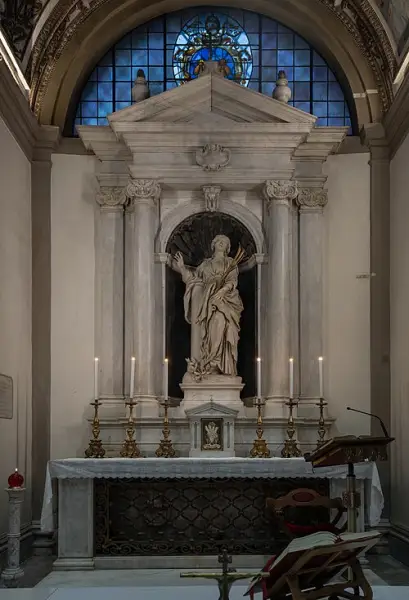
Saint Bibiana of Rome — also Bibiane, Viviana or Vivian — is an early Christian virgin martyr of the fourth century. The earliest notice of her in an authentic historical authority comes not from a passion narrative but from the Liber Pontificalis, which records in its life of Pope Simplicius (468–483) that he dedicated a basilica housing the body of the martyr Bibiana close by the palatium Licinianum; that basilica is today's church of Santa Bibiana in Rome, which keeps a celebrated statue of the saint by Gian Lorenzo Bernini. The legend attached to her name tells of a family destroyed by the persecution under Julian the Apostate. Her father Flavianus, a former prefect, was banished and died of his ill-treatment; her mother Dafrosa was put to death; her sister Demetria died after confessing the faith before the governor; and Bibiana herself, refusing the seductions and blows with which the woman Rufina tried to shake her chastity, was bound to a pillar and scourged with lead-weighted whips until she died. An alternative version of the account sets her suffering in 363, under Apronianus, governor of Rome for the apostate emperor. Her body, exposed for wild beasts that would not touch it, was buried by a priest named John beside her mother and sister in the family house, which afterwards became the church that preserves her name.
The Complete Life
A daughter of Christian Rome
Bibiana belongs to that multitude of Roman martyrs whose historical core is a tomb, a church and a feast, around which a legend later crystallised. What can be said of her beginnings comes from the passion story itself: she was a Roman girl of the fourth century, born to Christian parents of standing. In the principal version of the account her father Flavianus had held office as a prefect, which placed the family among the educated governing class of the city, before the return of paganism under Julian cost him everything. An alternative tradition, drawing on the same cycle, names her father Flavian, a Roman knight, and her mother Dafrosa — the two fathers, prefect and knight, being perhaps variant memories of one man of equestrian rank. The household counted at least two daughters, Bibiana and her elder sister Demetria, and its Christianity was evidently of the confessed, unhidden kind, for when the storm broke it broke on all of them at once. That a family of this class should be annihilated rather than quietly conform is itself the point of the narrative: the legend presents the martyrs not as peasants surprised by a mob but as people who had every worldly reason to compromise and did not.
§ Legend
Virginity kept against the empire
The vocation for which Bibiana is honoured is virginity — the title her iconography gives her, virgin and martyr, names the two inseparable poles of her witness. In the legend the governor's assault on her is aimed precisely at this consecration: she is placed in the charge of a woman named Rufina, who tries first to seduce and then, with blows, to break her, so that her refusal might be displayed as corruption rather than constancy. The device was a stock element of ancient martyr-acts, and its very conventionality tells the reader what the early Church wanted remembered: that the virgin's body was hers to give to God alone, and that the state's power stopped at the threshold of that consent. Rufina's failure — the Christian virgin remains faithful, persuasion and violence alike useless against her — is the hinge of the story. Bibiana's persistence enraged Apronianus, the governor of the alternate account, beyond the ordinary penalties. It is worth noticing that neither her sister's death nor her mother's had moved her; nor poverty, nor hunger, in the version in which the stripped sisters are left to want in their own house, passing the days in fasting and prayer. Her virginity was not passivity but a long, deliberate act of the will, sustained through every pressure an empire could apply.
§ Legend
The witness of a household
The passion of Bibiana is in fact the passion of a whole family, presented as a single coordinated act of witness. Flavian, the father, is tortured and exiled, dying of his wounds in the place of banishment; Dafrosa, the mother, is beheaded; Demetria, summoned with her sister before the governor after their goods are confiscated, confesses her faith and falls dead at his feet; and Bibiana alone is reserved, as the narrative says, for greater sufferings. In the earlier strand of the legend the mother and sister die natural deaths under persecution and are buried by Bibiana's own hands in the family house — an act of pious daring which the story lingers over, the daughter laying her dead in the one place the state has left them. Whether by sword or sickness, the household is extinguished member by member, and the youngest is made the last and fullest testimony. The point of such family passiones was ecclesial as much as edifying: they showed that the faith could be transmitted entire through a domestic church — parents, children, home — and that a Christian house, emptied by the empire, could become by burial and by memory a shrine.
§ Legend
Joy under the lash
The spirituality transmitted in Bibiana's story is a spirituality of joy in suffering. The account says plainly that she endured her torments with joy and died under the executioner's blows — not merely accepting the pillar and the lead-weighted scourges but transfigured by them. Such joy was the ancient Church's signature argument, the one answer to persecution that no edict could answer back: it could be explained as madness, but it could not be produced to order, and it converted more observers than it killed. The afterword of the narrative makes the same point in another register. Her body was exposed in the open for the wild beasts to destroy, and none would touch it; the animal creation, in the grammar of the martyrs, refuses to violate what the human court has condemned. Two days later a priest named John, one of the clergy who served the persecuted community of the city, took the body and buried it beside her mother and sister. The prayer of the later Church has always found in her a patron for those who suffer in the very forms she suffered: epileptics, the mentally ill, the tortured, the headache-ridden, and single laywomen who keep faith without the shelter of a cloister or a family.
§ Legend
The pillar, the beasts and the burial
The end of the legend is told with a terrible economy. Enraged at the constancy of the virgin, the governor ordered her bound to a pillar and beaten with scourges weighted with lead plummets until death released her; she died under the blows, and the column and the leaded thong became her permanent emblems in Christian art, together with a branch and a dagger that later iconography added. Her body, laid in the open air for the beasts, remained untouched; after two days the priest John buried it in the house that had held her mother's and sister's graves. The chronology is uncertain in the way martyr-act chronology always is: the principal account places her death in 360, while an alternate account, in which the emperor Julian makes Apronianus governor of Rome and the persecution proceeds from him, sets the events in 363 — dates that frame, in either case, the short reign of the apostate emperor. What is firm is the aftermath. The house became a church; the martyr's grave became an altar; and within little more than a century the bishops of Rome were building over the spot a basilica worthy of her name.
§ Legend
From domestic shrine to papal basilica
Bibiana's entry into documented history comes through the Liber Pontificalis, the book of the popes, whose life of Simplicius — who ruled the Roman church from 468 to 483 — records that he consecrated a basilica of the holy martyr containing her body near the palatium Licinianum, the palace quarter on the Esquiline slope. That sentence, with its precise topography, is the bedrock: whatever the legends say, by the 470s a pope had set a martyr named Bibiana's remains under an altar in a consecrated church. The martyrologies of the ninth century drew their fuller accounts from the circulating legend, and it is through that channel — Bollandist and Roman martyrology alike — that her feast reached the universal calendar on 2 December. The basilica itself, Santa Bibiana, stands in Rome to this day, rebuilt in the seventeenth century under Urban VIII, when the young Gian Lorenzo Bernini gave it both its façade and its statue of the saint, showing her at the column with the leaded scourges in a sculptor's hand. She is not to be confused with her third-century namesake Vibiana, the patroness of the Archdiocese of Los Angeles, whose relics and cult are entirely distinct.
§ Legend
Santa Bibiana and her patronages
Bibiana's afterlife in the Church's memory is unusually well marked for a martyr of whom so little is certain. Her church, Santa Bibiana in Rome, has kept her body for over fifteen centuries, and Bernini's statue there — the saint bound to her column, face lifted in the composure of her final joy — made her one of the visible figures of the Roman baroque. The patronages that gathered around her name map the anxieties of the societies that prayed to her: she is invoked against epilepsy and for epileptics, against headaches and even hangovers, against insanity and for the mentally ill — afflictions once read as seizures of the person by forces outside control, entrusted therefore to a saint whom no power could move. She is patron of torture victims, an office that returns her passion to the present tense, and of single laywomen, who keep the state in life in which she kept hers. Her attribute of the column, the instrument of her death, became her emblem; her branch and dagger travelled with her into the painters' repertoire. The distinction from Vibiana of Los Angeles is itself part of her legacy: two martyrs, two cities, one calendar day's neighbourhood, and a confusion the Church has had to unmake more than once.
§ Legend
Timeline
- 360
Died in Rome as a martyr, per the article's record of her
§ Introduction
- 363
Under the alternate account, Julian appointed Apronianus governor of Rome and Bibiana perished in the persecution he began
§ Legend
- 468
During the pontificate of Simplicius (468–483), a basilica holding her body was consecrated near the palatium Licinianum
§ Introduction
In Their Own Words
consecrated a basilica of the holy martyr Bibiana, which contained her body, near the 'palatium Licinianum'
The Record
- Patron of
- Epileptics and against epilepsy·Against hangovers and headaches·The mentally ill and against insanity·Single laywomen·Torture victims·Her parish in Rome
- Symbols
- Column or pillar with scourge of leaded thongs·Branch of a tree·Dagger·Depicted tied to a column
- Canonization
- Pre-congregation; an early Roman martyr whose basilica was consecrated by Pope Simplicius.
Prayer
Bibliography
Show 6 sources
- Johann Peter Kirsch, "St. Bibiana", The Catholic Encyclopedia, vol. 2, New York: Robert Appleton Company, 1907.
- Alban Butler, Lives of the Saints, vol. XII, 1866.
- "Bibiana", Britannica Kids, retrieved 2025-04-19.
- "St. Bibiana - Saints & Angels", Catholic Online, retrieved 2025-04-19.
- "St. Bibiana", EWTN Global Catholic Television Network, retrieved 2025-04-19.
- "Meet the patron saint of LA you've never heard of", LAist, 2018-07-18.
Profile text adapted from the Wikipedia article, licensed CC BY-SA 4.0.
Pray with this saint every day
Save St. Bibiana of Rome to your favorites, read the full profile, and get feast-day reminders in the Saints app.
Get the Saints AppFree on the App Store for iPhone and iPad