
1st century (Gospel of Matthew); named from the 8th century·Feast January 6
St. Caspar, Melchior and Balthazar
The Magi who adored the infant Christ
Overview
The Biblical Magi — the Three Wise Men, the Three Kings, the Three Magi — are the distinguished foreigners who, in the second chapter of Matthew's Gospel, come to the infant Jesus bearing gold, frankincense and myrrh. Matthew gives them no names, no number, no faces and no country beyond "from the east"; every particular beyond the gifts and the star was supplied by later Christian tradition. The word magi is the Greek magoi, from Old Persian maguš, the priestly caste of Zoroastrianism, famed across the ancient world for reading the heavens; English "magic" descends from the same root. Within three centuries the Magi were being called kings, in fulfilment read backwards from Isaiah and the Psalms, and by the eighth century the chronicle Excerpta Latina Barbari had given them the names the West still uses: Balthazar, Caspar and Melchior. Eastern churches give other names — the Syrians Larvandad, Gushnasaph and Hormisdas, the Armenians Kagpha, Badadakharida and Badadilma, and Syriac tradition at times counts twelve. Tradition makes them, between the three, the three ages of man and the three parts of the known world, with Balthazar increasingly shown as a young African king. Their relics, said to have been found by Helena and carried to Constantinople, were translated to Milan in 344 and to Cologne in 1162, where the Shrine of the Three Kings remains one of Europe's great pilgrimages.
The Complete Life
What Matthew actually says
The whole biblical foundation of the Magi is a dozen verses. In Herod's reign, once Jesus had been born at Bethlehem, sages out of the East reached Jerusalem, asking where the newly born king of the Jews lay, whose star they had watched rising; they had come, they said, to pay him homage. Herod assembled the chief priests and scribes, who answered with the prophecy of Bethlehem, and the king sent the visitors on to search for the child and bring him word. The star moved before them and halted above the place where the child lay; joy overwhelmed the travellers, entered the house — not a stable — and found the child with Mary his mother. They knelt and paid him homage, opened their treasure chests, and offered their gold, frankincense and myrrh; then, warned in a dream against returning to Herod, they made their way home to their own land by a different road. That is all. The text gives no interval since the birth, no number of visitors, no names, no retinue, no crowns; the traditional scenes that put them at the manger beside the shepherds are an artistic convention fusing two separate gospel moments. Modern scholars mostly treat the Magi as figures of legend rather than of history — and the Church's tradition has never depended on resolving that question.
§ Biblical account
Priests of the stars
The word at the centre of the story carries the oldest answer to the question of who they were. Magi is the plural of Greek magos, from Old Persian maguš, born in the Avestan term for the Iranian priestly caste of Zoroastrianism; within that tradition the priests watched the heavens with particular care and gained an international reputation for astrology, which the ancient world regarded as a science. The translation history is a map of Christian unease with that pedigree: the King James Version renders the word as wise men, the same rendering it gives the Babylonian wise men of Daniel; other translations — the New English Bible, J. B. Phillips, the Twentieth Century New Testament among them — say astrologers outright; and the same Greek word becomes sorcerer for Elymas and Simon Magus elsewhere in Acts. Whatever they were, Matthew's phrase "from the east" — Greek for 'from the risings', of the sun — directs attention to the Parthian Empire, the Persian-centred power stretching from eastern Syria toward India, whose dominant religion was precisely Zoroastrianism with its priestly magos class. The apocryphal Syriac Infancy Gospel even supplies a motive: they were pursuing a prophecy of their own prophet, Zoradascht. Scholars such as Anders Hultgård have argued that the gospel story was shaped by an Iranian legend of magi and a star announcing a ruler's birth.
§ Description
The first recognition
Read as Christian theology, the visit of the Magi is the first act of recognition in the Gospel. Later interpretation made much of the adoration offered by Magi and shepherds together as the earliest human acknowledgment by human beings of Christ as Redeemer — the representatives of the Gentile nations arriving, with the representative of Israel's poor, at the same cradle. Their gesture is recorded with legal precision: they are described as falling down, kneeling, bowing — the Greek says, having fallen, they worshipped him — the prostration customarily offered to a king and still practised in the Eastern Churches, especially in Lent. John Chrysostom, reading the gifts, asserted that the Magi worshipped Jesus as God: the offerings were fit not merely for a king but for God, and he contrasted them with the traditional Jewish offerings of sheep and calves. The coming of the star-led visitors also answered the prophecies — kings falling down before him, all nations serving him, camels from Sheba bringing gold and frankincense — which is exactly why the Church so quickly crowned them. Within the story their mission ends in obedience to a dream: warned not to return to Herod, they slip away by another road, the first people in the Gospel to defy a tyrant at the bidding of a warning from God.
§ Biblical account
Gold, frankincense and myrrh
Three gifts, and the number three probably settled there because of them. The interpretations the tradition has laid on the offering fall into two great families. In the first, all three are simply the tribute due to a king — gold the precious metal, frankincense the perfume of worship, myrrh the anointing oil, and Seleucus I is recorded offering the same three to Apollo at Didyma in 288/7 BC, a possible precedent. In the second, each gift is a symbol: gold for kingship on earth, frankincense for deity, myrrh — the embalming oil — for death. That reading is ancient, going back to Origen, and Prudentius had already versified it in the late fourth century; the carol "We Three Kings" carries it into every school concert, and a more general version makes the gold virtue, the frankincense prayer and the myrrh suffering. Myrrh had its own long afterlife in the sacramental life of the East: the holy oil of chrismation and unction in the Orthodox Church is traditionally scented with it, and receiving those sacraments is called receiving the myrrh. Some scholars have proposed instead that the gifts were medicinal rather than tributary. Scripture says nothing of what became of them; the legends fill the gap with thieves, Judas, the financing of the flight into Egypt, and the anointing of the dead Christ with the myrrh given at his birth.
§ Gifts of the Magi
Martyrdom traditions and the tombs
After their return, scripture is entirely silent — one country, Matthew says, absorbed them again. The traditions that follow are extravagant and unverifiable — legend rather than history. The Chronicon of Dexter, a martyrology first printed in 1610 and later judged a pious forgery, describes the martyrdom of the three kings in Arabia Felix; a competing German tradition likewise made them martyrs without supplying details. Marco Polo claimed to have been shown three great monuments, side by side, at Saveh south of Tehran, with the bodies still entire, hair and beard remaining. The dominant western account is the relic history: Helena, mother of Constantine, found the remains on her pilgrimage of 326–328 and brought them to Constantinople; in 344 they were translated to Milan, where Eustorgius I interred them beneath his basilica; and in 1162, after Frederick Barbarossa took the city, Archbishop Rainald von Dassel carried them to Cologne, where their translation is commemorated liturgically every 24 July. Philipp von Hochstaden commissioned the great golden shrine that still stands in the cathedral, and the Milanese consoled themselves by distributing fragments of their emptied tomb as secondary relics across southern France — which is why the Magi ride in such numbers on Limoges champlevé chasses.
§ Tombs
From wise men to kings to saints
The elevation of the Magi is a case study in how tradition works on a text. Nothing in Matthew implies rulers of any kind; the identification as kings came from reading the Gospel in the light of Isaiah 60, Psalm 68 and Psalm 72 — all kings shall fall down before him — and was widely accepted by about 500. The Reformers pushed back hardest: Calvin dismissed the royal reading as popish invention of the most ridiculous kind, fit for nothing but laughter. The names arrived even later than the crowns. The earliest surviving list is in the Excerpta Latina Barbari, an eighth-century Latin translation of a lost Greek chronicle probably composed in Alexandria two centuries earlier: Bithisarea, Melichior and Gathaspa, which time smoothed into Balthazar, Melchior and Caspar. A parallel eighth-century text, the Collectanea et Flores, added details and kept the three kings. Eastern Christianity never adopted the western names: the Syrians honour Larvandad, Gushnasaph and Hormisdas; the Ethiopians Hor, Karsudan and Basanater; the Armenians Kagpha, Badadakharida and Badadilma; and Michael the Syrian's chronicle lists eleven, all Zoroastrian names — which fits his habit of using "mage" simply for Zoroastrian. Venerated as saints and in some traditions martyrs, they needed no canonisation process: their sanctity was assumed from the text, and their cult fixed by their relics.
§ Identities and background
The kings of January
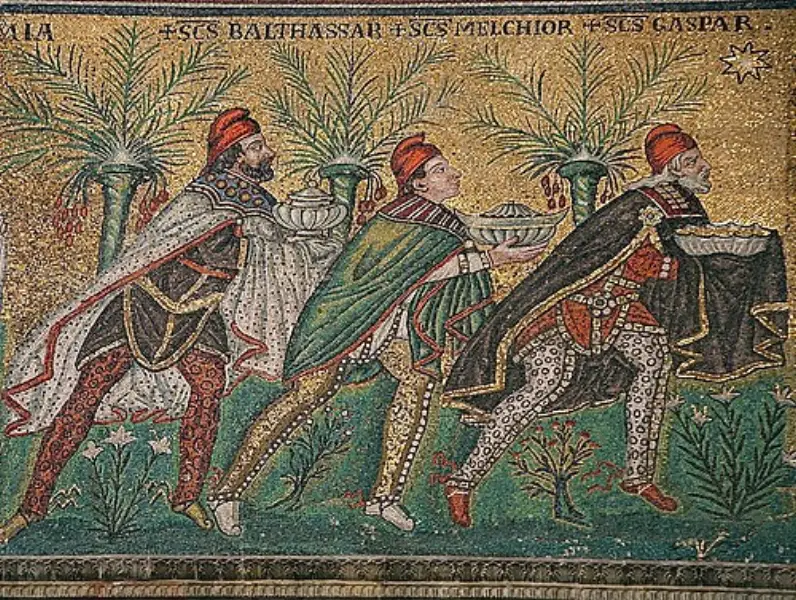
No figures of the Nativity have a longer cultural afterlife. In art they appear from the third-century catacombs onward, Persian-dressed in Byzantine convention, crowned from the tenth century, and often halo-less even as saints — perhaps to keep attention on the Holy Family, or because only the lead king, kneeling, has yet performed the worship that ensures the status. From the twelfth century the three become the three ages of man and the three quarters of the world: Caspar old and gold-bearing, Melchior middle-aged with the frankincense, Balthazar a young African or Moor with the myrrh, his blackness becoming common in northern Europe by the fifteenth. Their feast governs customs across continents: the Hispanic Reyes Magos bring children their gifts on the morning of 6 January, with cabalgatas the evening before; German and Austrian Sternsinger go door to door as star-singers, chalking C+M+B on the lintels; king cakes hide their figurines from Madrid to New Orleans. Literature and music have never let them rest — Ben-Hur, The Other Wise Man, The Gift of the Magi, Eliot's Journey of the Magi, Menotti's Amahl and the Night Visitors — and even Neon Genesis Evangelion names its three supercomputers Balthasar, Melchior and Caspar. On Epiphany the Western Church keeps them; on Christmas Day the Eastern; and between the two dates the whole Christian world, at some moment each year, becomes a little like them: travellers following a light.
§ Later interpretations
Timeline
- -288
King Seleucus I Nicator offers gold, frankincense and myrrh to Apollo at Didyma, a possible precedent for the Magi's three gifts.
§ Gifts of the Magi
- -5
Colin Humphreys argues the Star of Bethlehem was a comet seen in 5 BC that guided the visitors' journey.
§ Country of origin and journey
- 66
Tiridates I of Armenia travels to Rome with his magi to honour Nero, a suggested model for the Gospel homage.
§ Country of origin and journey
- 326
Tradition holds that Helena, mother of Constantine, finds the Magi's remains in Palestine and takes them to Constantinople.
§ Tombs
- 344
The relics reach Milan — in some accounts carried by Bishop Eustorgius I — and are buried in a tomb beneath the basilica.
§ Tombs
- 1162
After Emperor Frederick I takes Milan, Archbishop Rainald von Dassel has the relics moved to Cologne Cathedral.
§ Tombs
- 1305
Giotto's Arena Chapel fresco shows Caspar old, Melchior middle-aged and Balthazar young, fixing the kings as three ages of man.
§ Country of origin and journey
- 1375
The Catalan Atlas names a province called Tarshish as the Wise Kings' homeland and records their entombment at Cologne.
§ Country of origin and journey
- 1610
The Chronicon of Dexter, later judged a pious forgery, first appears, recounting the three Magi's martyrdom in Arabia Felix.
§ Martyrdom traditions
- 1857
John Henry Hopkins Jr.'s carol 'We Three Kings' carries the medieval symbolism of the gifts into popular song.
§ Gifts of the Magi
- 1999
After the September 7 Athens earthquake, the golden reliquary of the gifts at Mount Athos is shown publicly in Athens.
§ Gifts of the Magi
- 2014
The relics are shown in Ukraine and Belarus at Christmas, their first departure from Greece in more than five centuries.
§ Gifts of the Magi
In Their Own Words
gold, as to a king; myrrh, as to one who was mortal; and incense, as to a God
But the most ridiculous contrivance of the Papists on this subject is, that those men were kings... Beyond all doubt, they have been stupefied by a righteous judgment of God, that all might laugh at [their] gross ignorance.
Where is He who has been born King of the Jews? For we have seen His star in the East and have come to worship Him.
We have seen a star of great size shining among these stars, and obscuring their light, so that the stars did not appear; and we thus knew that a king has been born to Israel, and we have come to worship him.
The Record
- Patron of
- Gift-bringers to children in the Hispanic world·Patron saints of the National Shrine of Virgen La Divina Pastora, Gapan, Nueva Ecija, the Philippines·Invoked in the blessing of homes at Epiphany (C + M + B)
- Symbols
- Gold, frankincense and myrrh·Crowns, from the tenth century in art·Persian dress with breeches and Phrygian caps in Byzantine art·The star of Bethlehem
- Canonization
- Venerated as saints, and in some traditions as martyrs, from the early Church; no formal canonisation — their relics are honoured at Cologne.
Prayer
Bibliography
Show 7 sources
- Gertrud Schiller, Iconography of Christian Art, vol. I, London: Lund Humphries, 1971.
- Richard C. Trexler, Journey of the Magi: Meanings in History of a Christian Story, Princeton: Princeton University Press, 1997.
- Raymond E. Brown, The Birth of the Messiah: A Commentary on the Infancy Narratives in Matthew and Luke, London: G. Chapman, 1977.
- Bruce Metzger, New Testament Studies: Philological, Versional, and Patristic, vol. 10, Leiden: Brill, 1980.
- Michael R. Molnar, The Star of Bethlehem: The Legacy of the Magi, Rutgers University Press, 1999.
- Brent Landau, Revelation of the Magi: The Lost Tale of the Wise Men's Journey to Bethlehem, HarperOne, 2010.
- W. F. Albright and C. S. Mann, "Matthew", The Anchor Bible Series, New York: Doubleday, 1971.
Profile text adapted from the Wikipedia article, licensed CC BY-SA 4.0.
Pray with this saint every day
Save St. Caspar, Melchior and Balthazar to your favorites, read the full profile, and get feast-day reminders in the Saints app.
Get the Saints AppFree on the App Store for iPhone and iPad