
died 3rd century·Feast May 9
St. Bienheuré
Dragon-Slaying Hermit of Vendôme
Overview
Bienheuré — the name is a French form of the Latin Beatus, and he also appears as Bié — is a semi-legendary saint of Vendôme in the Loire valley. The tradition of the town holds that he lived as a hermit in a cave on the hillside nearby, and like several other saints of Gaul and beyond he is remembered as a dragon-slayer: the beast he overcame was said to be enormous, so long that when it went down to drink from a distant river the tip of its tail still lay in its den, and so thirsty that it could drain the river Loir dry. Different versions of the legend give different endings to the combat — the monster fleeing at the mere sight of the holy man, or felled by a single stroke of his staff, or strangled by its own chain. Behind the legend lies a remembered missionary, for the saint is identified with a preacher who travelled not only in Vendôme but in the Garonne country, at Laon, and at Nantes; his death is placed at Chevresson near Laon. A chapel of the fifth century once stood over the hillside where he was said to have lived, and his cult endures in Vendôme to this day.
The Complete Life
The Hermit of the Cave
The legend of Bienheuré begins, as hermit legends so often do, with withdrawal. The saint is said to have made his home in a cave near Vendôme, on the hillside above the town, and the tradition is careful to describe the life he led there before anything dramatic befell him: he fasted, and he prayed. This ordering matters. In the Christian imagination of the early medieval West the combat with the dragon was never a feat of arms but the fruit of ascetic discipline; the holy man prevailed over the monster precisely because he had first conquered himself. The beast of the Vendôme story is painted on a heroic scale — a creature so vast that its head could drink from a river at some distance while its tail still rested in its lair, and so prodigious in its thirst that it emptied the Loir when it stooped to drink. Three endings were told for the struggle. In one, the dragon simply fled at the sight of the saint. In another, Bienheuré struck it down with a single blow of his staff, the hermit's ordinary walking stick become an instrument of victory. In the third, the monster was strangled by its own chain, bound, as it were, by the very thing that held it. Behind all three lies the same conviction: that holiness has power over chaos.
§ Legend
The Missionary Behind the Legend
The historicity of Bienheuré is admittedly thin, but the tradition about him is not only about dragons. He is identified with a missionary who travelled and preached in several regions of Gaul besides the Vendômois: in the Garonne country of the south-west, at Laon in the north, and at Nantes on the Loire. The pattern is a familiar one in the hagiography of Roman Gaul — a wandering preacher whose course can be traced by the places that afterwards claimed him, and whose death is located at Chevresson, a place near Laon. A saint of this kind, half remembered and half invented, stands for the many evangelists of the third and fourth centuries who carried Christianity out from the towns into the countryside of Gaul and whose names survived only where a shrine or a feast kept them. Scholars note also that his story was conflated at some point with that of Beatus of Lungern, the Swiss dragon-saint, so that two regional traditions of dragon-combat reinforced one another. The historian must therefore handle Bienheuré with care; yet the association with real places along a real arc of country from the Garonne to the Aisne suggests that a genuine missionary career lies somewhere beneath the legend, even if its details are beyond recovery.
§ Historicity
Devotion at Vendôme
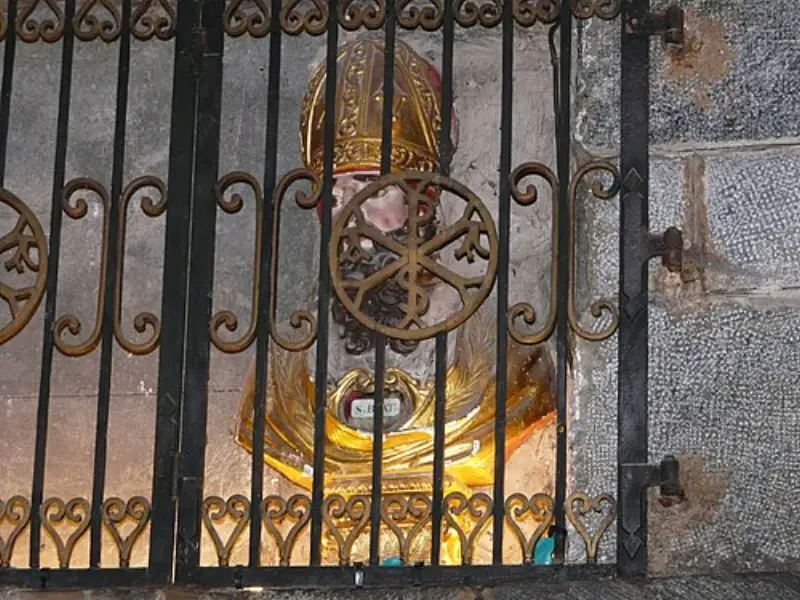
The cult of Bienheuré has shown remarkable persistence in Vendôme. A chapel going back to the fifth century was raised on the hillside where tradition said the hermit had lived, making his site of devotion one of the older Christian landmarks of the region; the presence of such an early chapel is itself the strongest argument that devotion to him is very old indeed. In modern times the saint has remained a civic as much as an ecclesiastical figure in the town's life. The Association du Faubourg Saint Bienheuré organizes an annual festival in his honour on the second Sunday of May, a date that keeps his feast in the season of 9 May while placing it where the whole community can take part. The bust of the saint preserved in the church of Saint-Béat and Saint-Privat at Saint-Béat in the Haute-Garonne shows how far his name travelled in the south-west, consistent with the tradition of his preaching in the Garonne country. He is honoured both in the Eastern Orthodox Church and in the Roman Catholic Church. Students of the saint may turn to Jean-Jacques Loisel's study of the saint of Vendôme, which walks in his legendary footsteps through the town and its country.
§ Veneration
Timeline
- 300
Semi-legendary hermit of Vendôme who, by local tradition, died during the third century at Chevresson near Laon.
§ Historicity
- 400
A chapel raised on the hillside of his reputed cave becomes the earliest dated witness to his cult.
§ Veneration
The Record
- Canonization
- Pre-congregation saint, venerated in Vendôme from late antiquity
Prayer
Bibliography
Show 5 sources
- "New Catholic Dictionary: Beatus, Saint" (dead link, archived 2007-08-12)
- Catholic Encyclopedia: Soissons
- "9. mai: Den hellige Beatus av Vendôme (200-t)"
- "Communauté du Pays de Vendôme - Association du Faubourg Saint Bienheuré" (dead link, archived 2007-09-28)
- Loisel, Jean-Jacques, Dans les pas de saint Bienheuré de Vendôme, Sté Sc et Lettres L & C (Blois), 1999, pp. 59–87
Profile text adapted from the Wikipedia article, licensed CC BY-SA 4.0.
Pray with this saint every day
Save St. Bienheuré to your favorites, read the full profile, and get feast-day reminders in the Saints app.
Get the Saints AppFree on the App Store for iPhone and iPad