
died c. 570·Feast November 24
St. Bieuzy
Breton hermit and healer of rabies
Overview
Bieuzy was a hermit of sixth-century Brittany and a close companion of the great Welsh teacher Saint Gildas. His name, drawn from the Old Breton word for "living", became fixed upon two Morbihan villages, Bieuzy and Bieuzy-Lanvaux, that grew up around his foundations. A native of the island of Great Britain, he crossed to Armorica and placed himself under Gildas as a disciple. In 538 the two men went up the valley of the Blavet and made their dwelling in a natural cave among the rocks near Castennec. When Gildas returned in time to his monastery of Rhuys, Bieuzy stayed behind, opened a school beside the hermitage, and watched a small settlement gather around it. He became renowned above all as a healer of rabies, and the affliction itself was long called by his name in the region. Around 570, tradition tells, he refused to abandon the celebration of Mass to cure a nobleman's hounds, and the furious lord struck him a blow that left him dying; the saint walked eighty kilometres to Rhuys and expired beneath the blessing of his master. His head is preserved at Pluvigner, and springs throughout Brittany still bear his name.
The Complete Life
From Britain to Armorica
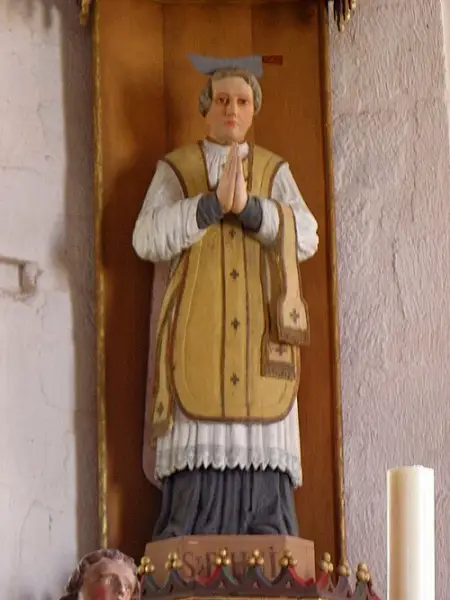
Bieuzy belonged to that generation of insular Christians who carried the monastic zeal of the Celtic lands across the Channel in the wake of Rome's fall. The Breton accounts describe him as a native of Great Britain who left his homeland for Armorica, joining the stream of settlers and churchmen who were giving the peninsula its new name and its new faith. His very name is a piece of that migration: it descends from the Old Breton biu or bihui, meaning "living", a fitting name for a saint whose memory kept a healing spring alive in village after village. In Brittany he sought out Saint Gildas, the austre abbot whose reputation for learning and holiness drew disciples from both sides of the sea, and became one of his followers. The relationship shaped the rest of his life; every later account shows him walking in Gildas's shadow, founding where his master directed, and finally dying beneath his blessing. The villages of Bieuzy and Bieuzy-Lanvaux in Morbihan still carry the name he left among them, and the statue of the saint stands in the church of Notre-Dame at Bieuzy, where his settlers' camp once stood. He is numbered among the many British monks who made sixth-century Brittany a land of hermits, schools, and holy wells.
§ Life
The Hermitage on the Blavet
In the year 538, according to the tradition recorded by the hagiographers, Bieuzy went up the valley of the Blavet in the company of Saint Gildas, who had already established his famous monastery at Saint-Gildas-de-Rhuys on the nearby coast. Along the river the two men found a site to their liking: an enormous formation of rock standing above the Blavet close to Castennec, its hollow a natural cave. There they established a hermitage and oratory, dwelling in the rock itself after the manner of the desert fathers. The partnership lasted some years before Gildas was called back to his abbey at Rhuys; Bieuzy remained. Alone or nearly so among the rocks, he did what the missionary monks of Brittany always did at such stations: he opened a school, gathering the children of the surrounding countryside for instruction in the faith and the psalms. Families came to live near the teacher, and from those few dwellings grew the village that still bears his name. The establishments of both master and disciple were burned away during the Norman raids of the ninth and tenth centuries, and the cave oratory lay in ruins until the sixteenth century, when it was rebuilt as the Chapelle Saint-Gildas — yet the site has never been forgotten, and the chapel still marks the place where two saints once prayed.
§ Life
The Healer of Rabies
Beyond his work as teacher and hermit, Bieuzy became known throughout the Breton countryside for one particular grace: the curing of rabies, the dread disease of dogs and wolves that terrorized farm and village alike. The sickness itself came to be called le mal de Saint Bieuzy, so completely did the locals identify their affliction with the saint who mastered it. This patronage was no abstraction; it was sought at the springs dedicated to him, where affected animals and ailing people were brought in hope. The fountain at Bieuzy, an elegant sixteenth-century construction raised by the Rimaison family, was believed to cure rabies in any dog brought to it soon after the bite, and to relieve toothache in any sufferer who circled the structure three times with the mouth filled with water. The spring at Bieuzy-Lanvaux worked the same cure for toothache under the same conditions. At Ploemeur, a fountain built in 1826 and later lost in the undergrowth before a local association restored it, mothers of the nineteenth century carried their infants around the water three times so that the children would gain the strength to walk. Faith in the hermit-healer outlasted war, neglect, and even the disappearance of his statue from the fountain niche in 1974.
§ His cult in Brittany
The Blow and the Last Journey
The account of Bieuzy's death is among the strangest of the Breton legends, preserved by the hagiographer Guy Autret de Missirien. Around the year 570, a servant came to the hermit while he was celebrating Mass and begged him to interrupt the sacred rite and heal his master's pack of dogs, which rabies had stricken. Bieuzy refused to pause the sacrifice. The lord himself, furious at the refusal, came and struck the saint a blow with a sword — an axe, a knife, or a cutlass in other tellings — so violent that the blade remained fixed in the skull. Rather than fall, Bieuzy set out on foot for the abbey of Rhuys, eighty kilometres away, to die where his master lived. On the road he halted for a night at the place now called Bieuzy-Lanvaux, near Pluvigner, the weapon still lodged in his wound, and the spring there has protected sufferers of rabies and migraine ever since. He reached Rhuys and breathed his last under the blessing of Saint Gildas. Justice, the legend adds, was not slow: the lord returned home to find his horses and cattle gone mad, and the rabid dogs turned upon their master and his servants and killed them. The story fixed forever the image of the saint with the blade in his head, interceding for those whom rabies threatened.
§ Life
Springs, Relics, and Villages
The cult of Bieuzy rooted itself so deeply in the soil of Morbihan that his name became part of its map. He is the patron of Bieuzy, once called Bieuzy-les-Eaux, and of Saint-Bihy near Quintin in the neighbouring Côtes-d'Armor; the old parish of Bihoué in Morbihan was dedicated to him before being absorbed as a trève of Quéven. His relics remain an object of devotion: the saint's head reposes in a reliquary within the chapel of Notre-Dame-des-Orties at Pluvigner, not far from the spring of his last night on earth. The fountains dedicated to him — the sixteenth-century Fontaine de Saint-Bieuzy with the arms of the Rimaison family at its crown, the spring of Bieuzy-Lanvaux, and the restored fountain at Ploemeur — preserve the memory of the healer in water rather than stone, and each carries its own ritual of circling and prayer recorded by folklorists. Stained-glass windows at the church of Notre-Dame in Bieuzy show the scenes of his legend: the lord raising his weapon against the saint, and Gildas blessing him at the last. Few of the Celtic saints left so precise a landscape of memory — a cave chapel, a reliquary, three fountains, and two villages — and the Breton people have kept all of it in his keeping.
§ His cult in Brittany
Timeline
- 538
He went up the Blavet valley with Saint Gildas and settled in a cave hermitage near Castennec.
§ Life
- 570
After refusing to interrupt Mass for a lord's rabid dogs, he was struck down and died at Rhuys under Gildas's blessing.
§ Life
- 1826
The Saint-Bieuzy spring at Ploemeur in Morbihan was built near a hamlet that carries his name.
§ His cult in Brittany
- 1974
The statuette of the saint that stood in the niche of the Fontaine de Saint-Bieuzy disappeared.
§ His cult in Brittany
The Record
- Patron of
- Bieuzy-les-Eaux in Morbihan·Saint-Bihy near Quintin·against rabies·against migraines·against toothache
- Symbols
- sword or axe embedded in the skull·hermit's habit·book
- Canonization
- Pre-congregation; venerated in Brittany since the early Middle Ages
Prayer
Bibliography
Show 5 sources
- Stéphan, Alain (1996). Tous les prénoms bretons. Luçon: Jean-Paul Gisserot, pp. 23-24. ISBN 2877473953.
- A Menology of England and Wales; or, Brief Memorials of the Ancient British and English Saints. London: Burns & Oates, 1892, p. 564.
- Le Mené, J.-M (1888). Histoire du Diocèse de Vannes. Tome 1. Vannes: Eugène Lafolye, pp. 75-76.
- Rosenzweig, Louis Théophile (1860). "Statistique archéologique de l'arondissement de Napoléonville". Bulletin de la Société Polymathique du Morbihan: 19.
- Poulain, Albert; Rio, Bernard (2008). Fontaines de Bretagne. Histoire, légendes, magie, médecine, religion, architecture. Fouesnant: Yoran Embanner, p. 31. ISBN 9782916579153.
Profile text adapted from the Wikipedia article, licensed CC BY-SA 4.0.
Pray with this saint every day
Save St. Bieuzy to your favorites, read the full profile, and get feast-day reminders in the Saints app.
Get the Saints AppFree on the App Store for iPhone and iPad