
died 734·Feast November 27
St. Bilihildis of Altmünster
Widowed Noblewoman and Founding Abbess of Mainz
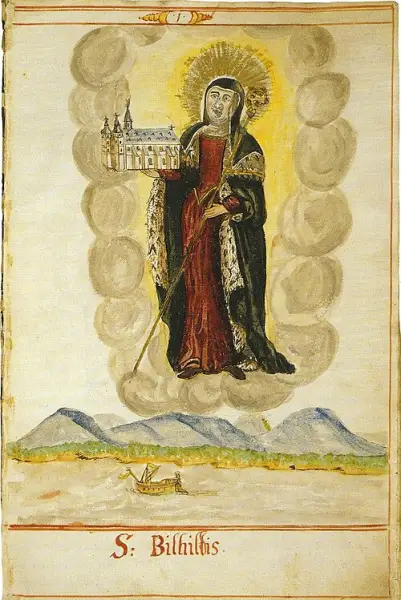
Overview
Bilihildis — also spelled Bilhild, Bilihilt, or Bilehild — was a Frankish noblewoman of the seventh and early eighth centuries, remembered as the founder and first abbess of the monastery of Altmünster at Mainz. The hagiography makes her a daughter of Count Jberin and his wife Mathilda, born at Hocheim, a name usually identified with modern Veitshöchheim near Würzburg though Alfred Wendehorst argued for Hochheim am Main. Fleeing the invading Huns with her family, she was raised as a Christian at Würzburg; she longed for the religious life, but her parents forced her, about the year 672, into marriage with a heathen Frankish ruler called Hetan; she came to love him yet never won him to the font. When Hetan fell in battle, she saw her opening: she sailed to Mainz, obtained leave from the bishop — her uncle, given in the sources as Sigibert, a misreading for Rigibert — sold her possessions, and with her wealth established a house for religious women that became Altmünster. Her death came on 27 November 734; burial followed in the church of the house she had built, and the grave there was reported to breathe a sweet fragrance and to be the scene of many wonders. Modern scholarship, notably Brigitte Flug's, treats the life cautiously: firm evidence of her existence goes back only to the twelfth century, and the vitae were composed after 1060.
The Complete Life
A Frankish Noblewoman's Childhood
The hagiographical tradition places Bilihildis's birth in the seventh century at Hocheim, the daughter of Count Jberin and his wife Mathilda. The identification of that place name is disputed. The usual reading takes it for modern Veitshöchheim near Würzburg in Bavaria, but Alfred Wendehorst, examining the question critically, judged that the reference is more probably to Hochheim am Main, and that the link drawn to Würzburg and its East-Frankish connections arose later, as an attempt to explain the monastery's foundation after the fact. The legend then gives her childhood a violent setting: her family is forced to flee before invading Huns, and the girl is taken to Würzburg, where she is brought up as a Christian. Whatever the historical worth of these details, they set the frame in which her later choices were made — a world of Frankish counts, arranged marriages, and a church still taking root among the eastern Franks. It is worth holding in mind how early modern scholarship dates the written sources: her vitae were composed after 1060, centuries after the events they describe, and Brigitte Flug judged that even the earliest of them, the short Latin prose life in the Merovingian manner, could not have been written within living memory of the saint. The biography of Bilihildis is thus a medieval reconstruction of an eighth-century life, built around a real foundation and a real grave.
§ Biography
A Marriage Not of Her Choosing
The central drama of the life of Bilihildis, as the vita tells it, is the collision between her desire for God and her family's ambition. From her youth, the text says, she wanted to devote herself to Christ; her parents instead forced her into marriage around 672 with a pagan Frankish duke named Hetan. The union is portrayed with surprising tenderness — she loved her husband — but she could not convert him, and the marriage remained religiously divided. Scholars have tried to identify Hetan with one of the two Hedans of the Würzburg line, and the attempt shows how difficult the chronology is. Hedan I, the elder, appears to have lived too early: as Hubert Mordek established, he died only after 676, which would place the founding of Altmünster in Bilihildis's seventies, an unlikely proposition. Hedan II fails the other way, for he was himself a Christian and had a wife attested in 704 and again in 716 or 717. The vita then resolves the impasse by battle: Hetan is called away to war and killed, and in his absence Bilihildis sees the opening she has waited for. Her response is decisive. She sells what she owns at Hochheim and travels by ship down to Mainz, where the bishop — her uncle, named in the sources as Sigibert, generally understood as a misreading of Rigibert of Mainz — grants her permission to begin a foundation for religious women.
§ Hagiography
Founding Altmünster
The foundation Bilihildis made at Mainz became the monastery of Altmünster, and she served as its first abbess. What is most striking in the account is the source of its endowment: her own considerable wealth, released by the sale of her possessions at Hochheim. A widowed noblewoman's fortune, converted into a house for religious women, is the exact mechanism by which a great many Frankish convents came into being, and the vita of Bilihildis preserves the pattern faithfully — so faithfully that Brigitte Flug recognized in the story the stock Merovingian template, in use for comparable holy women from the 500s onward: childhood devotion, humility and abstinence, an imposed marriage, escape, and an abbey at the end. Within that scheme, however, certain details seem to belong to the local memory of a real woman. The vita notes, oddly, that she was baptized only later in life — a strange touch for a legend eager to display early holiness, and possibly a trace of genuine biography. Her death came on 27 November 734, and she was buried in the church of the abbey she had built. There, the account says, her grave soon gave off a sweet odour and many miracles occurred at it — the signs by which Merovingian hagiography proved sanctity, and the reason her cult took root at Mainz and never left.
§ Hagiography
What the Legend Is Made Of
The commentators who have studied Bilihildis most closely — Brigitte Flug above all — read her vita less as biography than as devotional literature assembled from stock. Besides the standard scheme of the forced marriage and the flight to the cloister, the longer versions of the life show debts to other hagiographical writing: the longer prose life may be modelled on texts about the Frankish queen and saint Radegund, and is certainly indebted to the vitae of Kilian, the apostle of the Würzburg region. The German vernacular versions add local geographical and historical colour, along with extra particulars: her maiden name, given as Mathildis, and the gift of a sudarium — a cloth said to have covered the face of Christ after the crucifixion — presented by a queen named Imnechild, or in another redaction Kunegundis, and venerated at Altmünster from the fifteenth century. Flug's overall judgement is sober but not dismissive. She does not deny that Bilihildis may have been regarded as a saint in her own lifetime or soon after; what she doubts is that a vita was written so early, pointing to errors such as the mangled name of the bishop. In her view the author did not know Bilihildis personally and probably misread the name in the monastery's foundational deed. The sweet odour of the grave and the miracles reported there belong to the repertoire by which such sainthood was demonstrated; the abbey and the wealth behind it belong to history.
§ Commentary
Traces and Remembrance
Bilihildis left traces in the documentary and literary record that extend well beyond her vita. The name Bilihilt occurs in a fifth or sixth century manuscript containing texts by Priscillian, the controversial Iberian ascetic, and that occurrence has been identified with the Bilihildis who founded Altmünster — a link that, if accepted, would carry her name back centuries before her own lifetime and is best treated with caution. A sixteenth-century missal from Mainz, containing a calendar of Rhenish saints, carries a Mass of Saint Bilhildis appointed for her day; the J. Paul Getty Museum bought the volume in 1986 — a measure of how widely her liturgical memory travelled. Modern literature found her repeatedly. Alois Henninger, a German poet who wrote abundantly in devotional narrative verse, devoted to her a long poem running to eighteen six-line stanzas in his 1845 Nassau collection, praising her beauty and her steadfast devotion to God. The Protestant theologian Johannes Heinrich August Ebrard wrote a biography of her, which Julie Sutter retold in English for the Religious Tract Society, with particular attention to the influence of Iroscottish Christianity. Her feast remains 27 November, kept in the locality of Mainz that her foundation served.
§ Historical traces and legacy
Timeline
- 650
Born in the seventh century at Hocheim, daughter of Count Jberin and his wife Mathilda.
§ Hagiography
- 672
Her parents compel her to marry the pagan Frankish duke Hetan, whom she loves but cannot convert.
§ Hagiography
- 27 Nov 734
Dies at Altmünster and is buried in the abbey church, where her grave soon gives off a sweet aroma and works miracles.
§ Hagiography
- 1060
The vitae on which her biography rests are composed after this date, beginning with the short Latin prose life.
§ Biography
- 1100
The twelfth century is the earliest point to which firm written evidence of her existence extends.
§ Biography
- 1400
A sudarium said to have covered Christ's face, given by Queen Imnechild, is venerated at Altmünster from the fifteenth century.
§ Commentary
- 1845
Alois Henninger devotes an eighteen-stanza devotional poem to her in his Nassau collection.
§ Historical traces and legacy
- 1883
Ebrard's biography of Bilihildis is retold in English by Julie Sutter for the Religious Tract Society.
§ Historical traces and legacy
- 1986
The J. Paul Getty Museum acquires a sixteenth-century Mainz missal containing a Mass of Saint Bilhildis.
§ Historical traces and legacy
The Record
- Major works
- Founded the monastery of Altmünster near Mainz, of which she was the first abbess
- Canonization
- Pre-congregation; venerated locally as a saint, with a feast on 27 November
Prayer
Bibliography
Show 8 sources
- Chadwick, Henry (1976). Priscillian of Avila: the occult and the charismatic in the early church. Clarendon. ISBN 978-0-19-826643-3.
- Flug, Brigitte (2006). Äussere Bindung und innere Ordnung: das Altmünsterkloster in Mainz in seiner Geschichte und Verfassung von den Anfängen bis zum Ende des 14. Jahrhunderts. Franz Steiner. ISBN 9783515082419.
- Henninger, Alois (1845). "Die Heilige Bilehildis". Nassau in seinen sagen, Geschichten und Liedern. Wiesbaden: A. Scholz. pp. 176–179.
- Meier, Andreas (2003). Band 1: Brieftexte. Band 2: Kommentar. Walter de Gruyter. ISBN 9783110898767.
- Mordek, Hubert (1994). "Die Hedenen als politische Kraft im austrasischen Frankenreich". In Karl Martell in seiner Zeit. Sigmaringen: J. Thorbecke.
- Wendehorst, Alfred (1969). "Die Grundung des Bistums". Die Bistumer der Kirchenprovinz Mainz. Das Bistum Wurzburg II. Walter de Gruyter. pp. 9–17.
- Werner, Franz (1827). Der Dom von Mainz und seine Denkmäler. Müller.
- Ebrard, Johann Heinrich August; Sutter, Julie (1883). Bilihild, given in English by J. Sutter.
Profile text adapted from the Wikipedia article, licensed CC BY-SA 4.0.
Pray with this saint every day
Save St. Bilihildis of Altmünster to your favorites, read the full profile, and get feast-day reminders in the Saints app.
Get the Saints AppFree on the App Store for iPhone and iPad