
c. 600 – 3 December 649 or 650·Feast December 3
St. Birinus
Apostle to the West Saxons and First Bishop of Dorchester
Overview
Birinus, also known as Berin or Birin, was a Frankish bishop of the seventh century celebrated as the 'Apostle to the West Saxons' for converting the kingdom of Wessex to Christianity. Born around 600 in Francia, he became a Benedictine monk and was consecrated bishop by Asterius in Genoa, having received from Pope Honorius I a commission to evangelize the West Saxons — a charge that originally covered parts of Britain where no missionary work had yet reached and may have been directed toward the Mercians as well. He arrived in Wessex in 634, landing at the port of Hamwic, in the area of modern Southampton where St Mary's Church was founded during his brief stay. In 635 he persuaded King Cynegils to accept preaching; the king's prospective alliance with the Christian Oswald of Northumbria foundered on Oswald's refusal to ally with a pagan, and Cynegils was baptized, granting Birinus Dorchester-on-Thames as his episcopal see. There Birinus worked for the rest of his life, baptizing Cynegils's son Cwichelm in 636 and his grandson Cuthred in 639, and founding churches across Wessex. He died at Dorchester on 3 December 649 or 650 and was succeeded by Agilbertus. His relics were later translated to Winchester.
The Complete Life
A Frankish Monk and Bishop
Birinus came from the Frankish lands across the Channel, born around the year 600 into a church that had been Christian for centuries and that stood in a close and sometimes difficult relationship with the mission fields of Britain. He was a Benedictine monk, formed in the rule that was steadily becoming the common discipline of western monasticism, and he rose to episcopal office: he was made bishop by Asterius — the consecration is placed at Genoa — before he ever set foot in England. His commission came from Pope Honorius I, and its scope is worth noting, for it was not narrowly West Saxon. The charge required him to preach in regions of Britain untouched by any earlier mission, and it may also have directed him to carry the gospel to the Mercians, the powerful midland kingdom that was to prove the great pagan rival of the Christian courts of the age. In the event Birinus never reached the Mercians. He arrived instead in Wessex in 634, landing at Hamwic, the port whose site now lies in the St Mary's area of Southampton, and during his brief time there a church was founded that still bears that dedication. He was, in other words, a continental missionary bishop of the classic Augustinian pattern: sent from abroad, armed with papal authority, and prepared to work through the conversion of a king.
§ Life and ministry
The Conversion of Wessex
The decisive moment of Birinus's ministry came in 635, when he persuaded Cynegils, king of the West Saxons, to allow him to preach. The political setting was delicately balanced. Cynegils was seeking a pact with Oswald of Northumbria, planning to make war jointly on the Mercians; when the two rulers met for their last discussions, the pact hung on a religious point: Oswald, a Christian, would not bind himself to a pagan. The obstacle was removed by baptism, and Cynegils was received into the Church, with the consequence that Wessex acquired both an ally and a bishop in a single season. Cynegils gave Birinus Dorchester-on-Thames for his episcopal see, a small walled town in the Thames valley that became the base for the evangelization of the kingdom. There followed a decade of pastoral consolidation. Birinus baptized the king's son Cwichelm in 636 and his grandson Cuthred in 639, standing godfather to the boy, so that three generations of the royal house entered the Church through his hands. He is also credited with establishing churches across Wessex: foundations ascribed to him include St Mary's at Reading, St Peter and St Paul at Checkendon near Reading, and the original Ipsden church, erected roughly two miles from where the present one stands. Though his commission may have pointed toward the Mercians, he stayed in Wessex to the end.
§ Life and ministry
Death at Dorchester
Birinus spent the whole of his English ministry from the see that Cynegils had granted him, his death at Dorchester occurring on 3 December of 649, or possibly 650, the records supporting both years for the close of a life that had opened around 600. His episcopate at Dorchester thus covered some fifteen years, from the establishment of the see in 634 until his death, a span in which the West Saxon church moved from the baptism of its king to the possession of a network of foundations. The office did not lapse with him: he was succeeded by Agilbertus, a Frank like himself, and the see of Dorchester was in time translated to Winchester, whose long episcopal succession is traced back through Birinus as its origin. The manner of his death is not recorded; what the tradition preserved instead was the place of his burial and the later history of his remains. His body rested at Dorchester, where the abbey that grew up around the site became his shrine, and after his death his relics were eventually translated to Winchester — a move that reflects the political and ecclesiastical shift of power in Wessex toward the southern capital. Parts of the shrine were destroyed in later centuries, though small portions survive and a modern replica now stands in place; the Catholic church at Dorchester, one of the first built after Pius IX restored the English hierarchy, is dedicated to him.
§ Veneration
Honoured in Three Communions
Birinus belongs to that company of early English saints whose cult antedates every formal process and who are claimed alike by the great church bodies that later divided. Catholics, Orthodox, and Anglicans alike honour him as a saint, each communion keeping him as the apostle of the West Saxons. His liturgical commemoration varies with the calendar. In the Roman Catholic Church and the Orthodox Church his feast falls on 3 December, though some churches celebrate it on 5 December; in the Church of England the day is 4 September, where it holds the rank of a commemoration. His entry into the official Roman calendar came late: the Roman Martyrology took up his feast toward the close of the sixteenth century, when that roll was being systematically compiled, which is a measure of how far his cult had been a matter of local and national rather than universal observance until the counter-reformation church took stock of the northern saints. The Orthodox venerates him under the title of holy hierarch. This breadth of commemoration is fitting for a man whose work preceded the divisions of the later church by nearly a thousand years, and whose converts at Dorchester could have known nothing of the communions that would one day each count him as their own.
§ Veneration
Shrines, dedications, and a modern window
The memory of Birinus has remained alive in the landscape and devotion of the Thames valley and beyond. At Dorchester on Thames the abbey preserves the site of his shrine, now destroyed in its medieval form, with small surviving parts and a modern replica in place; Winchester Cathedral, his other shrine after the translation of his relics, likewise lost its medieval shrine. Several Church of England parishes bear his dedication, among them Berinsfield in Oxfordshire and Redlynch in Wiltshire, and the Catholic church at Dorchester — raised in the first wave of building once Pius IX had restored the English hierarchy — likewise bears his name; the church of St Birinus at Morgan's Vale and St Birinus School at Didcot extend the pattern. The oldest witness to his life, beyond the brief record of Bede, is the vita written by Lantfred, a continental monk of the Winchester circle, in the eleventh century. In 2013 St Michael's, Easthampstead, at Bracknell placed in its porch a new stained-glass window from the hand of Thomas Denny, depicting the baptism of Cynegils by Birinus — the founding act of West Saxon Christianity rendered in contemporary glass. As patron of Berkshire and of Dorchester, he remains the titular apostle of a wide stretch of the country he evangelized.
§ Veneration
Timeline
- 600
Born in Francia, by tradition, around the year 600.
§ Life and ministry
- 634
Consecrated earlier by Asterius of Milan at Genoa, lands at the port of Hamwic and begins the mission to the West Saxons.
§ Life and ministry
- 635
Baptizes King Cynegils after the talks with Oswald of Northumbria, and receives Dorchester-on-Thames as his see.
§ Life and ministry
- 636
Baptizes Cynegils's son Cwichelm.
§ Life and ministry
- 639
Baptizes the king's grandson Cuthred, standing as his godfather.
§ Life and ministry
- 3 Dec 649
Dies at Dorchester on 3 December of 649 or 650, and is succeeded as bishop by Agilbertus.
§ Life and ministry
- 1590
In the late sixteenth century his feast is added to the Roman Martyrology.
§ Veneration
- 2013
A stained glass window by Thomas Denny depicting the baptism of Cynegils is unveiled at St Michael's, Easthampstead, Bracknell.
§ Veneration
The Record
- Major works
- Founded St Mary's Church at Reading·Founded St Peter and St Paul, Checkendon, near Reading·Founded the first church at Ipsden
- Patron of
- Patron of Berkshire·Patron of Dorchester
- Symbols
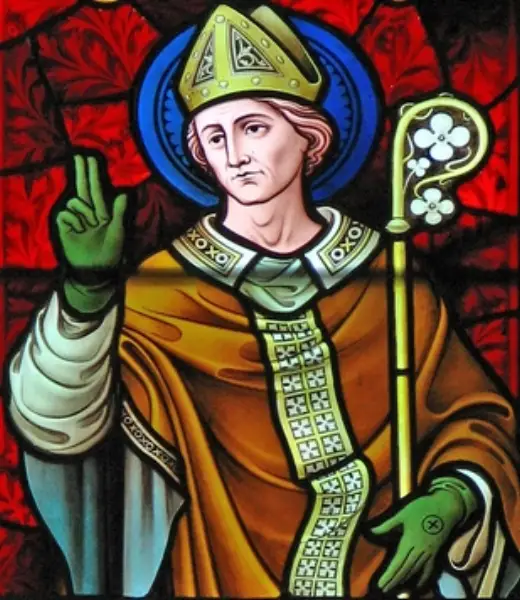
- Bishop's vestments·Shown baptising a king
- Canonization
- Pre-congregation; his feast entered the Roman Martyrology in the late 16th century, and he is venerated by Catholics, the Orthodox, and Anglicans
Prayer
Bibliography
Show 11 sources
- Bately, Janet M. (1986). The Anglo-Saxon Chronicle: A Collaborative Edition, vol. 3. Cambridge: D.S. Brewer. ISBN 978-0-85991-103-0.
- Bede (1969). Bede's Ecclesiastical History of the English People. Oxford: Clarendon Press. ISBN 978-0-19-822202-6.
- Church of England Liturgical Commission (2000). Common Worship. London: Church House Publishing. ISBN 978-0-7151-2000-2.
- Coles, R. J. (1981). Southampton's Historic Buildings. City of Southampton Society.
- Davis, A. C. (1912). "Birinus". In Ollard, S. L. (ed.). A Dictionary of English Church History. London: A. R. Mowbray and Co. pp. 56–57.
- Farmer, David (2011). The Oxford Dictionary of Saints (rev. 5th ed.). Oxford: Oxford University Press. ISBN 978-0-1995-9660-7.
- Kirby, D. P. (2000). The Earliest English Kings. New York: Routledge. ISBN 978-0-415-24211-0.
- Livingstone, E. A., ed. (2013). The Concise Oxford Dictionary of the Christian Church (3rd ed.). Oxford: Oxford University Press.
- Powicke, F. Maurice; Fryde, E. B. (1961). Handbook of British Chronology (2nd ed.). London: Royal Historical Society.
- Thompson, E. Maunde (1886). "Birinus". In Stephen, Leslie (ed.). Dictionary of National Biography, vol. 5. New York: Macmillan. p. 80.
- Walsh, Michael (2007). A New Dictionary of Saints: East and West. London: Burns & Oats. ISBN 978-0-86012-438-2.
Profile text adapted from the Wikipedia article, licensed CC BY-SA 4.0.
Pray with this saint every day
Save St. Birinus to your favorites, read the full profile, and get feast-day reminders in the Saints app.
Get the Saints AppFree on the App Store for iPhone and iPad