
364 – 384·Feast January 22
St. Blaesilla
Roman widow whose severe fasting convulsed the church of Jerome
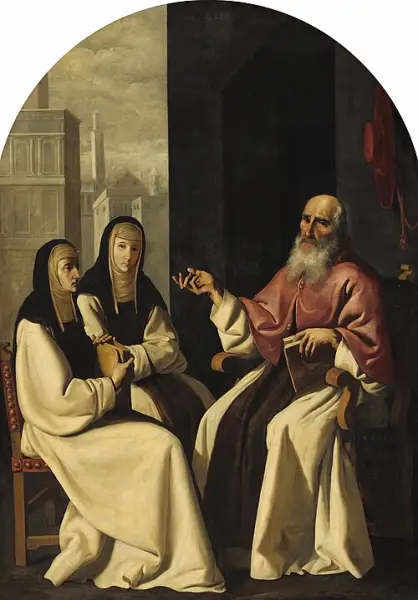
Overview
Blaesilla, also written Blesilla, was a Roman widow of the fourth century and a disciple of Saint Jerome. Born in 364 into a wealthy senatorial family, she was the eldest daughter of Paula of Rome, widow of the senator Toxotius, and sister of Eustochium; her mother and sister belonged to that circle of aristocratic Christian women in late-antique Rome who gathered around Jerome for spiritual direction. Beautiful, gifted, and fond of the pleasures of her class, Blaesilla married at eighteen a Christian young man named Furius, son of Titiana; he died only seven months into the marriage, leaving her a rich young widow. She continued the dress, parties, and social life she loved until a life-threatening fever changed her. Recovered, she turned to severe asceticism: plain clothing, extreme fasting, and intense study, learning Greek with a perfect accent and Hebrew within months, and pressing Jerome for commentaries to read. Her body could not sustain the discipline. Within four months she was dead, in 384, not yet twenty-one. Her death provoked a bitter controversy in Rome, where many blamed Jerome and demanded the expulsion of monks; an inquiry after the death of Pope Damasus I cost Jerome his position, and he left for Antioch and then Jerusalem, followed by Paula and Eustochium, who founded with him a monastery at Bethlehem. Modern researchers have regarded Blaesilla as probably the earliest documented case of death from anorexia nervosa.
The Complete Life
An Aristocratic Roman Childhood
Blaesilla came into the world at Rome in 364, born to one of the wealthy families that still set the tone of the city's social and political life. Her mother was Paula of Rome, the widow of Toxotius, a senator of substance, and through her father's side the family had further distinction, for Toxotius' brother had served as vicarius of Rome and proconsul of Africa. Blaesilla was Paula's eldest daughter and had three sisters, among them Eustochium, who would become famous in her own right. The household belonged to a notable phenomenon of fourth-century Christianity: a vigorous community of well-born women, figures such as Paula and Asella, who took seriously the ascetic teaching of the day and placed themselves under the guidance of Jerome when he resided in Rome. This was the atmosphere in which Blaesilla grew up, though she did not at first imitate it. Contemporaries remembered her as a beautiful and talented girl attached to the amusements of her class; she delighted in the theater, in dinner parties, and in the company of other young aristocrats. It is a portrait of a Roman debutante of the highest station, placed beside a mother and a younger sister already moving toward poverty, prayer, and Scripture. The tension between those two ways of life, the merry and the austere, would run through the whole of her short story, and it is visible from her earliest years in the contrast between the girl and her own family.
§ Life
Marriage, Widowhood, and a Fever That Changed Everything
At eighteen Blaesilla was married to Furius, a son of Titiana, a woman who, like Blaesilla's own mother, was devoutly Christian; the match joined two households of the believing aristocracy. The marriage lasted seven months. Furius died, and Blaesilla found herself, still a teenager, a wealthy widow with her whole life apparently before her. Her response was the ordinary one for her age and station: she mourned, and then she resumed, with her time and money, the round of dress, appearance, and entertainment that widowhood left her free to enjoy. Historian Joyce Salisbury observes that she was simply too young to give up the glittering existence she loved. Jerome, whose entire program rested on fasting and the subduing of the flesh as a means of fixing the mind on God, rebuked her for what he saw as her frivolity. The decisive intervention, however, came not from the preacher but from illness. Soon after her husband's death Blaesilla contracted a fever grave enough to threaten her life. She recovered, and those around her recorded that she came out of the sickness a changed woman. Joan Carroll Cruz reads the turn as a yielding to the promptings of grace. Whether it was grace, or the shock of mortality, or, as historian John Matthews has conjectured, depression following a life-threatening illness, the young widow thereafter chose to spend what remained of her short life in great austerity.
§ Life
Study, Languages, and the Discipline of Fasting
The austerity Blaesilla adopted after her illness was intellectual as much as physical, and the intellectual side is the more attractive to modern eyes. She gave herself to Scripture, and with startling speed: she learned to speak Greek with what the sources call a perfect accent, and she acquired Hebrew in a matter of months, an achievement few of any age can claim. Books accompanied her everywhere, and she pressed Jerome, with something of a student's imperiousness, to write commentaries that she could study. His tribute to her mind has preserved her better than any monument: recalling how earnestly she prayed, how brightly she conversed, how tenacious a memory she kept and how rapid a mind she had, he asked who could remember her without a sigh. The physical side of her conversion was harder. She put on plain clothing and submitted herself to fasts of an extremity that visibly weakened her. In Jerome's understanding this was the point: he taught that rigorous fasting helped his followers control the flesh and attend to God, and Blaesilla embraced the teaching with the same totality she had shown in learning languages. Her family watched her decline with growing alarm. The two strands of her spirituality, the brilliant student and the self-starving ascetic, existed in the same young woman, and it is one of the tragedies of her story that the same wholeheartedness that mastered Hebrew in months could not be turned away from a discipline that was destroying her.
§ Life
Four Months to the End
The final act of Blaesilla's life was brief and devastating. Her body proved unequal to the demands her asceticism placed upon it; within four months of her turn to severity she was dead, in the year 384, at twenty years of age. Her last illness and death are known chiefly from Jerome's own account in a letter to Paula. At the funeral Paula's grief broke her: she collapsed in mid-procession and was carried from the scene senseless, a detail Jerome records without appearing to grasp its cruelty; John Matthews has suggested that her collapse owed something to her own ascetic weakening from lack of food. Jerome's consolation was of a piece with his theology: he proclaimed his dead pupil the conqueror in the struggle against Satan, a verdict that offered the mother spiritual victory in exchange for her daughter. Whatever comfort it gave Paula, the wider city received the death differently. Romans saw a lively young woman destroyed by fasting under clerical influence, and their grief turned to anger at the man they held responsible. The last months of Blaesilla's life therefore set in motion consequences that outlasted her: a family bereaved, a spiritual director discredited in the capital, and a congregation of Roman opinion hardened against the monastic movement that had only recently planted itself in the city's aristocratic households.
§ Reactions to her death
Controversy, Bethlehem, and a Modern Diagnosis
The controversy that followed Blaesilla's death reshaped the lives of everyone around her. Hooper and Schwartz report that the city was convulsed by bitter dispute, and Salisbury records that many held Jerome responsible for the loss of so vivid a young woman. His behavior worsened his case: he insisted to Paula that her daughter should not be mourned and treated the mother's grief as excessive complaints, which struck Romans as heartless and polarized opinion against him. Public feeling reached the point of demands that monks be expelled from Rome altogether. Jerome's position had already been weakened by his attacks on the Roman clergy while he served as secretary to Pope Damasus I, and when Damasus died in December 384 an inquiry into his relationship with Paula forced him from office. He left for Antioch and then Jerusalem, where Paula and Eustochium joined him; they laid no blame on him for the death, certain that she had departed in God's grace, and with Paula's support Jerome lived his last thirty-four years as an ascetic at the double monastery she founded at Bethlehem. It was for Blaesilla, according to Cruz, that he translated Ecclesiastes. Her memory survived in the calendars: her feast is kept on January 22, and she is honored in both the Catholic and the Orthodox Church. In the modern literature she has gained a second, sadder fame, as researchers have identified her as probably the first recorded death from anorexia nervosa and compared her motivation to that of modern patients.
§ Legacy and veneration
Timeline
- 364
Born in Rome, eldest daughter of Paula and of the late senator Toxotius.
§ Life
- 382
Married Furius, son of Titiana, at the age of eighteen.
§ Life
- 382
Widowed after seven months of marriage; soon afterward survived a life-threatening fever and embraced severe asceticism.
§ Life
- 384
Died in Rome at about twenty years of age, weakened by extreme fasting, within four months of her conversion to austerity.
§ Life
- 384
Her funeral provoked her mother Paula's collapse; many Romans blamed Jerome for the death and demanded that monks be driven out of the city.
§ Reactions to her death
- Dec 384
After Pope Damasus I died in December, an inquiry into Jerome's relationship with Paula forced Jerome from his position; he left Rome for Antioch and Jerusalem.
§ Reactions to her death
- 385
Paula and Eustochium followed Jerome to the Holy Land and eventually established a double monastery at Bethlehem.
§ Reactions to her death
In Their Own Words
Who can recall without a sigh the earnestness of her prayers, the brilliancy of her conversation, the tenacity of her memory, and the quickness of her intellect?
the victor in the struggle against Satan
The Record
- Canonization
- Pre-congregation; venerated in the Catholic Church and the Orthodox Church
Prayer
Bibliography
Show 9 sources
- Cruz, Joan Carroll (2015). Lay Saints: Ascetics and Penitents. Charlotte, North Carolina: TAN Books. ISBN 978-0-89555-847-3.
- Salisbury, Joyce E. (2001). "Blaesilla". Encyclopedia of Women in the Ancient World. Santa Barbara, California: ABC-CLIO. pp. 32-33.
- Hooper, Finley; Schwartz, Matthew (1991). Roman Letters: History from a Personal Point of View. Detroit: Wayne State University Press. p. 206.
- Matthews, John (2009). Roman Perspectives: Studies in Political and Cultural History, from the First to the Fifth Century. Swansea: Classical Press of Wales. p. 264.
- Schaff, Philip, ed. (2007). "Letter XXXIX. To Paula." Jerome: Letters and Select Works. New York: Cosimo Classics. pp. 49-54.
- Docx, Martine K. F., and Govaert, Paul (November 2016). "The First Deadly Victim of Anorexia Nervosa in History Called Blaesilla". Acta Psychiatrica Belgica 3:116, pp. 25-28.
- Dunbar, Agnes B.C. (1901). A Dictionary of Saintly Women. Vol. 1. London: George Bell & Sons. p. 123.
- Shlain, Leonard (1999). The Alphabet Versus the Goddess: The Conflict Between Word and Image. New York: Penguin. p. 246.
- Saltet, Louis. "St. Paula." The Catholic Encyclopedia Vol. 11. New York: Robert Appleton Company, 1911.
Profile text adapted from the Wikipedia article, licensed CC BY-SA 4.0.
Pray with this saint every day
Save St. Blaesilla to your favorites, read the full profile, and get feast-day reminders in the Saints app.
Get the Saints AppFree on the App Store for iPhone and iPad