
died 316·Feast February 3
St. Blaise
Bishop and martyr, patron of throats
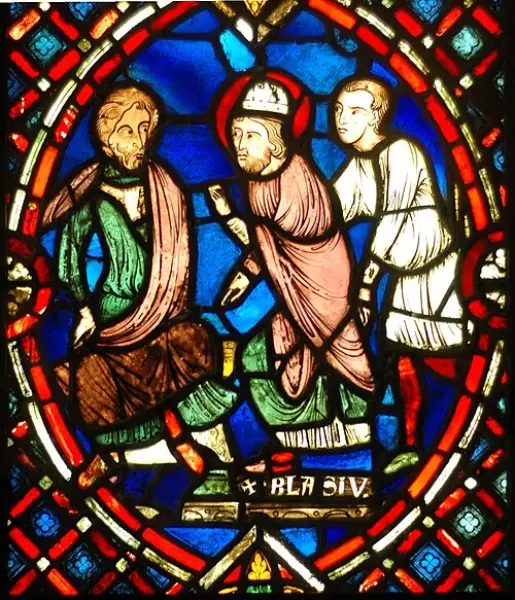
Overview
Blaise of Sebaste was a physician who became bishop of Sebastea in historical Lesser Armenia, in the land of modern Sivas in Turkey, and died a martyr's death around 316. Trained in philosophy and skilled in medicine, he was chosen by the acclamation of his people to lead the church of his native city, and his ministry joined the healing of bodies to the curing of souls. When the emperor Licinius renewed persecution, the governor Agricola arrested the bishop, scourged him, and cast him into prison; the accounts tell of a mother whose only son was choking on a fish bone and was restored at the saint's prayer as he was led away, and of a poor widow's pig returned alive by a wolf at his command. He was beaten, torn with iron combs, and beheaded. His cult is among the oldest in Christendom: a writer of about 500 already invokes his aid for afflictions of the throat, his feast is kept on February 3 in the West and February 11 in the East, and the blessing of throats with crossed candles is given in his name in churches across the world. He is patron of Dubrovnik, of wool combers, and of the Fourteen Holy Helpers.
The Complete Life
Physician of Sebastea
Blaise came from Sebastea, the chief city of historical Lesser Armenia, a province whose Church was already ancient when he was born and whose mountains looked out toward the Armenian plateau. Of his family and upbringing the early traditions say little, but they agree that in his youth he studied philosophy, the standard education of the late Roman world, and that he then took up the practice of medicine in his native city. He exercised that art, the accounts tell, with a rare union of skill, goodwill, and piety, so that patients came to regard his cures as something more than natural. In an age when the boundary between physician and priest was porous, the Christian doctor occupied a privileged place in the life of a city: he entered homes at moments of fear, could speak of the God who heals, and was judged by his works rather than his words. The earliest documentary trace of the saint is itself medical, for Aëtius Amidenus, a Byzantine medical writer of about the year 500, prescribed the invocation of Blaise for patients with objects stuck in the throat — the beginning of the saint's long association with that part of the body. Medicine made him known to his city; his reputation for holiness made him known to its Church.
§ Early records
Called to the Episcopate
The transition from healer of bodies to shepherd of souls came about, according to the Acts, in the most public way possible: when the bishop of Sebastea died, the whole people acclaimed Blaise as his successor. He accepted, and the physician of the city became its chief pastor. The accounts describe a retreat that preceded or accompanied this elevation: from being a healer of bodily ailments he became an expert in the care of souls, and for a time he withdrew to a cavern in the mountains, where he gave himself to prayer. There, the legend says, wild beasts came to him on their own to receive his blessing, and he in turn was helped by the animals — the origin of his special patronage of creatures and of his depiction in art surrounded by beasts in a cave. As bishop he taught as much by the example of his life as by preaching, and the virtues the records single out are those of a man of prayer in public office: humility toward the sick who flocked to him, gentleness toward the poor, courage in a Church that had known successive persecutions. Miracles were attributed to him abundantly, and pilgrims came from every direction seeking cures of both body and spirit, so that the episcopate of the Armenian doctor became a ministry of healing in its fullest sense.
§ Life
The Miracles of the Way
Two stories, fixed in the Acts and repeated wherever his cult travelled, show the saint's mission in miniature. The first occurred as the soldiers led him from his mountain cave to the prison of Sebastea: a distressed mother threw her only son at his feet, the child choking to death on a fish bone. Blaise prayed, and the boy was cured on the spot. From this episode comes the blessing of throats that bears his name to this day. The second story followed on the same road: a poor woman wept because a wolf had seized her pig, her only wealth. At the saint's command the wolf brought the animal back alive and unhurt. When he sat in the dark cell awaiting execution, that same widow came to him carrying two fine wax candles, and asked to be allowed to light them so that his last night would not be wholly dark. From her gift comes the second emblem of his cult, the two crossed candles. The stories bind together the themes of his patronage: the healing of the throat, the protection of animals, the honour given to the poor, and the candles blessed on Candlemas eve that priests still hold in a cross over the heads of the faithful each February 3, invoking the bishop and martyr against every disease of the throat.
§ Blessing of St Blaise
The Prayer of the Cave
The spirituality of Blaise joined two great currents of the early Church: the medicine of mercy and the asceticism of the desert. His first vocation taught him that God's compassion reaches the body as truly as the soul, and as bishop he never abandoned the healing works that had made him famous; the sick of every condition found their way to him, and he received them as his charge. His second vocation, forged in the cavern outside the city, taught him that the strength for such ministry flows from solitude and prayer. The wild beasts that came to him in that retreat became the emblem of a harmony restored between humanity and creation — a foretaste, the tradition suggests, of the peace of paradise, and the reason painters place him in his grotto among lions and bears. He taught his people, the records insist, as much by his manner of life as by his words, and his sanctity was attested by many signs. The blessing he left to the Church is a theology in miniature: two candles crossed like a tiny cross, held against the throat, the organ of speech and breath, asking God through the martyr's intercession to deliver from every illness of the throat and every other ill — a prayer that what we speak and what we breathe may both be given over to God.
§ Life
Persecution and Martyrdom
The persecution that claimed Blaise came late in the era of the great persecutions. In 316 the emperor Licinius ordered the suppression of the Christians of the eastern provinces, and Agricola, governor of Cappadocia and Lesser Armenia, arrived in Sebastea to carry out the decree. The bishop of the city was the first man he arrested. The interrogation that followed, the governor's attempt to make him sacrifice to the gods, his refusal, the severe scourging, and the imprisonment are all attested in the earliest accounts. While he awaited sentence, the miracles of the road — the choking child, the restored pig, the widow's candles — took place, and the Acts add that the governor, unable to shake his constancy, finally ordered him beaten with sticks, his flesh torn apart with iron combs, and his head struck off. The iron comb, an instrument of carding, became the instrument of his passion, and by a providence that the medieval mind loved, it made him the natural patron of wool combers, whose trade tool it resembled. The place of his death near Sebastea was marked and visited for centuries: Marco Polo wrote of the spot where the saint won his crown, and the Franciscan traveller William of Rubruck described the shrine below the citadel mount when he passed through Armenia in 1253.
§ Acts of St Blaise
One of the Fourteen Holy Helpers
Blaise was never canonized by process, for his martyrdom was his canonization; the Church of the East venerated him from the first centuries, and the West received his cult through Armenia and the Balkans. No western group honoured him before the eighth century, but from that point his feast spread steadily, and by the eleventh and twelfth his following had become one of the largest in Europe; the thirteenth-century Golden Legend carried his story into every parish library. He took his place among the Fourteen Holy Helpers, the company of saints invoked in Germany and central Europe against plague and sudden death, each with a specialty — his being diseases of the throat. The legendary Acts written some four centuries after his death shaped this devotion, and though their narratives are the work of hagiographers rather than historians, the core facts of an episcopal martyrdom at Sebastea around 316 were never doubted. His feast is kept on February 3 in the Catholic and Anglican calendars, on February 11 in the Byzantine tradition, and in January in the Armenian rite; he is honoured by Catholics, Eastern and Oriental Orthodox, Anglicans, and Western Rite Orthodox alike, one of the few saints whose cult spans every division of Christendom. The Armenian Order of Saint Blaise keeps his name among his own people.
§ Veneration of Saint Blaise
From Dubrovnik to the Ends of the Earth
Few saints own a city as Blaise owns Dubrovnik. Revealed, so the chroniclers say, in a vision of 971 to warn the citizens of Venetian treachery, he became first the guardian of the Republic of Ragusa and then its very emblem: his effigy stood on the state seal and the coinage until the Napoleonic age, and every February 3 the city still parades his skull, a piece of his throat bone, and his hands through streets filled with processions and white doves. His remains rest at Maratea in Basilicata on a mountain named for him, though other cities claim bodies, heads, and arms enough that one scholar of 1822 mocked the martyr as armed like a giant. In England, the Council of Oxford forbade work on his feast in 1222; Cornwall keeps his name at St Blazey, and Bradford made him patron of its woollen mills. English woolworkers of the eighteenth and nineteenth centuries adopted him as the mascot of their pageants, crediting him with teaching the nation to comb wool. His cult reached Icelandic farms and a Goan church built by Croatian sailors in 1541; in Spanish lands he is San Blas, in Brazil São Brás, in Italy San Biagio. And every year, in countless parishes, two crossed candles touch the throats of the faithful in his name.
§ In Croatia
Timeline
- 316
Seized under Licinius, interrogated and scourged by Governor Agricola, then imprisoned, tortured with iron combs, and beheaded.
§ Life
- 500
The medical writings of Aëtius Amidenus supply the earliest reference to Blaise, invoking his aid for patients with objects lodged in the throat.
§ Early records
- 971
In a vision to a canon of Dubrovnik, Blaise revealed Venetian galleys spying on the city's defences, beginning his role as that city's protector.
§ In Croatia
- 1222
The Council of Oxford forbade all labour on his feast day, marking his firm establishment in England.
§ In Great Britain
- 1253
The traveller William of Rubruck recorded the shrine of the saint near the citadel mount of Sebastea.
§ Early records
- 1541
Croatian sailors and traders settled in Goa built a chapel in his honour, later replicated from the Dubrovnik church.
§ In India
- 1563
The Goa chapel of St Blaise was elevated to the rank of a parish church.
§ In India
- 1961
A Catholic middle school named for him opened in Bradford, Yorkshire, whose woollen industry honoured the martyr of the wool combs.
§ In Great Britain
In Their Own Words
With a little research, we would find Saint Blaise armed with a hundred arms, like the giant of the fable. The fingers, teeth, feet of this voluminous saint are too scattered for us to undertake to bring them together.
The Record
- Patron of
- infants·animals·builders·stonecutters·carvers·drapers·wool workers and the wool industry·wool combers·veterinarians·physicians·healing·throats and against choking·ENT illnesses·the sick·Bradford·Salerno·Maratea·Sicily·Dubrovnik·Ciudad del Este·Campanário, Madeira·Rubiera·Sebaste, Antique·Armenian Order of Saint Blaise
- Symbols
- bishop's vestments·two crossed candles·tending a choking boy·wool comb·animals and wild beasts·iron combs
- Canonization
- Pre-congregation; venerated as a martyr since antiquity and counted among the Fourteen Holy Helpers
Prayer
Bibliography
Show 7 sources
- Kirsch, Johann Peter. "St. Blaise." The Catholic Encyclopedia. Vol. 2. New York: Robert Appleton Company, 1907.
- Marco Polo. Travels of Marco Polo, the Venetian (1260-1295), I, ch. 46.
- Rockhill, William Woodville, ed. and tr. The Journey of William of Rubruck to the eastern parts of the world, 1253-55. 1900, p. 276.
- Foley O.F.M., Leonard. "Saint Blaise", Saint of the Day, Lives, Lessons, and Feasts (revised by Pat McCloskey O.F.M.). Franciscan Media. ISBN 978-0-86716-887-7.
- "Festivity of Saint Blaise, the patron of Dubrovnik". UNESCO Intangible Cultural Heritage.
- Cormack, Margaret (January 2014). "The Cult of St Blaise in Iceland". Saga-Book of the Viking Society.
- Collin de Plancy, Jacques-Albin-Simon. Dictionnaire critique des reliques et des images miraculeuses. 1822, pp. 95-96.
Profile text adapted from the Wikipedia article, licensed CC BY-SA 4.0.
Pray with this saint every day
Save St. Blaise to your favorites, read the full profile, and get feast-day reminders in the Saints app.
Get the Saints AppFree on the App Store for iPhone and iPad