
c. 162 – 177·Feast June 2
St. Blandina
Slave girl and last survivor of the martyrs of Lyon
Overview
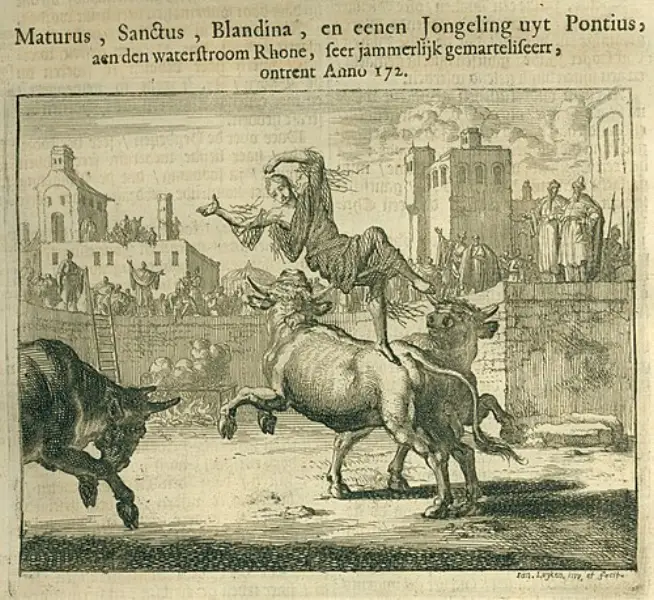
Blandina was a Christian slave, born around 162, who died in 177 at Lugdunum, the Roman city that is modern Lyon in France, during the persecution under Emperor Marcus Aurelius. She belonged to the band of Lyon martyrs whose sufferings are recorded in a letter sent by the church of Lyon to the churches of Asia Minor, a document quoted at length by Eusebius in his Ecclesiastical History and the source of nearly everything known about her. Arrested together with her Christian master while the imperial legate was absent, the frail young woman was tortured by the legate upon his return; her companions had feared her bodily weakness, yet her executioners wearied before she did, and to every question she answered that she was a Christian and that Christians commit no wrongdoing. Slaves testifying under torture had spread the standard rumors of cannibalism and incest, which the authorities hoped to extract from the prisoners. In the amphitheater during the public games, Blandina was bound to a stake in the shape of a cross while beasts were loosed at her; by tradition they did not touch her, and she was returned to prison. She encouraged Ponticus, the youngest of the company at fifteen years old, to hold out through his own torments. Last of the martyrs to die, she was flogged, held over a burning grate, netted and given to a wild steer that tossed her on its horns, and at last dispatched with a blade. Ancient and modern writers alike have read her as a mother to her fellow sufferers and an athlete of Christ, and her feast is kept on June 2.
The Complete Life
A Slave in Lugdunum
Blandina entered the world around the year 162 in Lugdunum, the capital of Roman Gaul whose site is now the city of Lyon in France, and she left it before her sixteenth year had fully passed. Her station in life was the lowest the empire recognized: she was a slave, and her master was himself a Christian, so that when the storm of persecution broke over the community she was swept into prison along with the household she served. Nothing in the sources supplies a family, an education, or a history; what they supply instead is a body, repeatedly described as frail, small, and weak, and a will that astonished everyone who tested it. The setting of her short life matters to her story. Across the empire's opening two Christian centuries, harassment of believers was largely left to local officials; the emperors of the second century tended to treat Christianity as a local nuisance to be handled by subordinates, though the number and harshness of persecutions appears to have risen under Marcus Aurelius. How far the emperor himself directed or even knew of the Gallic proceedings remains unclear and debated among historians. Blandina's fate was therefore decided at the provincial level, by a chiliarch and a duumvir who filled the prisons while the legate was away, and by the legate who held the trials when he returned.
§ Traditional history
The Ordeals in the Arena
The sequence of Blandina's sufferings, as the Lyon letter preserves it, is among the most detailed martyr narratives to survive from antiquity. Brought to trial with the other confessors, she was tortured with a severity that exhausted her tormentors, who ran out of things to do to her while she continued to repeat her single confession. The authorities had a specific crime in mind. Slaves, dreading the rack, had testified against their masters that Christians practiced cannibalism and incest when they gathered, a rumor as old as the rumors about the faith itself, and the legate was determined to wring an admission of such misconduct from the prisoners. His report to Marcus Aurelius proposed death for those who held to the faith and release for those who renounced it, and the emperor's reply drew the familiar line of citizenship: Roman citizens who persisted were to be beheaded, while the rest, among them the slave girl, were to be tortured. She was therefore exposed in the town's amphitheater at the time of the public games. Bound to a stake in the figure of a cross, she prayed aloud for her companions and her captors alike while the beasts were loosed; by tradition they never touched her, and she was taken down and returned to jail. Days later, after watching her fellow Christians die, she followed them as the last of the martyrs: flogged, held over a red-hot grate, netted and exposed to a wild steer that gored and tossed her, and finished off with a dagger.
§ Traditional history
Mother and Athlete of Christ
The letter from Lyon did more than chronicle suffering; it gave the sufferings a shape, and the shape it chose for Blandina has two faces. The first is maternal. Of all the martyrs of Lyon she is the only woman the narrative follows throughout, and she is presented as a mother who sends her children ahead of her to God before following them herself; the account has her undergoing every trial her children faced before her own began. Her bond with Ponticus, the fifteen-year-old boy who was the youngest of the company, is deliberately patterned on the mother of the seven sons in 4 Maccabees, so that her encouragement of the boy becomes an act of spiritual motherhood offered as an example to other Christian women. The second face is athletic. Early martyrology loved the figure of the athlete of Christ, the Christian who competes in the arena of martyrdom and wins the crown, and Blandina, despite every adjective of weakness attached to her, is made to fit it exactly: she endures a full day of torture, outlasts her torturers, and prevails again in the amphitheater where she prays for herself and her companions in the posture of a crucifixion. The spectators, the letter says, saw Christ in her as she confronted the adversary, and she is said to have won the crown of immortality because she had clothed herself in Christ. The slave girl is thus read simultaneously as mother and champion, frailty made manifold.
§ Significance
Memory in Lyon and Beyond
Blandina's afterlife has been unusually concrete for a martyr of the second century. Her feast is celebrated on June 2, and her name is attached to places as well as to calendars: two communes in France bear her name, and the amphitheater in Lyon, the Amphitheatre of the Three Gauls in which she died, carries a plaque recounting the story of the martyrs in which she is the only one mentioned by name; a pole standing in the arena serves as a memorial to the martyrs, herself included. The Church of Saint-Blandine de Lyon preserves a tympanum by Jules Comparat, painted in 1886, showing her martyrdom, and a church of Saint Irénaeus in Lyon keeps an image of her. She is honored across a strikingly wide range of traditions, counted among the saints by the Catholic Church, the Eastern Orthodox Church, the Eastern Catholic Churches, the Anglican Communion, and Oriental Orthodoxy. Her narrative has continued to reach readers far from patristics: the troubled young heroine of Tess Gunty's prize-winning novel The Rabbit Hutch takes the name Blandine upon reading the saint's story and gives two pages to recounting her death. Scholars, from Eusebius's first excerptors to modern students of gender in martyr texts such as Stephanie Cobb and Elizabeth Goodine, have kept her case at the center of the study of early Christian martyrdom.
§ Legacy
Timeline
- 162
Born in Lugdunum, Roman Gaul, in approximately this year.
§ Introduction
- 177
Imprisoned with her master during the persecution under Marcus Aurelius, after local magistrates arrested confessing Christians.
§ Traditional history
- 177
Tortured by the imperial legate on his return, yet answered every question by declaring herself a Christian who committed no wrongdoing.
§ Traditional history
- 177
Bound to a stake in the arena during the public games; the wild beasts, by tradition, left her unharmed and she was returned to prison.
§ Traditional history
- 177
Encouraged the young Ponticus, a boy of fifteen, to hold fast to Christ through his own torments.
§ Traditional history
- 177
Died as the last of the Lyon martyrs, scourged, burned on a red-hot grate, tossed by a wild steer, and killed with a dagger.
§ Traditional history
- 177
The church of Lyon recounted the martyrs' sufferings in a letter to the churches of Asia Minor, later quoted by Eusebius.
§ Traditional history
In Their Own Words
I am a Christian, and we commit no wrongdoing.
Blandina herself passed through all the ordeals of her children.
won the crown of immortality
The Record
- Symbols
- A bull·Depicted tied to a pillar with a lion and bear near her
- Canonization
- Pre-congregation; venerated in the Catholic Church, Eastern Orthodox Church, Eastern Catholic Churches, Anglican Communion, and Oriental Orthodoxy
Prayer
Bibliography
Show 9 sources
- Kirsch, Johann Peter. "St. Blandina." The Catholic Encyclopedia. Vol. 2. New York: Robert Appleton Company, 1907.
- Eusebius. Historia Ecclesiastica, Books 5.1.47 and 5.2.
- Butler, Alban. Lives of the Saints, Vol. VI, 1866.
- Ehrman, Bart (1999). After the New Testament: 100-300 CE: A Reader in Early Christianity (2nd ed.). Oxford University Press.
- Cobb, Stephanie (2008). Dying to be Men: Gender and Language in Early Christian Martyr Texts. Columbia University Press.
- Moss, Candida (2013). The Myth of Persecution: How Early Christians Invented a Story of Martyrdom. HarperCollins.
- McLynn, Frank (2010). Marcus Aurelius: A Life. Da Capo Press. p. 295.
- Barnes, Timothy D. "Legislation Against the Christians." Journal of Roman Studies, Vol. 58 (1968).
- Goodine, Elizabeth (2014). Standing at Lyon: An Examination of the Martyrdom of Blandina of Lyon. Piscataway, NJ: Gorgias Press.
Profile text adapted from the Wikipedia article, licensed CC BY-SA 4.0.
Pray with this saint every day
Save St. Blandina to your favorites, read the full profile, and get feast-day reminders in the Saints app.
Get the Saints AppFree on the App Store for iPhone and iPad