
died 590·Feast August 10
St. Blane
Bishop and confessor of Bute and Dunblane
Overview
Blane, whose Gaelic name was Bláán, was a bishop and confessor of the early Scottish Church, born on the Isle of Bute and died in 590. His mother was an Irish woman of holy lineage, sister of Saint Cathan, and it was Cathan who took charge of the boy's education, sending him to Ireland to be trained under the abbots Comgall and Kenneth — a formation in the strict monastic schools that produced so many of the Celtic bishops. Blane became a monk, returned to Scotland, and laboured as a bishop among the Picts, leaving his name upon the map from Strathblane in the central lowlands to Dunblane in the north. The medieval traditions preserve him as a man of stern holiness: one legend tells how he carried earth from Rome to hallow his chapel on Bute, cursing a woman who refused to help him when the carrying-frame broke, and barring women from burial beside the men in his cemetery — a custom that endured until 1661. Miracles were credited to him, including the restoring of a dead boy to life. His ruins at Kingarth on Bute still stand, his monastery bell was long preserved at Dunblane, and his feast is kept on August 10.
The Complete Life
A Holy Family of Bute and Ireland
Blane's story begins in the intersection of two Christian worlds, the Gaelic settlements of western Scotland and the monasteries of Ireland. He was born on the Isle of Bute, the island that lies in the Firth of Clyde like a sentinel before the Cowal coast, at a date the old records do not preserve. The later Scottish traditions say that his mother came from Ireland and, more significantly, that she was sister of Saint Cathan, one of the revered monks of the region; through his mother, therefore, the boy belonged by blood to a family already marked by sanctity. It was his uncle Cathan who determined the shape of his life, arranging for his education across the North Channel in Ireland, where he studied under Saints Comgall and Kenneth. Comgall was the austere founder of Bangor, whose school disciplined generations of monks in psalmody, labour, and obedience, and under such masters the nephew of Cathan received the formation typical of the Celtic Church's best bishops: long psalmody, manual work, scriptural study, and a severity toward the flesh that later legends would exaggerate but never invent. From Ireland the young monk returned to the country of his birth, carrying with him the traditions of Bangor and the conviction that a bishop should first be a monk.
§ Origin
Monk and Bishop Among the Picts
Blane followed the normal course of Celtic sanctity: he became a monk, and out of the monastery came to the episcopate. The records state simply that he crossed into Scotland and rose to episcopal rank among the Picts, a phrase that covers a mission across the lands north of the Clyde where the Pictish kingdoms met the Gaelic settlements of Dalriada. What that ministry involved can be reconstructed from the places that kept his memory: churches on Bute itself, dedications at Kilblane and Kilblain whose very names mean the cell or church of Blane, and a chain of place names running from Strathblane at the foot of the Campsie Fells to Dunblane, the fort or hill of Blane, where the cathedral was later said to stand on ground he first hallowed. The bishop of that age travelled constantly, celebrated the sacraments at wooden altars, ordained the clergy of small monastic tribes, and arbitrated the affairs of a Christian people still half-rooted in the old ways. Scottish devotion never forgot him; the Aberdeen Breviary collected his miracles in detail, among them the raising of a lifeless boy back to life, and although the Bollandists rejected many of those medieval particulars, they never doubted the reality of the bishop whose grave drew pilgrims to Bute.
§ Origin
The Earth from Rome
The most colourtale attached to Blane tells of holy earth carried from Rome. Determined that the ground of his chapel on Bute should be consecrated in the fullest sense, he had soil brought from the tombs of the apostles, and bore the creels himself up the path from Port Lughdach, through the glen of Glencallum, toward the site he had chosen. On the way the rigwoodie — the strap that suspended the creels from his neck — snapped, and he asked a local woman, then walking down to the shore to gather shellfish, to help him raise the load. She refused. The saint's answer became proverbial in the island: in Gaelic he pronounced that whenever she went to the shore the tide would be high — a curse, mild in words but total in effect, against a gatherer of shellfish. After his church was raised he extended the same unbending spirit to the discipline of his cemetery, enacting that no woman should be buried beside the men; a separate ground was assigned to females, and that arrangement of separate burial lasted on Bute until 1661, when the Presbytery of Dunoon finally forbade it. Whatever a later age may think of the custom, the story preserved it: the people of Bute believed their founder's holiness had a severity in it, and they honoured the severity for eleven centuries.
§ Origin
Death and Burial at Kingarth
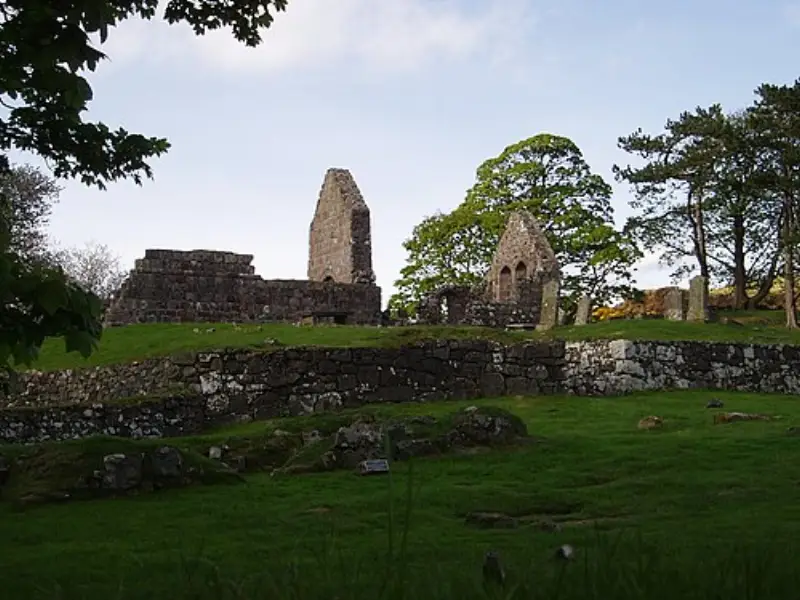
The best authorities agree that Blane died in 590, an old man in a Church that was still young. His remains were laid to rest at Kingarth on Bute, at the monastery that was his principal foundation, and the site of his burial became the spiritual centre of the island. There his church stood and fell and rose again through the centuries — the present ruins of St Blane's Chapel, standing in their walled enclosure about eight hundred metres from Dunagoil Bay, are medieval successors of his first building, but they guard the same ground and the same grave. The place remains one of the most beautifully sited of all Scottish early Christian sites, and antiquarians have made their way to it since the days of the old statistical accounts. The bell of his monastery, a hand-bell of the early Celtic type, was believed for centuries to survive at Dunblane, carried inland with his cult; and Dunblane Cathedral itself was said to have been founded on the spot where the saint had first established his church. He died, then, not as a martyr but as a confessor — one who spent a long life in faithfulness — and that is the title the old calendars give him: bishop and confessor of Scotland.
§ Associated Places
A Name Written on the Land
Blane left his name upon Scotland more durably than any document could have done. It sounds in Strathblane, the valley west of the Campsies; in Dunblane, whose medieval cathedral rose beside the church said to be his foundation; in Kilblane and Kilblain, the old cell-names of the west; and in the parish names and wells of Bute, where Blane's Well still marked the valley and Garcattoun recalled his uncle Cathan beside it. There was a church of St Blane at Dumfries as well, evidence that his cult crossed the country from sea to sea. Devotion to him was, from the earliest times, one of the popular cults of Scotland, kept alive by the monastic community of Kingarth long after the island fell within the orbit of the Norse world. His feast on August 10 was observed in the medieval Scottish calendars, and the Aberdeen Breviary printed his life for the reformed devotion of the sixteenth century, even as the Bollandists pruned its legends. Today the ruins at Kingarth are cared for as an ancient monument, the wells have dried or been forgotten, but the cathedral of Dunblane stands over the site he hallowed, and every traveller through central Scotland pronounces his name in passing: Blane, the bishop of Bute.
§ Associated Places
Timeline
- 590
Died after serving as a monk and bishop among the Picts; his remains were buried at Kingarth on Bute.
§ Origin
- 1661
The Presbytery of Dunoon abolished the centuries-old custom of burying women separately from men in his cemetery at Kingarth.
§ Origin
In Their Own Words
Whenever you go to the sea-shore may there be high tide.
The Record
- Major works
- founding of the church at Kingarth, Bute·church associated with the founding site of Dunblane Cathedral
- Patron of
- Bute and Kingarth·Dunblane
- Symbols
- bishop's crozier·bell·creel of earth
- Canonization
- Pre-congregation; venerated as a bishop and confessor from the early Scottish Church
Prayer
Bibliography
Show 5 sources
- Clarkson, Tim (2011). The Makers of Scotland: Picts, Romans, Gaels and Vikings. Edinburgh: Birlinn. ISBN 9781907909016.
- Hewison, James King (1893). The Isle of Bute in the olden time: with illustrations, maps, and plans. Edinburgh: W. Blackwood.
- O'Malia, Miles Joseph. "St. Blane." The Catholic Encyclopedia. Vol. 2. New York: Robert Appleton Company, 1907.
- Smith, John Guthrie (1886). The Parish of Strathblane and Its Inhabitants from Early Times. Glasgow: J. Maclehose and sons, p. 4.
- Chisholm, Hugh, ed. (1911). "Dunblane". Encyclopædia Britannica. Vol. 8 (11th ed.). Cambridge University Press, p. 670.
Profile text adapted from the Wikipedia article, licensed CC BY-SA 4.0.
Pray with this saint every day
Save St. Blane to your favorites, read the full profile, and get feast-day reminders in the Saints app.
Get the Saints AppFree on the App Store for iPhone and iPad