
fl. 5th–6th century; death year conjectural (c. 523)·Feast January 29
St. Blath of Kildare
Brigid's cook whose bread and bacon outweighed banquets
Overview
Saint Blath of Kildare, also called Blathnait and Latinized as Flora, was an Irish lay-sister who served as cook in the great monastic house founded by Saint Brigid at Kildare, probably in the fifth or sixth century. Her Irish name means flower, and the Martyrology of Gorman plays on it, calling her the blooming Blath, whence the Latin Flora by which she is also known. Apart from her office in the kitchen and her part in one famous miracle attached to Brigid, her claim on memory rests chiefly on her closeness to Ireland's foremost abbess and on the brief notices of her in the martyrologies and hagiographical collections. The sources describe her as a humble handmaid living in simple obedience, holding a subordinate place in the convent, yet winning by her faithful performance of ordinary work a wide reputation for holiness, the esteem of Brigid herself, and the regard of the whole Kildare community. A saying preserved in the lives of Brigid gives the flavor of her fame: to eat bread and bacon at Brigid's table beat feasting lavishly anywhere else. She appears most vividly in the Miracle of Loch Lemnachta, the New-milk Lough, when Brigid, ashamed at having too little food for eight visiting bishops, was told by an angel to milk the cows a second time, whereupon the herd gave milk enough, the story says, to fill every vessel in Leinster, the overflow forming a lake. Her feast is observed on January 29.
The Complete Life
A Handmaid's Place in Brigid's House
Blath's vocation was not to prominence but to the pot and the loaf. She lived as a lay-sister in Saint Brigid's abbey at Kildare in the fifth or sixth century, and her appointed work was the cooking for the monastic household, a subordinate station in a community that already ranked among the greatest ecclesiastical foundations of Ireland. The tradition that preserves her is unanimous about the character of the woman: a humble handmaid, living in simple obedience, fulfilling the ordinary duties of her office day after day. What distinguishes her in the record is the consequence that followed from that fidelity. The sources report that her conscientious discharge of common work earned her a great reputation for sanctity, together with the respect of Brigid, the most esteemed abbess in the Irish Church, and of the wider community gathered at Kildare. The pattern is a deliberate one in early Irish monastic writing, which delighted to set the great and the small side by side: the abbess whose name filled the calendars, and the sister who kept her kitchen, both belonging to the same household of God. Blath's name itself carries the point. In Irish it means flower, and the Martyrology of Gorman, with characteristic playfulness, styles her the blooming Blath, which is the origin of the Latin Flora under which she also appears in the sources.
§ Life
The Miracle of the New-milk Lough
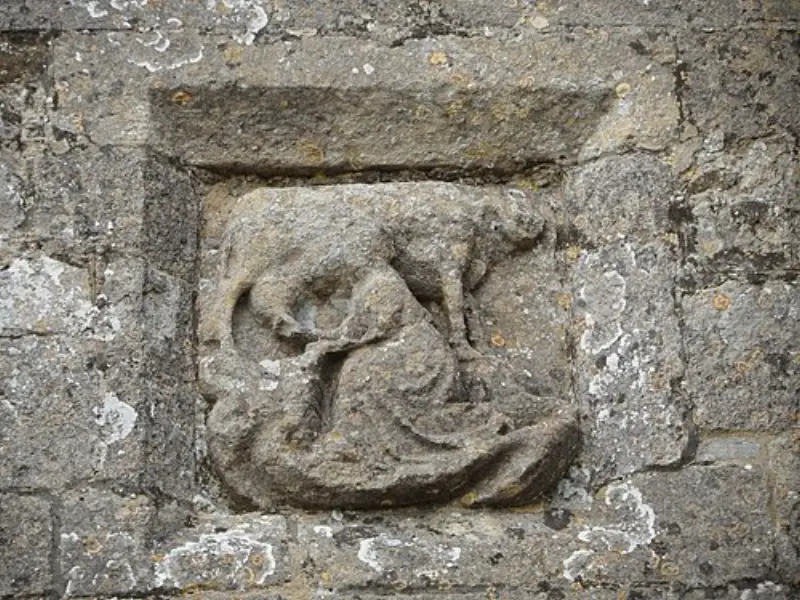
The single episode in which Blath steps forward as an individual is the Miracle of Loch Lemnachta, the New-milk Lough, told in the notes to the Martyrology of Oengus and preserved in further Brigidine sources. Eight bishops from Hui Briuin Cualann came to Kildare to visit Brigid. Conscious of her duties as a host, the abbess went directly to her cook and asked whether there was food enough for the bishops. Blath answered plainly that there was not; the Latin note records her reply with two words, dixit illa non. Brigid, ashamed before her guests at the poverty of the table, received an angelic instruction to milk the cows again. She obeyed, and the herd yielded an abundance out of all proportion to nature: the milk filled every tub in the dairy and would, the story says, have filled all the vessels of Leinster. What the tubs could not hold ran over the ground and gathered into a lake, which took and kept the name Loch Lemnachta, the lough of new milk. The tale is Brigid's miracle, but its hinge is Blath's honesty and her management of the convent's food; the abbess turns to her first, and the sacred economy of the house runs through her kitchen. The legend remained attached to the landscape, remembered in local tradition and recorded in the Schools' Collection of Irish folklore.
§ Miracles
A Death Date Nobody Can Prove
Of Blath's death the sources give almost nothing, and what they give is openly conjectural. The historian of Irish monasteries Mervyn Archdall speculated that she died in the year 523, selecting it because it was the year he believed Saint Brigid herself had passed away. He offered no specific data in support of the figure, and later writers have recognized it as an assumption derived from the date commonly assigned to Brigid's death rather than as an independent testimony about the cook of Kildare. The silence is instructive. Blath belongs to that large company of early Irish holy women and men whose existence is vouched for by calendars and casual notices rather than by narrative lives: her name surfaces in the martyrologies on its appointed day, and in the hagiography of the greater saint she served, but no account of her last days, her burial, or her passing was ever composed. The poverty of the record has not diminished her commemoration. If anything, the absence of legend around her death has left the emphasis exactly where the tradition placed it in her lifetime, on the sanctity achievable within a routine of ordinary service, and on the judgment of the Kildare community that the woman who kept Brigid's kitchen was herself a saint worthy of remembrance in the Church's calendar.
§ Historicity relating to her death
Remembered in the Irish Calendars
Blath's commemoration has been remarkably durable for so modest a figure. Her feast day is observed on January 29, and she is remembered in several of the principal calendars of the Irish saints: the Martyrology of Donegal, the great Franciscan compilation of the seventeenth century, and the earlier Martyrology of Gorman, whose poet styled her the blooming Blath. The notes to the Martyrology of Oengus, among the oldest of the Irish martyrologies, likewise record her name for that day, which carries her attestation back toward the early medieval period. Modern students of the Irish saints, from John O'Hanlon in the nineteenth century to the chroniclers of the Irish American Cultural Institute in the twentieth, have kept her in their accounts, and the Catholic Heritage Association of Ireland has published her story for contemporary readers. Her patronage reflects her life rather than any later invention: she is a patron of cooks, and of Kildare, the town whose greatest house she fed. Her iconographic attributes are the implements of her office, bread, a pitcher of milk, a platter of food, and bacon, so that in art she appears with the very things her hands prepared. She remains the standing example of a sanctity of the kitchen, invoked wherever ordinary work is offered to God.
§ Veneration
In Their Own Words
bread and bacon in Brigid's company were better than a banquet elsewhere
The Record
- Patron of
- Cooks·Kildare
- Symbols
- Bread·Pitcher of milk·Platter of food·Bacon
- Canonization
- Pre-congregation; commemorated in the Irish martyrologies
Prayer
Bibliography
Show 7 sources
- Marcella (2013-01-29). "The Catholic Heritage Association of Ireland: Saint Blath of Kildare". The Catholic Heritage Association of Ireland.
- O'Clery, Michael; O'Donovan, John; Reeves, William; Todd, James Henthorn (1864). The Martyrology of Donegal: a calendar of the saints of Ireland. Dublin: Printed for the Irish Archaeological and Celtic Society by A. Thom.
- O'Hanlon, John (1875). Lives of the Irish Saints: with special festivals, and the commemorations of holy persons. Dublin: J. Duffy.
- The book of saints: a dictionary of servants of God canonized by the Catholic Church. New York: Macmillan Co., 1947.
- Ryan, Mary D'Arcy (1974). The saints of Ireland: a chronological account of the lives and works of Ireland's saints and missionaries at home and abroad. St. Paul, Minnesota: Irish American Cultural Institute.
- Marcella (2012-02-01). "Trias Thaumaturga: The Feast of Saint Brigid in the Martyrology of Oengus". Trias Thaumaturga.
- "Story of Loughminane · Cill Dara (Pres. Convent) · The Schools' Collection". dúchas.ie.
Profile text adapted from the Wikipedia article, licensed CC BY-SA 4.0.
Pray with this saint every day
Save St. Blath of Kildare to your favorites, read the full profile, and get feast-day reminders in the Saints app.
Get the Saints AppFree on the App Store for iPhone and iPad